

Hands-On Preview: You Can't Play Stranger Than Heaven Like a Yakuza Game
by George Yang,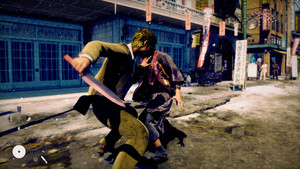
After spending 30 minutes playing Stranger Than Heaven, I now know that you can't play it like you would one of the bralwer titles in the Yakuza series—despite the visual similarities. At Summer Game Fest 2026, my demo focused on combat.
I was given the first three of the five eras to play in, Kokura in 1915, Kure in 1929, and Osaka in 1943. Kokura introduced combat mechanics to me. On a controller, the left and right triggers and bumpers control each of Makoto's sides of his body, respectively. Immediately, I could tell that Stranger Than Heaven's combat required a more methodical approach. You can't just spam a button or two continuously like you could in some of the Yakuza games.
You have access to a variety of different weapons, including a knife, crowbar, and hammer. They all have different speeds and properties so you'll have to find the best fit for your playstyle and situation.
You'll also have to constantly block enemy attacks, as they can deal a surprisingly significant amount of damage. And if you parry in the appropriate direction from where the enemy is attacking (left or right), you can open them up for some huge pain. This is especially important when having to fight against multiple enemies at once. You'll need to be aware of your surroundings at all times.
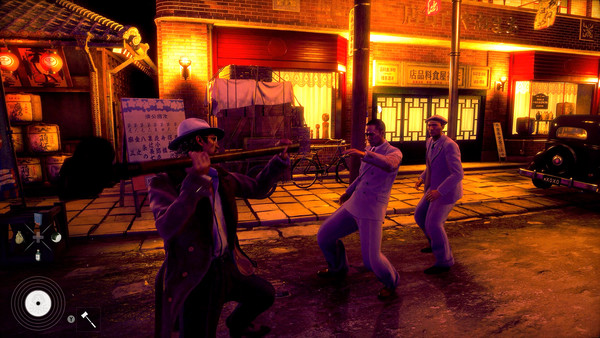
In the Kure era, I went up against multiple enemies, as well as a giant brute character with a giant knife. So not only did I have to get rid of his henchman, but also watch out for him. Here, my stamina management skills were really tested—doubly so as, in Stranger than Heaven, you're not given a standard bar that indicates stamina like you would have in a Dark Souls game.
You see, the bottom left of the screen shows your HP depicted as a circle, with bits of depleting every time you take damage. Your stamina can be seen as this sort of yellow “noise” that permeates around your HP circle. When guarding against hits, the volatility of the noise increases. Taking more damage while guarding will eventually shift the noise into red color—before eventually breaking your guard. If your guard is broken, you're completely defenseless as you double over to catch your breath. This gives enough time for enemies to decimate you, usually leading to a game over.
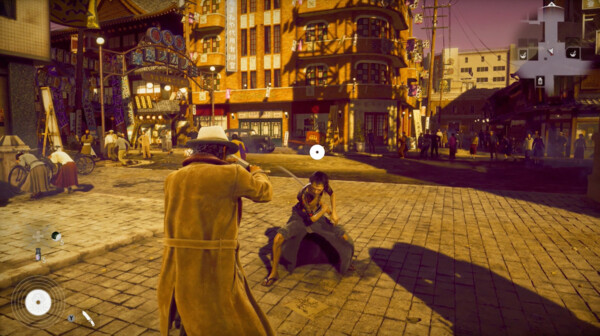
In the last era, Osaka, I had to take what I learned to fight a singular mini-boss battle against a shirtless, tattoo covered old guy with a samurai sword. And boy was he tough. I mixed up my attacks by stabbing him with the knife in my right hand with my right trigger, and then punching him with my empty left hand using the left trigger. This allowed me to stay unpredictable while I parried and blocked his incoming attacks. To make matters worse, he could heal himself by drinking alcohol! So every time he took his flask out, I rushed him like a mad dog to interrupt his little drinking session as I didn't want my previous work to go to waste.
Eventually, I took him down, and I felt immense satisfaction knowing that I, at least, had the basics of combat down. While I didn't get any glimpse of the story, at least the gameplay is fun and frenetic. I'm excited to see what more Stranger Than Heaven has to offer.
Stranger Than Heaven launches on January 15, 2027 for PC, PS5, and Xbox Series X|S.
discuss this in the forum |
