

The Astronaut Who Loves Anime
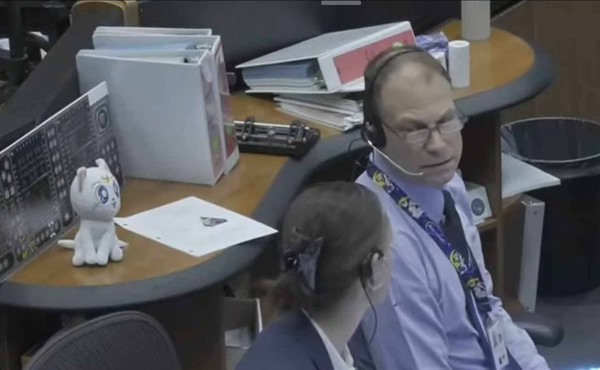
by Erica Friedman,Erica Friedman (Anime News Network): This spring, anime fans worldwide were thrilled to see Artemis the Cat from a very popular magical girl anime watching over NASA's Artemis II mission. Later, we were all excited to see the lead CAPCOM for the Artemis II mission, Dr. Stanley G. Love, proudly wearing a lanyard from that same series while guiding Artemis astronauts.
We all learned that Stanley Love is himself a NASA astronaut. He was a crew member on the Space Shuttle Atlantis and is now the Deputy Chief of the Astronaut Office's Rapid Prototyping Laboratory. I contacted NASA, and today I was able to speak with Dr. Love about his love for anime.
Joining us today is Dr. Stanley Love, the lead Capsule Communicator (CAPCOM) of the Artemis II mission, to talk to us about his love of science and anime. Welcome, Stan!
Dr. Stanley Love: Thank you! I'm glad to be here!
We're so glad to have you! This spring, anime fans worldwide were absolutely thrilled beyond belief that you were repping a very popular magical girl anime as part of CAPCOM. And I just wondered, how did NASA feel about having Artemis the cat in the room?
Dr. Stanley Love: Well, NASA is a big organization. There are a lot of people with different opinions. When I first saw how widespread the response got, I thought, “Uh-oh, I am in trouble!” But I never got in trouble. Although my boss' boss did kind of mention having gone viral. And his boss, the center director, kind of mentioned having gone viral. So I suspect I have inflicted a little bit of embarrassment on the higher-ups, but not enough to actually cause a problem.
So your fame is not too much?
Dr. Stanley Love: Not too much. It was close! And if I did get in trouble, my response was going to be, "Well, about five million people who otherwise wouldn't have been paying attention to Artemis II, paid attention to Artemis II!"
That's absolutely true! So how did it feel to be a media star, not for being the astronaut that you are, but for being an anime fan? Did your coworkers bust you a bit about it?
Dr. Stanley Love: No, they already know me pretty well. I drive an itasha car. So they thought that was just normal behavior for me, and I didn't get any extra ribbing from them.
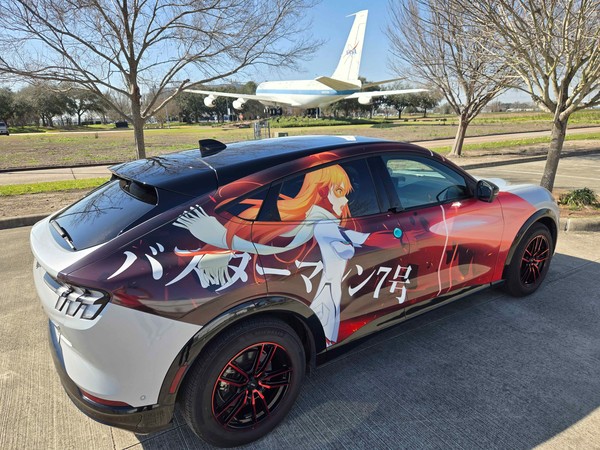
And so what did your use of items from the magical girl anime mean to you? Was Artemis's presence a message, a reminder, or just something fun to have?
Dr. Stanley Love: To me, it was kind of fun. I really loved that the cat shared a name with our program. I thought that was just perfect. The badge lanyard people seemed to notice before the cat. I bought that like 10 years ago. So, I'm an anime fan. Everybody has a badge lanyard with their little interest, [so I thought] "Oh, I'm going to get an anime badge lanyard!" So here are the requirements: anime, space-related, and this is the hard one, safe for work! So there was one option, so that's what I bought.
And on a normal workday, when I'm in the office building, I don't wear a badge lanyard. I wear my badge on the sleeve of my short-sleeve shirt. We're in Houston—short-sleeve weather all year. Because I go through badge readers like 30 times a day, and it's easier to just put my elbow up against the badge reader. But for Mission Control, it's a little different. So that was my Mission Control badge lanyard, including starting in 2020 when we began simulating for Artemis I. So I started sitting in Artemis I sims to learn about the spacecraft and the mission. I sat through the Artemis I mission, and then all the training for Artemis II was up to the Artemis II mission. So that was just my Mission Control badge lanyard, and I really wasn't thinking about it very much by the time the mission came around.
You forget that a lot of anime fans do that sort of thing! We're always looking.
Dr. Stanley Love: Yeah, it got a lot of attention.
I bet it did. Just a silly question, is there a planet that you particularly resonate with, whether from an anime association, or on your own?
Dr. Stanley Love: All right, so I get asked this question a lot. And the answer is yes, and it's Earth. And that always disappoints everyone. But watch this. [Breathes] I'm not dead! It's the only planet where you can do that, so I'm pretty partial to it! I am very interested in Saturn's moon Titan, because it has weather, rain, and seas. And then, I kind of hope they reinstate Pluto as a planet.
I feel a little messy about that one! What do you think draws all ages and genders to magical girl anime?>
Dr. Stanley Love: A lot of things! Marketers know this already: When you want to sell a product to a man, you use a picture of a good-looking woman. And when you want to sell a product to a woman, you use a picture of a good-looking woman. Go figure. So, magical girls have that covered.
If you watch a series like that and watch the transformation sequences and watch how the character changes when they go from their normal self to their transformed self, it's kind of an exercise in self-improvement. And it's also kind of a metaphor for growing up. You become a better version of yourself. And I think everybody likes to see that. It's fun to watch another person become a better version of themselves. It's fun to imagine if we could do the same ourselves. I think that's the appeal.
And then, of course, the art is always beautiful, and the stories are interesting, and there's a lot of wonder, romance, and so forth. So it's got all the things that make for good entertainment. And I think that's why audiences respond to it that way.
Did any anime or manga in any way influence your choice of career?
Dr. Stanley Love: Not really. But I think my career and my interest in anime stem from the same basic interests. So I like exploration and science, beauty—whether in art or in nature. So I think it's the same set of basic interests that influences both.
I know we can't really talk about specific series, but was there something that really piqued your interest at some point and thought, “That would be really cool for me to go to space!”
Dr. Stanley Love: I grew up on the original Star Trek. The original Star Wars movie came out when I was 11, and I thought that was the coolest thing ever! So I've been a big fan of science fiction my whole life. Anime science fiction, I didn't find out about until a little later. I grew up on Star Blazers and Speed Racer. But then Hayao Miyazaki's Castle in the Sky came out in 1988, I think. It came to an art house theater in Seattle, where I lived in 1989. And that just blew the top of my head off. “Wow! If there's more like that, I need to know about it!!” That's what really began my deeper interest in anime.
You said in our email conversation that you were a regular reader of ANN. So I was wondering, can you tell me what kinds of content you read? Do you like the news, or are you a features guy? Do you read the reviews? What's your favorite bit of ANN?
Dr. Stanley Love: I check in every day and just see what's up. My main anime challenge is finding good shows to watch because they're not all good [laughs]. There's a lot of repetition in themes that has gotten kind of tiresome. So I check ANN to see what shows are out there. I love the quarterly previews because that sort of helps separate the treasure from the trash. There's a famous quote from science fiction writer Theodore Sturgeon: “Ninety percent of everything is crap.”
He's a little off on that—I think a little bit more!
Dr. Stanley Love: Yeah, he's kind of conservative! Anyway, occasionally I'll read a feature if it's about something that I'm interested in. There was a recent [This Week in Anime column] about the 20th anniversary of The Melancholy of Haruhi Suzumiya. And they were going, “Oh my God, has it really been 20 years? I'm so old!” I'm like, “I was already old when she—nevermind.” So I guess I read all sorts of things there, but mainly I'm looking for clues to other really good shows that I don't yet know about.
That's excellent! And I want to say from the staff's perspective, we were all very excited to hear that you were interested in reading ANN. So thank you very much on our behalf.
Thinking about science in anime, it can be really extreme—has lots of effects and giant music associated with it. But watching the Artemis II mission, everything is very calm, very steady, and very stable. It's about predictability and stability. Can you tell us a little bit about how it is being in the room as part of a groundbreaking effort like Artemis II?
Dr. Stanley Love: In anime, they've got to keep your attention, and their audiences are used to a lot of fast change. And everything in space is really pretty slow. But during the launch phase of a mission, things are actually happening fast. And you saw the mission, you didn't see a training simulation. In our training simulations, the rocket launches, and then stuff starts breaking. One of the engines—the little gimballing thing that makes it steer—goes hard over and starts trying to push the rocket off course. And the communication—the control center is just flying. The CAPCOM is struggling to get the words up to the crew. The crew is struggling to get the right inputs in on their controls to save the day. And we do that over and over and over and over again, hundreds of times before we go fly. And then we go fly, and nothing breaks, or one thing breaks. And so it seems very calm, and everybody in the room is like, “It's too quiet! SOMETHING TERRIBLE IS GOING TO HAPPEN! IT'S TOO QUIET!” But in the end, it's okay.
To me though, being in that room when it's happening, if I'm doing a good job—that is, listening to flight controllers, totally aware of what the flight director is doing so that when the flight director wants me to say something to the crew, all he has to do is nod at me and I already have the words ready and I'm ready to go up to the crew—I feel like I have no sense of self. I am just a part of the machine, and I do what I need to do. That is a hard feeling to get. You're under pressure. Everything is very technical. It's easy to make a mistake, and then that ruins your concentration. But to me, that's the state of mind I want to be in, where my sense of self disappears, and I'm just doing the task.
It's a part of the team, literally. Very much the opposite of the way magical girl anime is, which is like, “Here's the magic power, go!”
Dr. Stanley Love: Although magical girl anime tends to focus on teams as well! After the response to my badge lanyard, I had to sit down and think about what it really meant to bring a magical girl into the control center. And they and we stand for many of the same things. There's a sort of code of professional ethics for flight controllers. And it starts with discipline, confidence, competence, responsibility, teamwork, vigilance, and there's one other that skips my mind at the moment. But interestingly, our Sailor Moon, among others, demonstrates all of those in her transformed form.
And interestingly, if you watch the first episode—I'm watching Sailor Moon Crystal because that's what's on Crunchyroll, easily available to me. The older series is harder to get—the character fails hard in all seven categories in the first five minutes of footage! And that includes the introductory anime, right? So, three and a half minutes, she hard fails all of those. But then, over time, she begins to develop those. And that to me—there's a parallel between what we try to do as astronauts and flight controllers. That code begins with instilling within ourselves these properties necessary for professional excellence. Which means that they don't exist to begin with. We have to develop them in ourselves. And there's that parallel in the entertainment that I was showcasing.
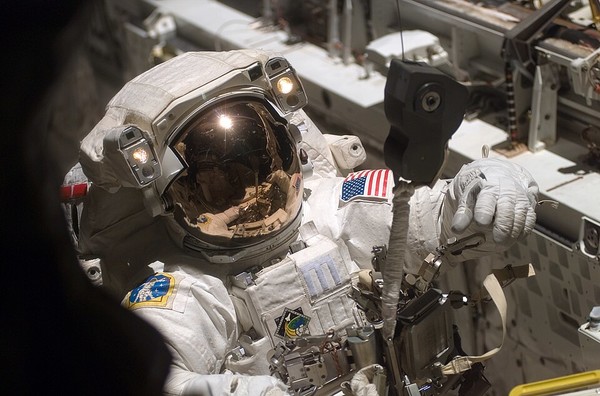
It's really common to have an opening image of planet Earth sort of floating there. And as we, the watchers, are sort of zooming in on it and getting closer and closer until it becomes like part of Earth. You've seen that in person, and you've shared that with fewer than 700 people in the history of humanity. And I wondered if you could tell us a little bit about the difference between watching something like that as part of media, and really getting to see it on your own.
Dr. Stanley Love: The actual sight out the window is quite a bit more compelling than just seeing it on a screen. The screen representations, by the way, have been getting better! Back in the '60s, the photograph of a globe, with no clouds. And of course, they always centered the globe on whatever the home country of the filmmaker was. When you go to space, where you happen to be is where you happen to be. And it doesn't always line up with places you know. My first impressions on looking out the window at the Earth right after we reached orbit on my space shuttle flight were, “Wow, that's amazing! I'm just sort of thrilled to be in this place and be able to see this! What a miracle that humans can do this!” Another thought was that all the air is down there. I just have a little bit in tanks, and we don't like to run out of air, and it's all down there, and that's a little uncomfortable! The third thought is that I have to get to work right now because we're very busy on the space mission.
So obviously you've got a lot of attention from a lot of different places. And I think in the end, it was probably good for Artemis because people who were not initially really mindful of the Artemis II mission were paying attention. And I just wondered if you had a message for the fans who saw you repping Sailor Moon and were excited to see a fellow fan at the controls?
Dr. Stanley Love: Number one is, you've got friends in high places! Number two is that you can be an anime fan and also a flight controller or an astronaut. Come work for us at NASA! We love people who like to imagine things! And anime is all about, “I imagine something, and then I draw it!” That's the first two steps of engineering! Folks, you imagine it, then you draw it, then you build it, and then you fly it! So come join us, please! We love folks who like to do that sort of stuff.
Is everyone there a nerd of some kind or other?
Dr. Stanley Love: Pretty much. We're all nerds of some kind or another.
Science nerd, engineering nerd, there are lots of different math nerds. I'm sure there are lots of different kinds!
Dr. Stanley Love: Well, we fly to the moon! Who else does?
Thank you to Dr. Stanley Love and NASA for collaborating with ANN on this interview.
discuss this in the forum (18 posts) |
