

The Fall Anime 2025 Preview Guide - Shabake
How would you rate episode 1 of
Shabake ?
Community score: 3.5
How would you rate episode 2 of
Shabake ?
Community score: 3.4
What is this?

During the Edo period lives Ichitarō, the young owner of Nagasakiya, one of the largest stores in Nihonbashi. He has been physically weak since birth and is unable to go outside. However, Ichitarō is always surrounded by spirits such as Hakutaku and Inugami, who serve and protect him. One night, Ichitarō sneaks out and witnesses a murder. From that day on, a series of bizarre murders began to occur in Edo. With the help of the spirits, Ichitarō's search for the culprit begins.
Shabake is based on the novel series by writer Megumi Hatakenaka and illustrator Yū Shibata. The anime series is streaming on Crunchyroll on Fridays.
How was the first episode?
Episode 1 Rating:
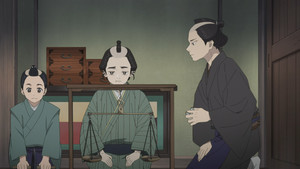
The highlight here is the yokai. There are certain ayakashi that pop up repeatedly across many series, like kappa or kitsune, but Shabake's first episode takes care to give us some less familiar faces, and I love that. Sickly Ichitarō can see yokai – possibly because his birth was the result of his mother's prayers to Inari – and otherworldly beings surround him. Two are relatively standard anime features: an inugami and a tsukumogami born from a bell. But the others are much more unique: a hakutaku, a byobu nozomi, and a cluster of tiny yanari. At least those last two are probably rarely seen because of their lore – byobu nozomi are “folding screen peepers,” best known for spying on people over folding screens, and yanari are “house squeakers,” meaning they just make a lot of noise in poorly built wooden houses. (A hakutaku is a particularly brilliant chimera.) Not exactly romantic yokai, or even particularly friendly ones in their lore.
But all bets are off when it comes to Ichitarō. Since his older brother died young, everyone has kept a firm eye on him, and now, in his young adulthood, that's really beginning to grate on him. Two of his yokai friends, Nikichi (hakutaku) and Sasuke (inugami), also serve as his guardians, meant to prevent him from overexerting himself. Still, the byobu nozomi takes his place when he just can't stand it anymore and needs to get out. (The yanari are easily bribed with dango.) And of course, none of them can keep Ichitarō from sneaking out and running headlong into a murderer and then practically tripping over his victim.
This, quite frankly, feels more like an “episode zero” than the first episode of Dusk Beyond the End of the World. It's primarily focused on setting up the characters and their dynamic, establishing Ichitarō's chafing at the restrictions placed upon him and the way he interacts with the yokai around him. It's not really doing much to set up the mystery that this is purported to be, at least not until the very end of the episode. While I still enjoyed it, I did find it dragged a bit, especially in the middle, when Ichitarō was walking around with the bell spirit. The all-brown color scheme doesn't help, especially since the past, Edo period or otherwise, wasn't uniformly sepia and dull green. It's an attempt to create a sense of a long-ago event that really isn't necessary, especially since the scenes of bustling Edo and the work in Ichitarō's family apothecary do the job more than adequately.
Still, I'm curious to see where this goes. I'm a sucker for mysteries, historical fiction, and folklore, so this is very squarely aimed at me. That I didn't love this first episode isn't a great sign, but I'm willing to give it the benefit of the doubt, if only because I really love the way faces are drawn.

Mysteries can take some time to set up, something Shabake is fully aware of. That does mean that this second episode may not grab everyone's interest, though – the mystery itself is largely absent until the final quarter of the episode, and the yokai angle is generally left by the wayside. (That may be precisely where Byobu Nozomi wants it – the poor guy was caught out and threatened with submersion.) Instead, this week we get more about Ichitaro's life in general, and I suspect that this will inform the narrative in definite ways going forward.
The main issue Ichitaro faces is that everyone sees him as having a frail immune system rather than as a person. Nikichi (I think; I haven't quite gotten him and Sasuke straight yet) remarks that had Ichitaro been headed to Yoshiwara, the red light district, rather than just out for a walk or for a snack, he might have been more understanding, and that's an interesting statement. It implies that he doesn't see Ichitaro as an adult; his behavior, along with his fragility, makes him look younger than seventeen. It's a terrible measure of adulthood, albeit one that's more expected in the era when the story is set, and it invalidates Ichitaro's very real yearning to be taken seriously. Sexual desire is no objective measure of adulthood, and Ichitaro is more than old enough to chafe at the constraints placed upon him.
The only person who appears to understand that is Eikichi, his friend across the street. Eikichi, who is apparently the world's worst mochi maker, seems to be an ally in Ichitaro's plans; at the very least, he helps him trade notes with someone. This is likely to be important as the mystery elements come into play more; Ichitaro's going to need both human and ayakashi help if he's going to become a master detective. (Which I'm assuming he will.)
Meanwhile, there's something amok with the crime Ichitaro discovered. The corpse, which formerly had its head, now lacks it, so someone obviously came back and finished the throat-cutting in a meaningful way. Why they'd do that is up for debate, and I'm hoping for a supernatural angle as well. Although this wasn't as interesting or compelling as the first episode, I'm still curious as to where this goes. I feel like it'll really take off given time.

Episode 1 Rating:
Shabake's first episode is the kind of premiere that I can recognize as a fairly well-made and intriguing product while also functioning pretty poorly as an introduction to a television show. The joke I made to my colleagues is that this is the sleepiest I have felt watching an anime about a sickly boy who makes friends with tiny, magical creatures since I last trudged through Arrietty during my recent Ghibli marathon. For a show that is ostensibly trying to capitalize on the possibilities that come from our world intermingling with the strange and even deadly realms of the supernatural, Shabake sure is boring.
I hate to place the blame on our infirm protagonist, Ichitarō, but my heart began to sink the moment I heard the little moppet speak. I've always held a grudge against the Tiny Tims of literature and film, on account of how I always get suspicious that the writers who rely on them are falling back on cheap sympathy points to avoid having to write an interesting character. To his credit, Ichitarō becomes more tolerable after the show skips ahead a decade or so and allows him to move around a little and stand up for himself, but he never becomes a protagonist that I feel has the strength to carry the entire story on his back.
As for the supporting cast of yokai, I was disappointed in how little of an impression they made. Shabake spends the opening act of the premiere introducing the yokai twins who become Ichitarō's protectors, only for them to basically disappear for the rest of the episode. The little puffball lion-things don't do much but stand around and squeak, and it isn't until Ichitarō witnesses the deadly blaze at the end of the episode that there's any genuine sense of mystery or wonder to be had.
Actually, I will give the episode credit for the scene where Ichitarō's Byoubu Nozoki pal emerges from the folding screen to help the kid sneak out of the house. The show's visuals are generally fine enough, but this was the one and only moment of Shabake's premiere that I felt truly invested in what was happening on-screen. It's a shame that the fun comes and goes so quickly, though. Maybe Shabake is the very slow-burning mystery that will pick up as it goes along, but I'll need to make sure I bring a backup can of caffeinated soda with me to next week's episode—just in case.
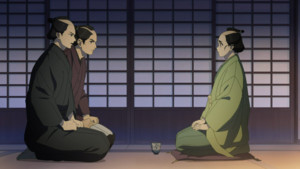
Shabake is a show that I really want to love, but I can't seem to find the “in” I need to enjoy it. I love stories about yokai, period pieces about 17th-century Japan, and murder mysteries. Despite all of these individual pieces that really ought to be clicking with me, Shabake remains a series that is less than the sum of its parts. I think I enjoyed this second episode a little more than the premiere, but it's not enough of a leap in quality to convince me to stick with Shabake in the long run.
As before, I think my biggest issue with Shabake is the way its generally sleepy pacing is married to our protagonist, Ichitaro. I can see the appeal of a historical fantasy where the supernatural elements are played relatively straight. Still, such stories generally need characters who are even more compelling than usual to offset the lack of wonder and tension that the mystical elements would usually provide. Since all the gods, spirits, and monsters are functionally indistinguishable from a supporting cast of normal humans—save for the occasional use of a special power or suchlike—Ichitaro has to bear the burden of getting us invested in the narrative. So far, he still isn't proving up to the task. His personal conflicts involving being taken more seriously by his family and proving his own capabilities just aren't terribly interesting when they're being channeled through such a meek little guy, and the show doesn't do a great job of making the whole murder mystery angle feel especially urgent, either. Also, if I'm being honest, it doesn't help that this show's particular approach to styling everyone's Edo-era chonmage hairstyles makes it harder for me to tell them apart (not to mention take them seriously).
I've learned that Shabake's novel series has also spawned a popular radio drama, which makes a lot of sense, because this is one talky show. Ichitaro talks to his yokai retainers, then to his dad, then to his mother, only to spend more time talking to Eichi and Oharu at the bakery. There is some investigation underway as Ichitaro wraps his head around the crime he's just witnessed, but there are also a lot of people reminding him of his sickly constitution, over and over. It all ends up blending together into a morass of exposition and repetitive characterization.
Still, I continue to respect Shabake as a show that is very committed to doing its own thing, even if it isn't necessarily my thing. It's a fine, functional little mystery with a promising supernatural twist. I wish it could pick up the pace a little bit and take advantage of all that potential. Even if I was feeling especially excited about the mysteries afoot, there isn't enough going on in this adaptation to convince me it would be any better or different an experience than simply checking out the audio drama. That's never a good sign, so far as anime is concerned.
Episode 1 Rating:
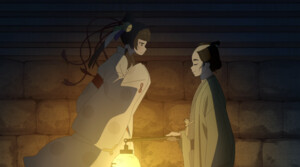
In time for October comes a show that has at least a little bit of spooky spirit stuff going on. Shabake is a period piece starring Ichitarō, who has instigated interactions with a host of classical Japanese spirits and…well, that's basically it so far. This premiere is really not in a rush to do anything apart from introductions of the supernatural cast of critters and barest whiffs of a plot conflict for Ichitarō to involve them in. That doesn't necessarily have to be a bad thing. Better shows have been predicated on less, and a story like this can absolutely get by on vibes if it has them. Shabake doesn't really have that vibe, though it's not critically failing at this moment either. It's a perfectly cromulent ghost story, and might even blossom into something cool if it can find its verve.
Ichitarō is solidly sympathetic, if nothing else. His grappling with his chronic condition isn't what gets him down so much as the fact that so many of his attendants don't really let him do anything because of it. Even after treatment that seems to have mitigated most of his issues and having been raised by a couple of cute spirit guys, he's still handled delicately, not allowed to do anything for himself. It's an ironic parallel to the gods and spirits watching over him to help him grow up healthy, that now he's so closely monitored that he can't do anything but sit around and keep his health. That's a functional character point, if anything, and seeing Ichitarō willingly pushing against it gives the plot its most basic vestiges of momentum.
I am kind of curious about what's here—the details of how Ichitarō became acquainted with all the different spirits in his orbit, who the mysterious guy he's sneaking off to see is, and what exactly's going on with the apparent murder mystery that this episode cuts off. These are functional hooks for a mystery/drama/whatever this show is going to be. And not for nothing, but plenty of the spirits themselves are pretty cute. I'd stick around for another episode or two to learn more about what's going on with that Byoubu Nozoki fella. But therein lies the issue of presenting all these characters and critters to the viewer at once without providing too much detail. I feel like I hardly know anything about, say, Suzuhikohime apart from her kind of cute design and propensity for exposition.
The direction and overall look of Shabake are similarly functional without being overbearing, hence the lack of vibes. The sequence of Ichitarō fleeing the stabby vagrant has a solid amount of tension to it that almost fits the style of the spooky season. More of that would drive up the appeal of a series like this. As-is, it's extremely fine, which is too bad given that this is the sort of project that would thrive if it had more of its own flavor coming through. Much like Ichitarō wishes he could do, the Shabake will be better if it's allowed to cut loose, to stretch its wings, to do more of its own thing.

I was hoping for a bigger shake-up by giving Shabake another chance, but it doesn't seem like it was meant to be. There is still a mystery brewing here, gradually, in a couple of scenes. But the murder is mostly background noise compared to Ichitaro's continued comings and goings and yokai yap sessions. That doesn't mean there aren't compelling questions being asked here and there, but the series, for now, seems almost overconfident in its languid pacing. It's just hanging out, doing its thing, and it's entirely up to audiences whether they want to come along. Unfortunately, I can see plenty of audiences checking out, least of all because Shabake isn't fully interested in filling them in along the way.
What I mean by that is that Shabake's primary mystery methodology thus far seems to be keeping viewers in the dark about information that some or all of the characters already know. The key example of this is Ichitaro's surreptitious sneak-outs to meet Matsunosuke, along with his exchanges of information with Eikichi. They talk about…something that's known to them but is being hidden from Ichitaro's handlers, but also obfuscated from the audience. It's all framed in a way that's building up to a dramatic reveal that'll probably happen in another episode or two and make the 'real' premise of Shabake apparent, but for now, it comes off like the series is making an effort to dodge around storytelling. This would be distracting enough, but then the show adds another layer of opacity by having said handlers reference mysterious, possibly contraband cargo coming into Ichitaro. Once again, the characters are driven by this information, but the audience has no context for it.
All this and, again, the actual murder mystery is mostly an afterthought. Ichitaro gets one new piece of information late in the episode, that the body somehow got beheaded after he came across it. The intent is to heighten the dramatic irony of Ichitaro having pertinent information about the state of the case that he can't reveal without also coming clean about his truancy—and the drama behind that is kneecapped because those watching don't even know why he's doing it.
Stories can effectively pace out reveals, both internal and external, to catch audiences by surprise or play that fun game of getting them to go back and recontextualize rewatches. But Shabake is covering up so much of its contextual information that those watching have nothing to go on.
A successful mystery box at least has to make the box look cool, but Shabake is still the same simple, drab, grounded TV drama it was last week. The special effects are especially understated, with the yokai briefly fading out when they need to do their ghostly disappearing acts. Some of the base ideas at work are still solid, like Ichitaro being reminded by Eikichi that even a sickly, sheltered rich kid is still doing better, worries-wise, than a working-class laborer. Maybe this will be pertinent whenever the show gets around to revealing what its actual deal is. But for now, it's an episode that seems uneventful in the moment and becomes more annoying when I reflect on it and try to evaluate what, if anything, it actually accomplished in all these obfuscated, meandering conversations.
Subscribe to Crunchyroll here!
Disclosure: Bandai Namco Filmworks Inc. (Sunrise) is a non-controlling, minority shareholder in Anime News Network Inc.
The views and opinions expressed in this article are solely those of the author(s) and do not necessarily represent the views of Anime News Network, its employees, owners, or sponsors.
discuss this in the forum (261 posts) |

this article has been modified since it was originally posted; see change history
back to The Fall 2025 Anime Preview Guide summoned by Crunchyroll
Season Preview Guide homepage / archives