

(5 questions; 35s to answer on average
Yes I'll do it later No
Hundred Scenes of AWAJIMA
Episode 10
by Sylvia Jones,
How would you rate episode 10 of
A Hundred Scenes of AWAJIMA ?
Community score: 4.2
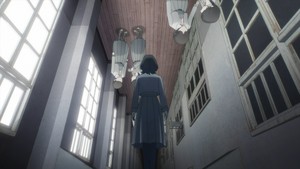
We are our parents' children, for better or worse. Hundred Scenes of Awajima has already explored the notion of legacy several times. In fact, the last third of this week's episode recapitulates Ibuki's strained relationship with her grandmother, albeit with small yet significant differences in how it's told. But before that, we get two stories about non-Awajima people with Awajima alumni for parents, and both contain the quiet profundities that we've come to expect from the series.
First, scriptwriter Shinji Hasegawa gives an interview with Wakana, who we now know also has a career in writing as an adult. I'd like to note here how many times we've seen an interview woven into Awajima's various vignettes. On one hand, it's a convenient narrative tool for Shimura to wield. The large cast and anthological nature of the story means it can't spend a lot of time with each character, so an interview creates a venue in which they can voice their introspections and motivations out loud. This is, arguably, a little clunky, especially when used as often as it has been. On the other hand, Awajima is in part a story about show business and the notion of celebrity. Actors act. We see them as they want to be seen, and that applies to both fictional settings and the real world. The portrait they paint in their interviews is not necessarily a reflection of who they are. Moreover, can anybody confidently purport to be able to talk about themselves in consistent and accurate language? I know I can't.
This point resonates with Shinji's account of growing up with his famous mother. At a very young age, he acquired the skill of editorializing his home life to make it more palatable for others. While he does not have a bad relationship with his mom, it's a more clinical one than the stereotypical portrait of the nuclear family—a portrait which does not accommodate the realities of a mother with a demanding career. Shinji comes across as sensitive to his mom's life's work, and he doesn't resent her, but he acknowledges the weird distance that exists between them. As a boy, he can't attend Awajima, so he can't fully follow in her footsteps. But by taking his mom's comment to heart and becoming a writer, he achieves something similar.
As an adult with his own child, Shinji comes to understand that he projected onto his mother all of the qualities he wanted to embody. Writing her was his way of figuring himself out, and I can definitely relate to that as a person who uses words as a spade to dig into parts of myself. But I like the bittersweetness of this segment's conclusion, which focuses on Utako's part in all of this. Now that she lives with him again, and now that they're both adults, Shinji sees his mom in a new light. There's a person beneath all of the masks he wove for her, and he doesn't know who that is. It's somebody who's lonely and vulnerable. Shinji, for all of his poignant introspection, bought into Utako's image as the renowned actress alongside everyone else. Even now, he's unsure if the kind old woman tending the garden is the same person who was away for most of his childhood. There's a disconnect there that may never be mended.
I don't think the second story is as strong as the first, but it's made stronger by the thematic connections between them. Yukari, like Shinji, is the child of a famous actress who graduated from Awajima. Yukari, however, has the opportunity to attend the academy, unlike Shinji, and that means she has to put up with the pain of it slipping through her grasp. That's not supposed to happen. Yukari is introduced in the title card as “Fumiko Shiro's daughter,” which brings to mind Shinji's photo with Utako, where her presence dwarfs his. Yukari takes active steps to be “Fumiko Shiro's daughter” as well, by attending the dance academy owned by her mom and setting her sights on Awajima. She does so while subconsciously acknowledging the privileges she enjoys as a result of her parentage. She applies to the school believing it to be nothing more than a formality.
When she is rejected, though, Yukari consciously looks at her situation. She realizes she could wield the nepo baby card, as many people are wont to do, and she could probably get in. Her classmates would resent her for it, but they would likely resent her either way. Yukari decides to take the nobler route of acknowledging her hubris and committing to more practice for another application the following year. It's a pat conclusion, but it strikes a similar balance to Shinji's. Yukari rejects her mom's offer to write a letter to the school, but she still wants to attend. She's still her mother's daughter.
In the final third, Ibuki recalls her time at Awajima with Emi. We know this story already. But it's not clear why she's narrating it in a detached, almost storybook-like style until the final scene, when we step outside the narrative and catch a glimpse of Wakana at Ibuki's hospital bed. This third part, therefore, becomes an echo of the first part, replacing Shinji's airy wistfulness with the heavy weight of Ibuki's regret. This time, Ibuki makes explicit the connection between her grandmother and Emi. She had hardened herself against her grandmother's harsh criticisms, but she could not handle similar barbs coming from someone she considered a friend, however warranted they might have been.
The adaptation sings when it depicts Emi's subsequent isolation from the rest of her class with unsettling surreality. It rains outside, but the puddle forms inside around her feet. Former friends saunter past while Emi finds herself walking alone on the ceiling. Eventually, the water swallows her whole and drags her down far away from Awajima's halls into the darkness. But this is an episode about proxies, and in the present, Ibuki is the one drowning. Last week, I had considered her hospital stay to be a respite from Awajima. However, given what she says to Wakana, it's clear that Ibuki cannot escape its walls so easily. Awajima is her mausoleum, where she will be forever interred.
Rating:
Hundred Scenes of AWAJIMA is currently streaming on Crunchyroll.
Sylvia is on Bluesky for all of your posting needs. In high school, you could catch her in the pit orchestra, but never on stage. You can also catch her chatting about trash and treasure alike on This Week in Anime.
The views and opinions expressed in this article are solely those of the author(s) and do not necessarily represent the views of Anime News Network, its employees, owners, or sponsors.
discuss this in the forum (7 posts) |

back to Hundred Scenes of AWAJIMA
Episode Review homepage / archives