

(5 questions; 35s to answer on average
Yes I'll do it later No
The Summer 2026 Anime Preview Guide
Jaadugar: A Witch in Mongolia
How would you rate episode 1 of
Jaadugar: A Witch in Mongolia ?
Community score: 4.2
What is this?
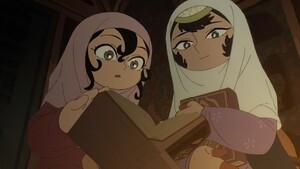
In the harem of the Khan, wisdom is beauty. The time: the thirteenth century. The place: Yeke Mongol Ulus, the greatest empire the world has ever known. The woman: Fatima, hailing from Persia, where medical technique and scientific knowledge have been perfected beyond all precedent. Fatima's desire for a stage where she can put her knowledge to work has brought her to the palace of the Mongols, where she falls under the wing of Töregene, the sixth wife of Ögedei, the second Great Khan―a mighty woman with complicated feelings about the direction of the empire. These two women are the axle upon which the politics of the palace, and soon the very world, will turn…
Jaadugar: A Witch in Mongolia is based on the A Witch's Life in Mongol manga series by Tomato Soup. The anime series is streaming on Crunchyroll on Saturdays.
How was the first episode?
Episode 1 Rating:
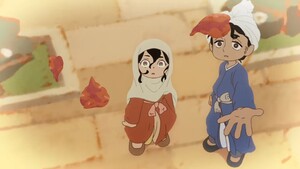
While I've only seen the first episode as of writing this, Jaadugar is one of those shows where I'm glad to see two episodes coming out at once. Simply put, at this moment, I don't really know how I feel about this anime—I don't have a real sense of what it is or what it will eventually be about. This is largely because, as the closing moments make clear, things are about to drastically change for Sitara with the Mongol hordes right on her doorstep.
Viewing this as a standalone episode, it is the story of a slave girl in the medieval city of Tus. At first, Sitara wants nothing more than to return to the home she shared with her mother. Of course, what she doesn't realize (due to being a literal child) is that what she really longs for is a return to the past. But the past is gone, and the best she can hope to do is make a new home.
Moreover, Sitara doesn't truly understand what it means to be a slave—that she is not on equal standing with someone like Muhammad and is rather owned by his family. While she's being treated with kid gloves due to her young age, it's a hard truth that she has no control over her existence—and one day, she may be forced to spend her days cleaning because most slave owners need slaves to do that rather than read books on mathematics or theology.
Thematically, this episode makes an interesting distinction. Many works of fiction (and non-fiction) promote the joy of learning—that gaining knowledge is a worthy endeavor in its own right. However, what Jaadugar espouses is the point of education. The more you learn about the past and the way the world works, the more you can predict what is to come—and thus be prepared for it. Or, to put it in a way more relevant to Sitara and her situation as a slave, the more you know, the more control you have over your life.
With just this first episode, Jaadugar so far is more a parable about the purpose of education than an actual story. That said, it does establish our heroine, Sitara, and gives us a base to build her story on—and I suspect the second episode will establish the status quo and give Sitara her ultimate purpose. We'll just have to watch and find out.

If the first episode was about the purpose of education, this second episode is about finding a reason to continue living. In this episode, Sitara goes from her highest point to her lowest. Fatima promises to make her Muhammad's bride, saying that she sees the young girl as the perfect match to one of the world's greatest young minds. Then Fatima is killed protecting Sitara, and Sitara loses the will to go on. But, upon meeting up with her fellow household slaves, she gains a new reason to live on.
Thus begins the tragic cycle of the episode: each time she gains a reason to keep going, it is torn from her. First, it's that Fatima's brother is still alive (but then they see his body). Then it is that Muhammad is alive (then they learn that all the inhabitants of the city he was in were slaughtered), then it's living for the sake of her fellow household slaves (who die off one by one). In the end, she is left more alone than she ever has been before and unable to find a reason not to commit suicide and end her suffering. It's then, at the last moment, that she is given one final lifeline. The son of Genghis Khan stole Fatima's most treasured item—a book that belonged to her late husband. Can Sitara truly give up on life when Fatima's killer holds that book?
That is the question we are left with at the end of the episode. And make no mistake, there is narrative brilliance in that question. For our purposes, it's not the book that is important but rather what it would mean to “take it back.” It's not as simple as stealing the book in the night and escaping—Sitara's thousands of miles from home, deep in enemy territory. She'd be dead and the book returned within hours if not minutes. Rather, to get the book back means to be in such a position that Sitara could take it without punishment—even if that means taking it from Fatima's murderer's cold, dead hands.
That is the path that lies ahead of Sitara and what this anime is truly about: a slave girl going from less than nothing to the heights of power that rival the greats of the Mongolian Empire at its height. And it's a journey I am eager to take alongside her.

Episode 1 Rating:
Despite knowing almost nothing about the original josei manga, Jaadugar: A Witch from Mongolia ranked highly among my list of most anticipated anime for the season. After all, it's being produced by one of the greatest modern anime studios, Science SARU, helmed by two accomplished directors, Abel Gongorra and Naoko Yamada. It's proper historical fiction set during the end of the Islamic Golden Age, an underutilized setting in which developments in mathematics, arts, and sciences were thriving in the Middle East. The art style is cartoony, but also brings the sights and sounds of 13th-century Persia to bustling life.
The first episode fulfilled all my hopes and dreams. Beautifully animated and brilliantly directed, it focuses on Sitara, a young slave girl whose masters, Fatima and her son Muhammed, decide to educate. There's a lot to love about Sitara, who overflows with spunk and sass despite being in a fairly desperate life situation. And while I'm not a historian and thus I cannot speak to its true accuracy, it provides a multilayered look at people's lives and views in the era. With Islamophobia and dictators who use religion as an excuse for tyranny and oppression so rampant in much of the world, it's refreshing to see characters talking about the importance of education in their faith and just being…humans.
And, with slavery such a common trope in anime (though, admittedly, it seems to have fallen out of favor in the last few years), it's a joy to see it portrayed with so much thought toward its historical context and conditions. Yes, some slaves with wealthy, kind masters were able to live in relative comfort. Sitara has a relatively long leash, and the other slaves in the house are treated humanely as well. Still, as her older compatriots remind her, her life is not her own. Everything about her material conditions is subject to the whims of another, and she has no agency to change them. Even her education is for the sake of entertaining her owners.
This first episode does feel a bit more like a prologue than anything else. It ends on a cliffhanger, with a group of Mongols preparing to invade Sitara's home. I'm looking forward to seeing what comes next.

I have a single complaint about this episode: I'm having a hard time swallowing how Sitara and Fatima's relationship has evolved from owner-slave to a mother-daughter bond. I suppose I don't have much cultural context for how slavery worked in the time period. Still, after all that was made in the first episode about how Sitara was subject to her owners' whims, no matter how well they treated her, it didn't match up with how things ultimately went. It's a small quibble that could turn well into a larger one down the line, or could amount to little beyond this moment.
Otherwise, however, this was a spectacular episode. The arrival of the Mongols completely upturns the contentment and comfort of the well-heeled household's life, razing and pillaging the town. The Mongol invasion was a key component of the end of the Islamic Golden Age, and seeing it through the eyes of characters whose lives were destroyed by it is far more powerful than reading about it in any nonfiction book. We sit and watch, helpless, as Sitara looks at the ruins of her city, as the things she treasures are stolen, as the people she loves are killed, and as she is torn from her home. We watch these things, knowing that real people went through something very similar to this. We watch, knowing that real people today are also going through something similar to this. And it breaks our hearts.
As expected, the visuals and music continue to be excellent, perfectly underscoring the mood of the scene. The cartoonish character art makes the historical details in the architecture and costume design stand out even more, while being just as expressive as standard anime art, if not more so. The warm shades of Fatima's house contrast with the cool tones of the desolate landscape that Sitara and her compatriots are forced to trudge through. The effect raises the highs and makes the lows all the more heartbreaking.
I've been looking forward to Jaadugar: A Witch in Mongolia since it was first announced, and I'm glad that it hasn't disappointed so far. But then, with that studio and staff, how could it?

Episode 1 Rating:
At this point, I will rush to the front of the proverbial line to enjoy any project that Science SARU has a hand in. With Jaadugar: A Witch in Mongolia, on top of the incredibly vibrant and emotive animation on display from frame one of the very first episode, we have the bonus of a story that centers on the kind of heroine and culture that you rarely see represented in anime - or any easily accessible media in the West, for that matter. My knowledge of the Middle East during the Middle Ages is mostly limited to podcasts and documentaries I have enjoyed that unsurprisingly focus almost entirely on the military exploits of Genghis Khan and his Mongolian army. While the infamous conqueror story will no doubt be relevant here, since Jaadugar's marketing has made it clear that our protagonist's life will become inextricably linked to the powers of the Khan Dynasty that have spread across Asia, Sitara's perspective is obviously not one that most history books and media have prioritized.
So, we've got a work of drop-dead-gorgeous animation that is telling us the fascinating, fictionalized account of a woman who is living through one of the most complex and compelling times of world history. What could there be to complain about? Honestly, so far as this first episode is concerned, I am struggling to identify even one measly nit to pick. While my tastes tend to lean towards the more cinematic and complex storyboarding of a show like, say, Dandadan, I cannot complain about Jaadugar's more reserved, story-book approach to laying out its sequences, since it is so effective for the fable that the anime is weaving. Almost every scene contains shots that seem like they could have been ripped straight from the pages of a lovingly illustrated picture book from days gone by (except here the stylized character designs and lush backgrounds complement the fantastical vision of the Persian culture that is on display, rather than reducing anything to crude stereotypes).
Sitara herself makes for a wonderful little heroine, possessing just the right amount of childish naivety to balance out her feisty and willful nature. She doesn't come across as a precocious genius in the body of a child, which is a trap that many lesser anime have fallen into when focusing on a younger main character. Rather, she is simply a resourceful and intelligent girl who is trying to maneuver through a world that cannot have been easy to survive for even the wealthy men and women that society privileged. Sitara is a slave, and no matter how benevolent her benefactors may wish to seem, Jaadugar doesn't let us forget that this child has been ripped from her home and forced into a system that only values her as a piece of property.
It makes sense that Sitara sees anything like education as just another tool wielded by masters to increase the value of their slaves, but that only makes it that much more satisfying revelation when our heroine befriends the gracious young Muhammad and learns that there is genuine power that comes with being educated and experienced. She might not be able to change her circumstances at will, but she can prepare herself for whatever challenges may come her way, and if nothing else, establish a friendship that will carry her through the years. What a lovely, heartfelt work this anime is shaping up to be. I am eagerly waiting for my next opportunity to spend time with Sitara and learn the next chapter of her story.

Watching the second episode of Jaadugar: A Witch in Mongolia, I found myself thinking back to the early episodes of Orb: On the Movements of the Earth. I honestly found the whole of Orb to be a frustratingly inconsistent and unsatisfying show, which I know is not the most popular opinion, but those first episodes of the series really struck me with how well they zeroed in on the almost transcendental experience that learning and discovery can be when the stars align, and one's passion for their own self-improvement and growth is ignited. Sitara, too, has discovered a zest for knowledge that enriches her life and her relationships, which makes her a very endearing hero to follow indeed.
I also really appreciate how sensitively and effectively Jaadugar is rooting Sitara's story in the culture of her world. I am no expert on the history of Persia and modern-day Iran, so I cannot say how accurate Jaadugar is compared to what you might find in a textbook or a thorough work, but I still must commend this anime for putting in the work to treat the time and place of its setting with such obvious care. How many times have you heard characters in an anime discuss their relationship to the tenants of Islam, especially with as much nuance as this? On the one hand, Sitara and her fellow slaves seem to be living a life of relative freedom to learn and express themselves, but they are still slaves, which is a system supported by and enforced by the same cultural and religious tenets that are meant to bring comfort, salvation, and peace.
This second episode also brings the darker elements of Sitara's story to bear, as the Mongols arrive at Tus and bring their bloodshed to Sitara's door. It is interesting to see the story marry its storybook visuals and stylized character designs with the violence of medieval war. I've seen plenty of anime try to exploit this sort of contrast for what amounts to pure shock value, but smarter productions linger in the friction of these opposing elements without drawing such gaudy attention to themselves. We don't need to see limbs flying off or geysers of spurting arterial blood to get the point of all this violence. It is enough to see Sitara's face when her mistress falls after shielding her from a Mongol's blade.
Given the subtitle of the anime, it was inevitable that Sitara's life in Persia would be upended so that she could be whisked away to Mongol. It is not necessarily a pleasant thing to watch unfold, the shattering of yet another home for this poor girl, but Jaadugar makes sure to tell the story with skill and empathy. I was already convinced this would be one of the season's finest programs after watching the premiere, but Jaadugar's second episode has clinched it. This is one series that you absolutely owe it to yourself to make time for this summer. You won't soon find anything else like it.
Episode 1 Rating:
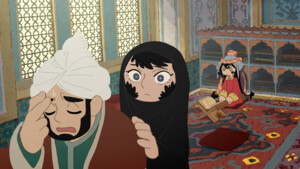
I feel like it's impossible to watch this episode without feeling at least a little bit anxious. As a story that utilizes real-world studies and historical conflicts to create an emotionally gripping narrative, this first episode does do a lot to get me emotionally invested in the tragedy it is obviously setting up. The story of a young slave girl who yearns for something more is a surprisingly typical story, but what I like is how the story highlights culturally the different viewpoints of everybody involved in this specific society. Everybody has a specific role and specific expectations thrust upon them, whether they're a scholar or a slave. However, Sitara wants to both define those expectations while also carving out a path for herself in a society that already makes it incredibly difficult to be anything more. The irony is that this episode ends with signs of that very society reaching its downfall, and the knife twist comes with that happening just as she was given all of this hope that she was going to be able to live a better life than the one that got her here in the first place.
Sometimes tragedies can be difficult to write because, as a reader, I don't always want to feel explicitly terrible by going through a hopeless situation. That is undoubtedly the case with A Witch's Life in Mongol, as the voiceover and foreshadowing in this first episode imply that she is going to be in for an incredibly hard life. Is she going to be forced to work within the confines of the roles and expectations that come with her background during this historical time, or is she going to be somebody who redefines how a lot of these things are done? I think finding that out is going to be one of the major elements of how I approach this story, but episode one is all about setting up. I'm curious how episode two will be about following through on communicating one of those exact ideas.
I will say, this first episode did a great job of actually getting me emotionally invested in all of the characters involved, despite their limited screen time. I felt the sense of love and community that was shared here, even though everybody has significantly different statuses. Obviously, I'm sure not every household in this country during this time was like this, but it did get me to genuinely believe that at least this family found a lot of joy and solace in how they lived. I also have to say this anime looks absolutely gorgeous so far, with a very simple color palette that still makes everything shine so brightly. I especially like the creative choice of having the character designs be devoid of outlines. You would think that would make it easy for them to blend in with all of the backgrounds, but in actuality, I think it led to some really charming and unique expressions that ended up making the characters feel a lot more memorable. I'm definitely going to be keeping an eye on this show because it is probably one of the most unique shows that is coming out this season.
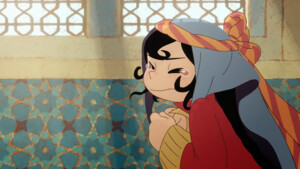
Finding a reason to live is not always easy, and I think this second episode really hammers that idea home. I was wondering how heavily the show was going to lean into despair after all of the set up and foreshadowing in the first episode. Suffice to say, I was not disappointed and just how badly Sitara was going to be dragged through the mud. She lost her home, her safety net, the closest thing she's had to a family for the past couple of years and there is this overall atmosphere of everyone just giving up. While I could argue that the series overplayed its hand a bit when it came to Sitara's relationship with Muhammad. Considering that the voice over in episode one explicitly said that they never saw each other again, this made the fact that the area he was supposedly living in being conquered become a bit of a moot point in some ways. However, the animation and use of shadows did a fantastic job of still communicating just how terrible the situation is.
As Sitara marched towards the soldiers in those final minutes, ready to give up on everything, I felt that. It's interesting that she was told about the benefits of being a slave and how there are sometimes positives to not being seen as a full person without it feeling weirdly fetishized like…other anime have done. I liked that dichotomy of how being a slave releases them from the burden of choice or punishment that would be assigned to those that are seen as people, but then what happens when the people that are in charge of your life are no longer around anymore? It's interesting because in some ways it's liberating, but in other ways that sense of comfort has been completely removed from Sitara's life. So now she's going to have to find a new purpose which I'm pretty sure is what the end of the second episode is implying. She has to become her own master if she wants to be able to survive these dire circumstances and I'm very curious to see how the establishment of that resolve is handled.
discuss this in the forum (64 posts) |

back to The Summer 2026 Anime Preview Guide
Season Preview Guide homepage / archives