

Game Review
by Grant Jones,Pragmata Game Review
Nintendo Switch 2, PC/Steam, Playstation 5, XBox Series X/S
| Description: |  |
||
Hugh and his team of investigators travel to the moon to find out what has gone awry. However, he is soon separated from his team as the AI running the lunar base has taken over. After meeting a small Pragmata known as Diana, the pair set off to survive and grow closer together in this third-person action survival title. Pragmata is developed and published by Capcom. Pragamata is available on PC/Steam, PlayStation 5, Xbox Series X/S, and Nintendo Switch 2. A Nintendo Switch 2 copy was provided for this review. |
|||
| Review: | |||
Pragmata is a game that, despite my best efforts and the quality on offer, I never could get into the groove with. Nonetheless, it's a beautiful game that makes a lot of noble attempts at novel design. 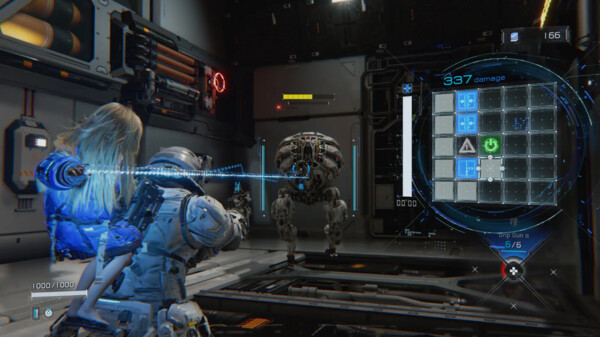 © CAPCOM First, the priors. Pragmata is a third-person action game with some light horror/survival elements. You play as Hugh, an investigator in the near future whose team goes to the moon, and their visit to the lunar facility there goes horribly awry. You are isolated and quickly meet up with a small android girl named (or that you help name) Diana. She pops on your back and assists you as you fight against the haywire artificial intelligence causing chaos and sending robots to kill you. You navigate the lunar facility, fighting and hacking to survive. Based on the general scuttlebutt, I gather that it shares a lot of similarities (at least on a surface level) with games like Dead Space and Death Stranding. I've not played either, so my closest touchstones would be Resident Evil with a bit of Kiryu-protecting-Haruka thrown in for good measure. The most prominent mechanic in the game is hacking. This is a feature that is intellectually very interesting. The hacking itself is simple at first, but quite varied. You have to solve puzzles in these pop-up minigames that can include opening locked doors, bypassing security, and other typical hacking activities. But most notably, it is also used in combat. Rather than simply aim down sights and fire at the enemy's weak points or switch weapons based on the enemies' capabilities, Diana can hack the robots on the fly to pop open their panels and allow Hugh to more effectively damage them. This is a neat approach and certainly creates a different kind of tension beyond simply making accurate shots or effective use of limited ammunition. It's an attempt to create another dimension to a well-established combat formula for third-person action games in this mold. 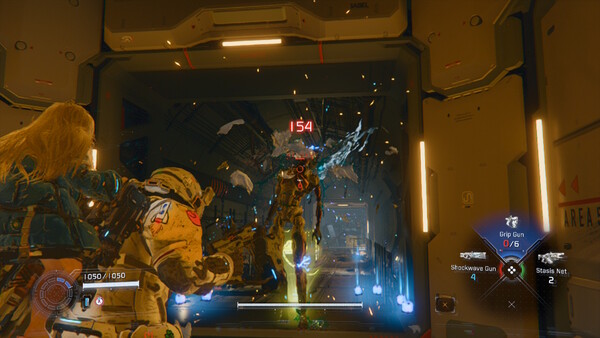 © CAPCOM My major problem is that I don't like it in practice. I won't say that I hate it, cause I don't. And I applaud the effort to carve out a new design space rather than rely on the same old formula. But for me, personally, it just isn't fun. It's mostly distracting. It's like I'm trying to play a game and someone is carrying on a conversation that they expect me to be actively participating in at the same time. I find myself trying to split my attention, and even when I'm successful, I don't find myself as invested in either activity. It's a strange situation where giving 50% of my focus to one task and 50% of my focus to another results in less than 100% enjoyment overall. And it's… everywhere. That's the game! So almost immediately, I could tell it was not going to be for me, and then it just continued to unroll for the rest of the game. Which, of course, makes it hard to review. The game is predicated on a mechanic that I bounced off of, and I found it undermined both my gameplay enjoyment and general immersion. That's… unfortunate. 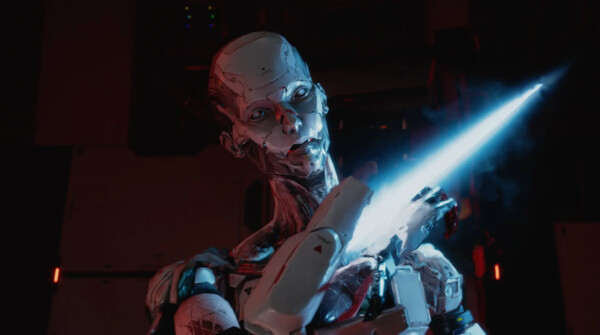 © CAPCOM Thankfully, Pragmata does have a lot of other benefits. The game is gorgeous to look at with a distinct visual flair. Or rather, it might be the lack of flair that is so appealing? There is a very conscious effort to ground the game in a sense of near-future verisimilitude which feels neither too close to be plausible nor too outrageous to be relatable. This is the kind of science fiction setting where the moon remains a lifeless rock, but additive printing and rogue AI make problems and solutions possible at high velocity. There's a sense that this future is not so far out of reach, where you could create a timeline with images from programs like Sputnik, Apollo, and Tiangong, and this world would slot in quite comfortably on the far right of the line. This contributes to the sense of danger and loneliness I feel, as the various space programs and all their ambitions have often made us realize just how difficult space travel is and how precious our little blue dot remains. In a way, Hugh and Diana embody this same visual dynamic with their gray and blue overalls and close proximity, battling against an uncaring horde of machines. This is best exemplified in the stunning environmental shots that so frequently pop up. While a lot of the game takes place in tight confines or enclosed spaces, there are also times when you come up for air and take in a breathtaking view full of color and vibrancy. It's gorgeous, rewarding, and perfectly timed to give a glimmer of hope before you return to the robo-battling. 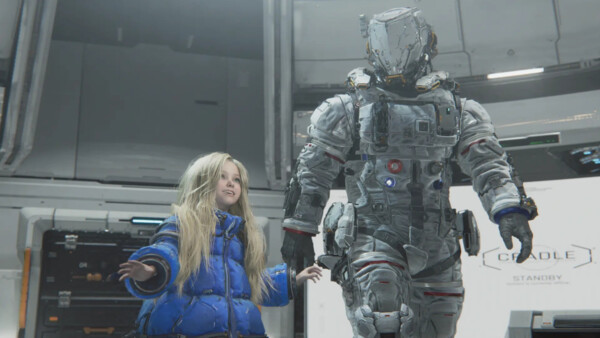 © CAPCOM There's also the home base you build over the course of the game. There's a central hub used between missions that connects to a tram system, allowing Hugh and Diana to deploy to new areas/levels while also allowing you to revisit prior regions to trawl for secrets or level up a bit. Like the hacking mechanic, it is very nakedly “gamey,” but it was the more successful of the two for my immersion. Mainly in the way it grows the bond between Hugh and Diana. As you find little gizmos, toys, and whatsits around the levels, you can bring them back and set up what amounts to a little play area for Diana. It was pretty clear what the team was aiming for, and I think they succeeded brilliantly here. Perhaps more than any other part of the game, this loop of “find fun thing, bring it home, see what Diana thinks about it” became my primary motivation beyond almost anything else it had to offer. It's also a place to upgrade weapons and so forth, and that's all fine, but really, it was the human connection that made it a success. 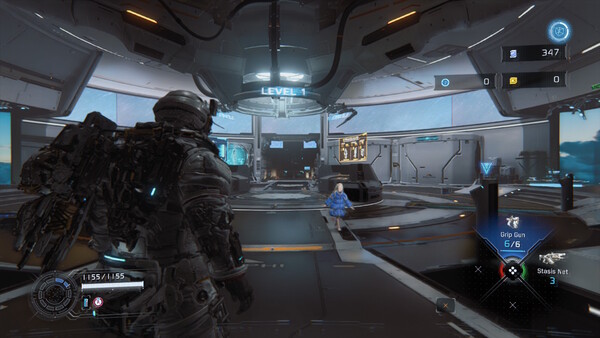 © CAPCOM It's just a generally smooth, concise game, clocking in somewhere around 15 hours plus or minus a chunk depending on how far afield you go. I welcome any high-budget, high-production value, mostly linear experience with a clear story to tell that clocks out right on time. Sprawling open worlds have become so common over the past fifteen years or so that I've become quite tired of climbing towers and collecting checklist items for their own sake. Having a game that is single-player focused, stable, and complete at launch, and a nice short experience that says what it wants to and bids you good day: that's a rare find in our current time. Pragmata is a good game. It's pretty and short and has enough heart and novel concepts that help it stand apart from the pack. If you're not like me and you enjoy its core hacking mechanic, there's a lot to love here, and I wouldn't be surprised if this becomes another regular feature in CAPCOM's stable. I feel like I'm just on the other side of the glass, unable to engage with an otherwise great game because its core gameplay doesn't appeal. C'est la vie. |
|
The views and opinions expressed in this article are solely those of the author(s) and do not necessarily represent the views of Anime News Network, its employees, owners, or sponsors.
|
| Grade: | |||
Overall : B-
Graphics : A-
Sound/Music : A
Gameplay : C+
Presentation : A
+ Gorgeous visuals, engaging setting, breezy runtime, and interesting attempts to shakeup established formulas ⚠ N/A |
|||
|
discuss this in the forum (3 posts) |
bookmark/share with:

|
|||