

(5 questions; 35s to answer on average
Yes I'll do it later No
The Summer 2026 Anime Preview Guide
The Villager of Level 999
How would you rate episode 1 of
The Villager of Level 999 ?
Community score: 2.7
How would you rate episode 2 of
The Villager of Level 999 ?
Community score: 3.0
What is this?

In a world of swords and sorcery called Earthqualia, everyone is born with a designated "class" or role. Koji Kagami, born into the weakest "villager" class, is level 999 despite that. Koji has a chance meeting with Alcie, the daughter of the demon lord, and together they seek a way for humans and demons to coexist.
The Villager of Level 999 is based on the light novel series by author Koneko Hoshitsuki and illustrator fuumi. The anime series is streaming on Crunchyroll on Wednesdays.
How was the first episode?

Episode 1 Rating:
There are moments in this episode when I thought that perhaps it wasn't quite as bland as I'd been thinking. I realize that's damning it with faint praise, but what else can you do when it takes all of nine seconds for the first episode to get to the idea of stat screens? I will give it credit, though, because it doesn't use the stats in the exact same way as every other RPG-inspired series – the screens can be summoned by their owners and are visible to those around them as a kind of shorthand for someone's strength and abilities. In a Japan renamed Hexaldria (for some reason) and overrun with monsters, that's not a bad thing, even if, as we see early on, not everyone is entirely clear on how this ought to be done.
But in the long run of this episode, this mechanic saves our protagonist Koji Kagami from having to prove his awesomeness to the hero Rex and his party of hand-picked ladies. While they're still sputtering about his skills, he just casually breaks out the stat screen that reveals his nigh-incomprehensible job as villager and level as 999. Rex's puny little mind can barely cope with this revelation, although I have to admit that Rex isn't doing so hot in the brain department prior to Kagami's admission of greatness. Anyone who rejects very viable party candidates based on gender isn't hero material, as countless other shows have taught us.
So far, Kagami is an acceptable protagonist, albeit a bland one. He seems to be more aware of his world than most of the other characters, however, which makes me question whether or not this is a stealth isekai story; as he passes Rex at the end, he murmurs that Rex has “doesn't understand how the world works,” which could imply that. There's also the fact that he has a distinctly Japanese name when no one else does, with the one exception being the princess' title of “Kannazuki.” Granted, that's kind of a weird title, since it refers to a “month without gods” rather than a priestess, but since Parna nicknames her “Ku-chan,” I think we have to assume that it is a title, since Ku refers to her name Kurull.
Of course, there are plenty of things to give one pause. I'm very worried about how they'll treat the femme-presenting character from the opening themes and I really don't love that this episode ended with a small child proposing to an adult man. There's also a very icky grooming joke when Rex chooses Tina for his party because she has “room to grow,” with the camera focusing on her breasts and lower abdomen. I don't have high hopes here, even if the thought I walk away from this episode with is “kind of bland.”
Well, at least Kagami refused little Alice's proposal of marriage. That's one of the few bright spots this series has going for it thus far. Actually, he's still pretty unobjectionable: he refuses to entertain thoughts of marrying a small child, he accepts Takako's gender identity, and he hasn't groped any members of the female cast. (The bar is in hell, isn't it? I typed that last sentence without stopping to think about how that should be required of anyone calling themselves a protagonist.) He even offers to buy Alice's dad the super expensive panacea he needs to recover without making any creepy comments, just a joke about how he'll expect five gold more in repayment. After two episodes, and even with the requisite tragic backstory, he seems to be a decent guy.
Interestingly enough, the closest we have to a terrible human being thus far is Rex, he of the creepy grooming joke in episode one. But even he's willing to step in and help save the town when the demon Menow attacks – though as Kagami points out, he doesn't think it through at all. It feels like the show wants us to view Kagami and Rex as opposites: Rex desperately wants to live up to his designation as “hero” to the point where he makes a lot of foolish (or gross) choices, while Kagami is a hero based on his actions but doesn't care to be known as one. In a better story, it would be an interesting foil for the journey. Here, it's just sort of… present as a thought in the text, getting lost between the art encouraging viewers to find Takako hilariously trans and Kurull getting blushy because Kagami smacked her on the head.
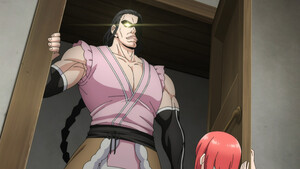
Takako is, of course, the biggest potential issue here. Kagami flat-out tells Alice that she's a woman, which is great, though I could have lived without the “joke” about her breast tissue. But the way she's drawn feels like we're meant to see her as a joke, a trans woman who looks more male than female. It's tired, transphobic, and frankly ought not to be happening in 2026, no matter what your culture of origin. It's great that Kagami and Alice accept Takako for who she is. The art really needs to follow suit.
At the end of these two episodes, I find myself largely unimpressed. Kagami's basic decency (and requisite tragic backstory) aren't enough to lift this above uninspired character designs, unfunny gags, and even a rain of magic hogs.

Episode 1 Rating:
I think I found a strong contender for the most generic fantasy series that's coming out this season and it isn't even close yet. The problem with shows like this is that I sometimes get scared I'm not going to have enough to write about, because when everything is being played to such a generic level, there's not really much I can add in terms of commentary or creative breakdown. Thankfully, this show seemed to predict my worries because it decided to randomly throw in a bunch of inconsistencies and tasteless garbage to help spice up its overall bland production. I wasn't expecting an uncomfortable grooming joke within the first ten minutes of the episode, but at least I can talk about how out of place that was.
The premise of the show just seems to be a typical power fantasy from the perspective of a pretty laid-back, almost painfully casual protagonist. The idea that Koji is just a villager who wants to live a simple life can be interesting, especially as a contrast to Rex and his party, who are trying desperately to fulfill the more typical harem fantasy group role. I will admit that the scene at the end of this episode where Koji reveals that he actually acquired the sacred sword that Rex and his party were looking for, only to sell it off because he said it is nothing special was the closest thing to a funny joke I can give this premiere. But then the episode goes a bit too far with that dichotomy by making the protagonist borderline unlikable, but in a weirdly inconsistent way. I can understand him wanting to keep things simple and I think it's cute that it's implied he got to his high-level by manipulating something about this world that the generic hero doesn't know about. But once he started going on about self-righteousness and how he doesn't want to really protect helpless people by beating the demon lord, even though he's shown he's willing to help people that are directly in front of him, it felt very weird. Like if it's such a non-issue for him then why not just beat the demon king to get it over with? I'm not really sure how I'm supposed to feel about most of these characters because so far the defining ones just kind of come off as generic or unlikable.
That's not even getting into the world building, which feels both overly simple and weirdly complicated at the same time. The show goes out of its way to make it clear that this is the real world that just randomly got overrun by monsters and thus ended up taking on the properties of a game fantasy setting. It's implied that it's been a couple of years since this all happened. But if the nature of the world has changed so much to the point where it is basically unrecognizable from any other generic fantasy setting, then why not make it a typical fantasy setting? That also just makes me question a lot of the history and politics of this world, like the fact that Japan now has a king and a princess? How exactly are the roles for all of these characters assigned? Is this supposed to be a typical fantasy series where I do take things seriously, or is it all supposed to be a farce? At its best, this premiere felt incredibly bland and uninspired, but at its worst, it is riddled with really weird narrative choices and inconsistencies that make me scratch my head more than it makes me want to genuinely engage with the material. Who knows, maybe the explanation for the little girl demon that wants to marry the protagonist will be the thing that wins me over with the next episode.

OK, that second episode was…better. I do have to give the show credit that it did answer a lot of my questions almost immediately with this second episode. Plus, there were some genuinely charming moments in this episode that showcased the characters can have a sense of emotional chemistry with each other. Does any of this really elevate the show beyond being that bland, generic power fantasy? Not really but at least this episode didn't really have anything that explicitly made me mad like the first episode did.
So it turns out that there is a lot more involved here between the humans, monsters and demons. Nobody seems to know where the monsters came from but humans and demons might not be that different from each other. However, the two seem to have a negative association with each other that is born out of a type of inherent prejudice. I like the fact that Koji doesn't want to take on the demon king because he seems to know them and it's implied that the reason for his high level might have something to do with those encounters. Koji actually shows a lot of genuine compassion here and some of the reveals about how he goes about things do make him a far more endearing character than what I saw before. Basically I fell for the show's bait and switch, but it makes sense why he needed to come off the way that he did to Rex and his party because he was looking out for this little demon girl almost immediately.
I do like the building of a rapport that Koji and Alice seem to be developing. I was scared with the marriage proposal, but it looks like the show is leaning more towards a type of sibling dynamic between the two which I do appreciate. Plus there's a little bit more background into how the leveling system and class system of this world works. The end of the episode does lean a little bit too much into that idea that everyone is an idiot except for the main character, but this is what I mean when I say that, so far, the show hasn't really done much to grow beyond the generic. It's starting to plant seeds and plan out what it wants to do a lot better which might also explain why this first and second episode needed to be watched together. However, I think it has to do a bit more than this in order for me to truly get invested with it. Right now it's still as generic as they come.

Episode 1 Rating:
Fellow gamers, I ask you: Has there ever been an RPG with a triple-digit level cap that wasn't explicitly designed to be a grindy waste of time? Before any of you cut in to “Um, Actually!” me about Disgaea, let me stop you right there. In the Disgaea games I've played, the level cap is 9,999. That's a whole extra digit to contend with, and it's the inherent absurdity of the inflated number systems in Disgaea that make it funny. None of the light novel FantaSlop we have to muck through every season is operating on Disgaea's level of charm or creativity. I'm not even convinced that most of these light novel authors have ever even played an RPG in their lives.
Such is the case with The Villager of Level 999, which doesn't come across as a story rooted in any genuine expression of interesting game mechanics or fantasy settings so much as it is the umpteenth ripoff of somebody else's ripoff of somebody else's ripoff of someone's hastily scribbled outline of a ripoff of Sword Art Online. Our main guy Kagami, another guy who was given that lame Kirito Haircut in place of a discernable personality. The setting is the same mishmash of forests and hillsides and vaguely European villages enclosed in circular walls. The music that accompanies all of the nothing happening on screen is such a stock cobbling together of strings and woodwinds that I genuinely would not be shocked to learn that it was stolen wholesale from a different crappy fantasy anime that nobody could be bothered to remember.
The premise, for those of you that are morbidly curious enough to keep reading past that last paragraph, is exactly what it says in the title. Kagami is level 999. There's a Demon King about and endless dungeons of caves and goblins to amble through. Some girls who are only distinguishable by their hairstyles and bust sizes eventually show up and decide that they don't have anything better to do than rely on Kagami to help them on their quest, what with him being a god amongst men and all.
Honestly, even for unabashed garbage, I was shocked at how little of a shit Villager of Level 999 gives about its own existence. Everything from the languid pacing to Kagami's own complete lack of interest in whatever is happening around him makes this show feel like it exists in spite of itself. I don't like to make accusations of “nobody caring” when it comes to the production of most any cartoon, since the sheer amount of work it takes to make even crap like this fit for airing means that some level of effort had to be put forth. Yet, when I watch a premiere like The Villager of Level 999's, It is difficult for me to comprehend how something so absent of even the tiniest spark of creative joy could exist.

Readers, do you remember how the first episode of The Villager of Level 999 was so terminally bankrupt of any creative meaning and drive that watching its premiere was akin to spending a half-hour trapped in a sensory deprivation tank with nothing but your own cursed thoughts to keep you company? Well, you just will not believe this, but it turns out that the show's second episode is also really bad. I know, this is a lot to take in all at once. I was nearly bowled over with shock when I finished watching the episode.
I like to believe that any creative work is capable of growing and improving, especially when it comes to television series, where stories often have multiple seasons to work out their kinks and play to their developing strengths. Let's all be honest, though: Has anyone ever heard of an anime that produced utter hogswollop for its very first episode only to miraculously recover in the span of just one week? I've been doing this job for a long time, and I cannot say that I've ever personally encountered such a cryptid. I think the kindest fate that The Villager of Level 999 could hope for is to merely stay the course towards its inevitable place in the dustbin of forgettable slop. The only other option is for the production to devolve into such a sorry state that The Villager of Level 999 becomes one of those “So Bad, It's Good!” irony viewings for certified trash-sickos.
Obviously, I'd like The Villager of Level 999 to completely burst into trash-fire flames, myself, because it would be hilarious. Unfortunately, nothing about this second episode gives me hope that this show will end up failing so spectacularly. Considering that the first half of the episode consists entirely of Kagami wandering around with that little Alice girl and explaining how money works, it is a miracle that I was even able to stay awake long enough to finish the episode. Last week, I made the only quasi-facetious remark about not believing that any of these light-novel authors have actually played one of the RPGs that they are so shamelessly exploiting. At this point, I'm starting to wonder how many of them have even read a book, or watched a television show, or seen a movie, or even paid full attention to some person telling an anecdote of what happened to them over the weekend. I don't know how else to explain shows like Villager spending so much of their time on scenes and dialogue that could not possibly be less interesting.
Okay, I guess the author of Villager has to have seen something in their lives, since that's the only way we could have gotten the idiotic caricature of Takako. The whole point of her character is that she looks like a big, buff crossdresser in a frilly pink gi, but she's actually a woman with boobs and a vagina. Despite the show's frivolous gestures towards magnanimity with Kagami acting all nonchalant about her, Takako is yet another blatant rehash of an ancient and completely-out-of-touch comedy trope that only survives because so many of the people currently writing stories in the Japanese entertainment industry never read or watched anything beyond the cheap cartoon comedies that made them laugh thirty years ago (and then a bunch of inexperienced kids get sucked into the content mill and rely on ripping off their elders to get a complete manuscript out of the door).
Anyways, don't watch The Villager of Level 999. It sucks, and it will bore you to tears.

Episode 1 Rating:
I have so many questions about the world of The Villager of Level 999. First of all: who decided to translate the title this way? It's nonsense, and “Level 999 Villager” is right there. This is 101-level Japanese, guys. Someone in their first few weeks of formally studying the language would be able to do a better job.
Second of all: what the heck happened that “stats” became a thing in Japan? I'm sure it's connected to the monsters and the demon lord, but there's so much more I want to know. Was it just Japan, or the whole world? If it was just Japan, maybe it had something to do with Dragon Quest, since this is clearly a ripoff… er, heavily inspired by the game series. How did the general population feel about this? Was there social upheaval when everyone was suddenly assigned jobs from birth? Also, why does Japan now resemble a generic fake medieval European town? Did they tear everything down and rebuild in the image of an extremely popular and influential JRPG series?
These are the questions that flitted through my mind as I watched The Villager of Level 999, because I sure wasn't engaged by the main story! Our Kirito clone du jour, Koji, saunters through the story without any interest in what's happening around him, professing only to care about making money. The dungeon is a series of identical tunnels with mining lighting, where he knocks out a series of identical blue ogres, each with a single blow (sometimes more than one at once). The town looks like every other LitRPG town, despite the unusual origin story, and the female characters have the usual level of leeriness to their cameras and designs. The opening theme is indistinguishable from three-quarters of other series in the genre.
It's so blah in presentation that it took me until about two-thirds into the episode to realize that this is supposed to be a comedy. There's no comedic timing or direction, so the supposed punchlines just come across as bad, weird, and/or nonsensical writing. The animation is disjointed and sauceless; is this really the studio of Baccano! and Penguindrum? This is not my beautiful house, this is not my beautiful wife, this is not my animation studio that has turned out a number of classic anime series!

Hi, I'm Koji Kagami, the level 999 villager! Nobody has been as powerful as me in the history of ever! Not only am I the strongest person in the world, but I'm also the only one who has stopped and considered that maybe demons are people too and have discovered a magical cloth that stops demon horns from turning animals into monsters. I'm also much smarter than those elitists with their high-faluting classes, who are high level but have noooooooo common sense. I also have a tragic backstory. I'm the bestest best boy around!
I didn't actually find this episode as objectionable as the previous. Koji is still an absolute chore, as is Rex and his harem/adventuring party. The animation still primarily consists of characters standing still and looking off-model, and the music is generic and on-the-nose. It's not a good series by any means, and I didn't enjoy watching it. However…
The dialog tended to be primarily expository in nature, and I found that I did have some interest in the world and how it works. The economy doesn't seem to be totally busted, either, as Koji gives examples of how much things cost. Alice is an actual character with a motivation that she's striving for, rather than the shrill hanger-on one may have expected from her marriage proposal at the end of the first episode. She wants to get a medicine to save her father, but it's expensive and hard to obtain, hence Koji patiently explaining human economics to her. It's actually kind of a nice scene, especially interspersed with the two of them walking through a market in the town square as merchants hawk their wares.
And then there's Takako. Oh, Takako. She is, in essence, a transphobic and misogynistic joke: a woman who became so strong that all the fat in her breasts melted away. It's not mentioned but apparently it also made her voice drop, broadened her shoulders, narrowed her hips, and squared her jaw. Her big introduction is Alice fainting at the sight of her. It's mean-spirited, especially coming on the heels of Dorohedoro, a series with multiple large cis women. But at the same time, she's a lovely person, and Alice quickly becomes comfortable with her. She's the kind of character who, given time, I may come to love in spite of the original creator's intentions.
The Villager of Level 999 may be less lazy and mean than I initially gave it credit for, but it still fumbles in some crucial ways.
Disclosure: Kadokawa World Entertainment (KWE), a wholly owned subsidiary of Kadokawa Corporation, is the majority owner of Anime News Network, LLC. One or more of the companies mentioned in this article are part of the Kadokawa Group of Companies.
discuss this in the forum (68 posts) |

this article has been modified since it was originally posted; see change history
back to The Summer 2026 Anime Preview Guide
Season Preview Guide homepage / archives