In the wake of Goodbye, Lara's finale, Sylvia and Coop discuss anime endings that left viewers wanting.
The views and opinions expressed by the participants in this chatlog are not the views of Anime News Network. Spoiler Warning for discussion of the series ahead.
Coop
I don't know about you, Sylvia, but it seems to me that folks have strong feelings about their endings.
Sylvia
Coop, I have a strong feeling about ending this column right now. Why have you brought this evil upon us? That's not the kind of ending we're talking about, and you know it. My disappointment is immeasurable and my day is ruined.
Now that your face is perfectly placed in your palm, I'd say we're in the perfect emotional space to talk a handful of endings to anime series that were initially reviled or considered divisive.
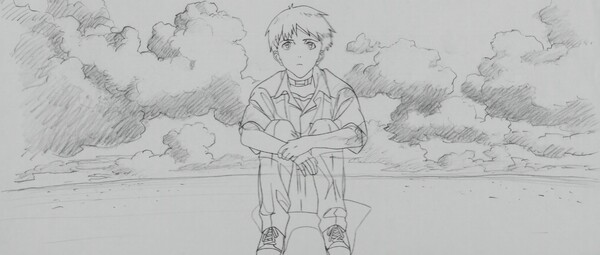
The final two episodes of Neon Genesis Evangelion are the poster child for such endings, but that's just the tip of the iceberg, baby. In fact, it sounds like there was some consternation swimming around a recent fishy favorite of yours, right, Sylvia?
For better or worse, yes. We've reached the end of another anime season, and that means it is a time of goodbyes. And one of those goodbyes was the goodbye to Goodbye, Lara, a big and bold conclusion which immediately spawned a range of reactions from "I loved it ;_;" to "let's beat the writer with hammers."
We at "This Week in Anime" (specifically you and I) preempted some of those reactions earlier in the season with our Dog Chess column. So I cannot say I was surprised. But I am nevertheless kinda bummed about it.
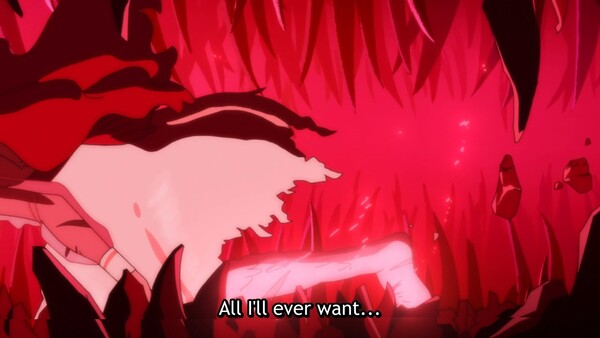
Since we talked about it last time, I've been a little more in touch with discussion around Lara's ending than the series itself. It's been sort of an End of Evangelion summer in my part of the woods. However, everything I've heard has me more intrigued to pop in and finish it for myself. Same with Wonder Egg Priority, which apparently is great until that last episode...and came up in the Lara conversation.
Before we continue, I'll throw in an extra disclaimer that we can't really do this column without discussing details about these series' conclusions, so from this point on, here be spoilers. You've been warned.
But anyway, with Lara specifically, it's not even the final episode so much as it's the final ~5 minutes. I think most people were on board with the story's climax, which invokes a lot of abstract, Ikuhara-esque imagery with the upshot of Lara confronting the pain in her own heart in order to rescue Mari's. There's no kiss, as it were, but it's a confession of love all the same, and one that Lara reciprocates from Mari earlier.
The show then timeskips 6 months ahead and shows Lara saying her goodbyes to the other characters, culminating in a parting with Mari at the train station.
It's abrupt. It's bittersweet. And its various minutiae have been dissected all sorts of ways over the past week and a change. Frankly, there's too much I'd want to say and write to adequately argue my piece, and that's not really the point of this column. But I do want to draw attention to what you just said: you've seen more discussion about the ending than about the rest of the series. And that, I think, does Goodbye, Lara a disservice.
I'd be inclined to agree. When any work has a highly criticized or maligned ending, that tends to become the conversation around that work for years to come. People forget about all the stellar or heartwarming moments that meant so much to them as they were experiencing the vast majority of a certain work. In Lara's case, the ending comes off as incredibly bittersweet, but it feels real. There are multitudes of people who come in and out of our lives; some stick around and others move on to the next phase of their own lives. It hurts when this happens, but it does.
There's no such thing as a "perfect ending" in life (and media, except Revolutionary Girl Utena), and works that embrace that truth are just as important as the ones where the girl gets the girl. Honestly, what you've told me has me going, "So what if after finding Utena, Anthy breaks things off so she can figure herself out a bit more?" Not a romantic ending, but a potentially realistic one.
And that's a perfectly valid interpretation of Lara's ending. You can also interpret it in a way that does not preclude Lara and Mari's romantic bond. Or you can interpret it as betraying their bond as established by the narrative leading up to that point. I think you can make sound arguments for several conclusions, or point at elements that could have been done differently, utilized more clearly, or expanded. We each bring a different set of personal circumstances to art, and in fact, that's why art exists! People love utilizing fictions, abstractions, and sublimations in order to pry at quintessences that straightforward language cannot penetrate. This necessarily creates debates about the meaning of artistic works, and in a perfect world, that's a good thing.
In our social media-poisoned reality, though, tribalism and conspiracy are king. Discussions don't happen. It's all different sides posting past each other, shadowboxing conveniently flimsy cutouts of their opponents. People invent circumstances and motivations out of nothing. People who haven't even watched the show feel compelled to chime in because it happens to be a popular topic, and their voices can be amplified as loud or louder than others depending on the size of their following and the whims of the algorithm. In this way, a contentious ending becomes a different monster entirely, feeding the discourse machine without nourishing any thoughtful conversation. And that's the shit that rankles me.
And I'm not saying I'm above that! Even now, I feel the compulsion to shadowbox my mental projections of what this column's comment section is going to look like. But there's no good reason for me to do that—to reduce the entirety of Goodbye, Lara to a series of gotchas that own my opponents in the marketplace of ideas.
Between this, that terrible JoJo's ending theme, and the chatter over a three-year-old tweet (for which the poster had to record a response to for heaven's sake), social media has been feeling more and more like it's only there to upset people. To make myself clear, I'm not talking about getting fired up over a serious topic that affects people's lives; I'm talking about nerd dick-waving contests and people making themselves upset over an art form they love. Unless someone's actually being hurt, we've got better things to be getting upset about.
Here's an example of one worth getting upset over—Mobile Suit Gundam GQuuuuuuX. Not for overindulging in a meta narrative about escaping the original series' looming cultural shadow, but for giving Tōru Furuya a featured cameo in its finale. This aired over a year after the actor admitted to having an abusive affair with a fan. I don't care if he was "the original Amuro" or if they were short on production time. If SEGA could hastily rip Pierre Taki out of Judgment and rebuild all of his character's assets because of cocaine charges, Khara and Sunrise could've brought in a new actor to record one line for this.
An objectively boneheaded move for sure, especially when they already recast Char! Like, come on, guys. Yet it's also interesting I saw less social media consternation about that than the other more subjectively contentious parts, like the metanarrative or the fact that Machu and Nyaan didn't bump uglies (which they should have imo). But that's an anecdotal observation, so I wouldn't want to draw any conclusions from that. And people certainly had issues with GQuuuuuuX's structure and story before that.
Sometimes, though, you see problems on the horizon and just don't want to acknowledge them. Since you brought it up earlier, and since it was brought up in conversation with Goodbye, Lara, I will swallow my sadness and mention Wonder Egg Priority, which holds the distinction of the most heartbreaking (derogatory) anime ending I've ever had to grapple with. It's in a league of its own. And it legit pissed me off to see people comparing it to Lara's conclusion. Y'all don't even know. I was there. I had to sit down and review that after nearly three months of huffing copium. It hurt me. I hated this.
I will still go to bat for a lot of Wonder Egg Priority, and probably more than most people will. But this is one ending where I believe it truly drags down everything that came before it.
Reading through your review, I get the impression that just stopping before the finale might be the best way to approach this one. There's nothing wrong with watching or playing through most of something and going "I've got what I wanted out of this," then peacing out. Though I'll admit that my morbid curiosity will likely lead me to watching the whole thing anyway. There are probably some lessons to be learned from how Wonder Egg beefs it on the dismount.
It's interesting, certainly. And not wanting for ambition. Most concretely, Wonder Egg is a lesson in how paramount project management is to making a successful anime series. Like, Lara could have benefited from a few extra episodes, but overall it adapted itself to its runtime well and told a complete character arc. Wonder Egg Priority's structure, meanwhile, collapsed like a house of cards and shoved every mean twist it could think of into its shoddily animated finale. Apples and oranges.
Though beloved, Macross is known quite well for its famously messy production and its similarly jumbled conclusion. However, it's not just the finale that has a less-than-sterling reputation; it's the eight episodes that led up to it as well. While I see that final arc as an intriguing postwar denouement to the main Macross tale, there are many who do not. Heck, series director Noboru Ishiguro might've been in that camp too if his old interview with AnimEigo from their ye olde DVD boxsets is to be believed—an interview I wrote about for Zimmerit a while back.
Slipping into his shoes for a minute, I totally get why Ishiguro was likely not a fan of something his team had to scramble even more to produce.
Absolutely. Every anime production only exists as a series of largely invisible compromises, as does any collaborative work of art. It makes tons of sense for any of the various artists involved to harbor complicated or negative feelings about that, depending on the result. But it definitely gets trickier when those compromises become evident to the audience, who bring their own ideas about who or what may be to blame.
Case in point, Hideaki Anno has come up with no fewer than three different endings to Evangelion, each of which represents a distinct creative vision, and each of which inspires a wide array of reactions. The original TV ending is most infamous, though, due to its stylistic and abstract departure from what audiences had come to expect from Eva. Yet if you watch it with an open mind, it stands on its own as an appropriately psychological conclusion to Shinji's arc. It represents a clear artistic vision. However, the consensus continues to view it as an "incomplete" version of the story eventually told by End of Evangelion.
Eva's conclusion (and the entire franchise, really) has fascinated me for years now, mostly because I came to it as an adult instead of an adolescent. I might've also been uniquely inoculated for any potential whiplash because one—people have been dissecting this ending for years—and two—one of my first experiences with Evangelion was randomly catching the final episode on Adult Swim one night. I had no clue why everyone was congratulating the sad kid until I was in my mid-twenties.
And that's a good point! Once-controversial endings can become less contentious as time goes on and audiences reevaluate things. Like I will still see people recommend skipping Eva's TV ending and going straight to End of Evangelion—which is wrong, mind you—but at least that's better than sending death threats to the director.
I strongly disagree with that recommendation as well, primarily because each ending builds on the last. I've come to personally frame it like this: Evangelion's conclusion is like having a panic attack you've lost all control over. The TV ending is the out-of-body sensation part of it, like you've been pulled out of your body and you're watching it all go on in slow motion while trying to mentally parse everything out. End of Eva is the panic attack occurring in real time and the eventual whiplash of when you're pulled back into your body. Two parts of one big panic attack.
For me, this is why Thrice Upon a Time hits so hard. After spending three films trying to avoid another attack, you finally have one and realize that it's time you have an honest conversation with yourself about it. A conversation that doesn't involve beating yourself up or blaming those who've done wrong by you, but accepting all of it for what it is and trying your best to move forward. Who's to say you won't have another attack, but trying to constantly replay (or "redo" in this case) everything isn't going to help either. I love that Shinji, myself, and perhaps Anno reached that conclusion by the end of this whole odyssey.
Oddly enough, it seems like Evangelion actually did hit me at a tender time. I just wasn't in high school.
I think that's why I gravitate towards more ambiguous and/or "unsatisfying" endings. I like leaving a series with a lot to chew on, and I like seeing how my interpretations change when I rewatch them, because (ideally) I'm not the same person who first watched it. But I can't deny the presence of some contrarianism in there. I really enjoyed Tokyo Ghoul: Root A, for example, despite many fans of the manga expressing disappointment over the many changes it made. So when the finale concluded on a long, unbroken, several-minute-long scene of Kaneki carrying his best friend's dead body, I loved how indulgent and bleak that was. It felt like the perfect mood to end this narrative on. The anime adaptation of Tokyo Ghoul:re then goes on to undo everything that made this effective for me, but regardless, I still respect the moxie.
Y'know, that reminds me of how rare anime-original endings or endings seem to be these days. Though not an ending, my brain keeps rounding back to the vitriol around Chainsaw Man's adaptation simply because it was doing its own thing and sticking to it. If I really want to seek out a story in its original form, I'll do that instead. Most of the time, I'd rather not watch a copy-and-paste from the manga. It defeats the point of bringing it into a new medium.
Fullmetal Alchemist is perhaps THE example when it comes to anime-original endings and adaptations overall. The 2003 series covered much of the manga's early goings-on before going off in its own direction with Arakawa's blessing. Six years later, Brotherhood was produced at the same studio, Bones, and cleverly swerved around the already adapted material. The studio already made a delicious FMA cake with its own distinct flavorings; why completely copy it to make a new one? Also, that first cake ruled. Actually, both cakes rule.
Again, as a fan of weird big swings, I vibe heavy with FMA 2003's last-minute swerve. And now there's certainly a healthy contingent of people in that camp, which is good. But while I'm generally a fan of adaptations doing their own thing, there are examples where it doesn't work out, i.e., the near-universally reviled second season of The Promised Neverland.
Although admittedly, that's more of a season-wide problem than one concentrated just in the ending.
Sounded like a legit case of "promises" broken from the rumbling I'd heard about it.
"Never" should have been the operative word there.
I guess you could say that it...never landed.
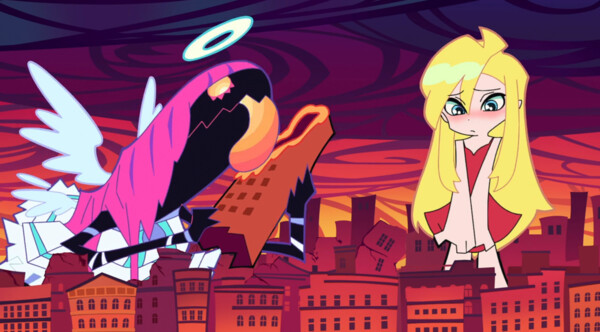
ANYWAY, we should also mention that the "Gainax Ending" used to be a whole thing understood by fandom at large, with its funniest example definitely being Panty & Stocking's original cliffhanger.
But more relevantly, the good ol' "Gainax Ending" sprung out of titles like the aforementioned Evangelion and Gunbuster, in which the finale takes some sort of wild last-minute swing that catches most audiences off guard... And also makes them wonder if the studio blew all their budget earlier on in production.
Personally, I think the takeaway from most "Gainax Endings" is that women can do anything.
After reviewing my notes, I concur. Women can do anything.
And that includes co-writing a column about controversial anime endings! This certainly hasn't been an exhaustive list (and I am consciously sparing our readers some of the rancor I could throw at, say, The Day I Became a God's rancid final episode). Still, overall, I think it tends to be a good sign when an ending sparks a variety of reactions. That usually means it has something to say. But I also believe the internet as it currently exists has been engineered to foster precisely the wrong kinds of reactions, so that part sucks. Maybe the ending we need most is the end of social media.
I will say, there is something truly special about dissociating to a potentially ill-fitting end credits sequence after watching an intensely distressing cliffhanger finale.
Please don't mention "ill-fitting end credits sequence;" I'm still traumatized by how you began this column.
A truly terrible ending we'll remember for generations to come.
Rebecca swims through anime and manga history to reach the depths of its mermaid fascination.― Hans Christian Andersen's 1837 literary fairy tale wasn't necessarily a natural fit for Japan. Japanese mermaids, as readers of Rumiko Takahashi know, are more likely to grant immortality if you consume their flesh than to fall in love with a human. But the strange metamorphosis of storytelling can always ...
What makes this final batch of episodes so strong is that almost everybody gets a moment to shine or a moment of introspection.― It's wild how far Pokémon Horizons has come. This final batch of episodes feels like the climax of this time skip and the entire Pokémon Horizons series. While some things are glossed over or could've received more focus, I genuinely believe this might be one of the strong...
More details to be revealed at Jump Festa '27 event on December 19-20― The "NARUTO: What's Next?" panel at New York Comic Con announced on Saturday that Masashi Kishimoto will launch a new manga in his Naruto franchise. The below video teases the title as Naruto Shadow Rising. More details will be revealed at the Jump Festa '27 event, which will take place on December 19-20.Kishimoto launched the Na...
Boruto, Ninku director Noriyuki Abe directs crossover series― The "NA RUTO: What's Next?" panel at New York Comic Con announced on Saturday more information about the new television anime "limited" series teased last month. The new anime is a crossover anime with Koji Kiriyama's Ninku ninja manga titled NARUTO×NINKŪ.The panel explained that Ninku inspired Masashi Kishimoto to create Naruto, and as t...
Yuzu seems passive, but she's really a survivor stumbling her way into the light.― The Cinderella fairy tale often draws knee-jerk reactions about passive heroines. Even some of her arguably more passive fairy tale sisters, like Snow White or Sleeping Beauty, are afforded more grace than the woman who rises from the ashes to become a princess. She's painted as the ultimate in passivity, a girl who w...
Based on story in 27th manga volume― The "Stone Fes. 2026" event announced on Saturday that production has been green-lit on Dr. Stone Terraforming, a sequel to the television anime of Riichirou Inagaki and Boichi's Dr. Stone manga. The new anime will adapt the "Terraforming" sequel story, set after the main story, from the 27th manga volume. The first television anime premiered in July 2019. Crunch...
Atsushi Nishigori’s three-part anthology film crams all his otaku obsessions into a feast of wild eye candy.― At the U.S. premiere of GROTESQQQUE at New York's Japan Society, director Atsushi Nishigori warned the audience it might be hard to connect the different segments of this anthology feature. The one overriding theme, he explained, is “things I like” — whether that's cute girls, monsters, mech...
Torneko's Mystery Dungeon is not a game that is a roguelike; it is a game that is like Rogue - and that distinction is more than mere semantics.― Dragon Quest Heroes: Torneko's Mystery Dungeon - Classic HD is a great classic game held back by curiosities surrounding its release. The facts of the matter are quite simple. This is a rerelease of the 1993 original, the first time it has been released in...
A major Fire Emblem anniversary and the release of Dead of Brain are among the big topics this week!― Welcome back, folks! I don't pay much attention to Star Wars, being that it's never really been my thing. But the outright adulation that's been going around for Star Wars: Galactic Racer has my attention. Apparently, ex-Burnout devs worked on the game, which in and of itself ought to be encourageme...
Joo spoke with Anime News Network about his debut, the influences behind his work, the Netflix adaptation, and his latest series, Adonai.― Dong-geun Joo, the creator of the popular webtoon All of Us Are Dead, visited Los Angeles to participate in an event at the Korean Culture Center Los Angeles celebrating Korean webtoons on September 11. Joo made his debut in 2009 with All of Us Are Dead, which w...
During our conversation, Kimura spoke about how he landed the role of Chihiro as well as his experience working with Tomokazu Seki, the voice actor for Kunishige Rokuhira.―
Prior to an incredibly enthusiastic, full-room world premiere of the Kagurabachi anime series, Taihi Kimura sat down with Anime News Network to talk about his role as Chihiro Rokuhira. Before Kimura landed his role as the black-...
The Preview Guide marches on with episode two of Apothecary Diaries season three. Jinshi, how we missed you. Check out our reviews of over 50 anime in the Fall 2026 Preview Guide. Sponsored by Crunchyroll.― Welcome to Anime News Network's Fall 2026 Anime Preview Guide! Here's how it works: our team of critics writes up their impressions instantly, and we post them here as they go. Each critic will ...
Series centers on prince who secretly hunts, eats monsters to avoid assassination― Anime studio WHITE FOX announced on Friday it is producing a television anime adaptation of Daken's How I Became King by Eating Monsters (Monster no Niku wo Kutteitara Ōi ni Tsuita Ken) light novel series. The anime will debut in 2027. Original novel illustrator Shiba and manga artist Karin Suzuragi both drew illustra...
― Thursday, October 8 News Dark Horse to Release Gou Tanabe's The Outsider and Other Early Adaptations Collection Macross Frontier Anime's Blu-ray Disc Ships in 2027 Gundam Seed Freedom Zero Prequel Anime's Trailer Reveals Theatrical Release in Japan on January 15, N. America in February 2027 Here U Are Anime Reveals 2nd Teaser Trailer The Guy She Was Interested In Wasn't A Guy at All Anime's 1st P...
Yoko Hikasa, Ryōhei Kimura, Tomoaki Maeno, Reina Ueda star in Alphatart, HereLee, SUMPUL's romantic fantasy― Crunchyroll announced at New York Comic Con on Thursday a television anime adaptation of HereLee and SUMPUL's webtoon The Remarried Empress. (The webtoon is itself based on Alphatart's original web novel.) TROYCA is animating the project for broadcast next year. The main cast members are: Yok...
New Japanese anime studio breccia, Korean animation studio Studio Jemi to animated series― Crunchyroll announced at its panel at New York Comic Con on Thursday that JH's The Boxer webtoon is getting a television anime adaptation from new Japanese anime studio breccia and Korean animation studio Studio Jemi. breccia is a new anime studio founded by Kinema Citrus founding member and producer Muneki Og...
It’s a clever, entertaining, optimistic show that deserves an audience.― During a season that boasted the long-awaited return of Magical Girl Lyrical Nanoha after an eleven-year absence from our screens, and with an unexpected revival of Magical Princess Minky Momo (after 32 years!) announced as an upcoming fall 2026 OVA, the second season of the delightful Magilumiere Magical Girls Inc. seems to ha...


 @RiderStrike
 @BWProwl
 @LucasDeRuyter
 @vestenet