

(5 questions; 35s to answer on average
Yes I'll do it later No
The Fall 2025 Manga Guide
Mushishi Collector's Edition
What's It About?
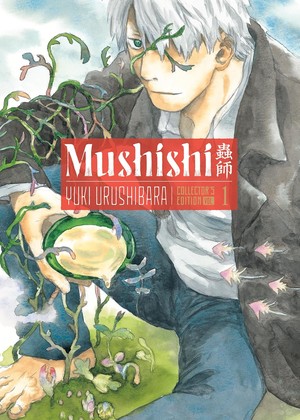
In this world, there are many creatures we interact with, but most of us cannot see them. We know of spirits and yokai, but living between worlds are also creatures that are called “mushi.” These creatures can affect humans, but only “Mushishi” can interact with them and remove them. Ginko is a mushishi who travels from place to place, helping the humans and places that are harmed, however inadvertently or malevolently, by these mushi
Mushishi Collector's Edition omnibus volume is written and illustrated by Yuki Urushibara. This volume is translated by Andres Oliver with lettering by Phil Christie. Published by Kodansha Comics (November 4, 2025). Rated T.
Is It Worth Reading?
Erica Friedman
Rating:

I'm a sucker for “melancholy loner travels through small villages righting wrongs and helping people” narratives, and I am equally a sucker for spirits and yokai stories. I'd certainly heard that Mushishi was good, but I enjoyed the heck out of this volume.
Ginko arrives on the scene without much depth to his character—all our time and attention is on the mushi and the people they affect. By the end of the volume, we still know little about Ginko, but each mushi is crafted with detailed care, giving us all sorts of things to be frightened of that we never worried about before. I'm torn about wanting to learn more about Ginko and wanting to learn nothing about him. Would that make the story better, or would it distract from the mushi, who are the real stars? I guess I'll find out if I read Volume 2.
Overwhelmingly, we want Ginko to help the people he helps, so it's a dopamine hit of “people getting the day they deserve” as well. But what really sold me was the art. Urushibara's vision for the mushi and the interstitial world they inhabit just blew me away.
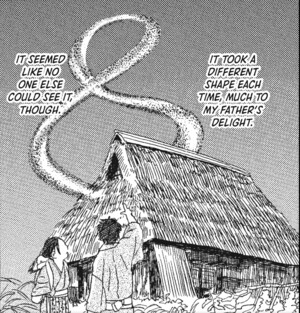
The one panel I chose represents all the living things on a mountain, in motion, in the act of “living,” actually took my breath away. It was such a profound look at all the things at once that make up ”life” that it was possible to step back and really begin to understand the space in which the mushi exist.
Read this! This is a perfect book to curl up with on a cool autumn night, if (you're in the Northern Hemisphere), and contemplate the melancholy, the fleeting quality of human existence, the different scales in life span for insects, animals, humans, and the great and small spirit creatures that exist side by side with us.
Caitlin Moore
Rating:
As I read through the new collector's edition of Mushishi, a strange thing happened to me: music started playing in my head. Could it have been the presence of a mushi in my living room? Or perhaps it was that Mushishi has been a series I've treasured for 20 years now, since it first aired? Either way, phantoms of the soft strums of Ally Kerr's “Sore Feet Song” would echo in my heart with every page.
Suffice it to say, Mushishi is not a new series to me. I've either read them or seen the anime version of the tales in this volume many times over, and it's always a pleasure to revisit them. It has, however, been out of print and prohibitively expensive on the second-hand market for a long time, so this new edition is a welcome invitation to any potential new readers to dive into Yuki Urushibara's mystical version of Japan. It is, for the most part, an anthology series about mushi, mysterious lifeforms with strange powers that are something like a manifestation of pure life force. Tying it all together is Ginko, a wandering mushi-shi who finds people affected by mushi and uses his expertise to resolve the strange ailments that mushi cause.
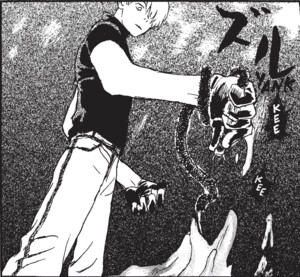
It takes some time for Urushibara to find her voice in this format; in the included author's notes, she mentions that the first story she wrote for it was based on a whim, and she struggled to find a home for her ideas. Her pen-and-ink art, every stroke of the pen visible in the hand-crosshatched panels, stands out in the modern era of digital production, but things do look a bit strange at first; Ginko has a weirdly scrawny, almost adolescent appearance, and the proportions are often off. However, as the volume goes on, the art comes to life. This edition includes color pages, and it's wonderful to finally see their soft watercolors available in English.
Above all else, these stories aren't just about the mushi, but the people affected by them. There's a profound respect for the struggle to find balance between living alongside nature and the dangers found therein; people who encounter mushi rarely come out the other side unscathed. That humanism – of Ginko not just hunting mushi, but of connecting to others – is what makes Mushishi so wonderful and has helped it capture the imaginations of fans for decades.
Kevin Cormack
Rating:
While I've always meant to get around to it, I admit I've never before read the manga, nor watched the anime of this well-regarded supernatural fantasy series. It doesn't help that Crunchyroll no longer streams 2005's first anime season, and in the UK at least, the DVDs are so out of print that even secondhand copies are nigh-on unobtainable. Del Rey's physical edition of the 10-volume manga series is also long out of print, so it's very welcome that Kodansha has opted to bring the series back in these new omnibus editions.
Mushishi is an anthology series at heart, with each chapter focusing on a different group of characters and a different “mushi”. The only common elements are the mushi themselves (primordial lifeforms that are neither animal nor plant, that are imperceptible to most people) and Ginko, a travelling “Mushishi”, or “mushi expert”. Structured a lot like Kino's Journey, with themes and creatures similar to GeGeGe no Kitarō, Ginko travels from place to place with no obvious set itinerary, and helps people whose lives have been affected by mushi.
It's a manga that requires the reader to be in a certain mood to truly appreciate. I admit I initially struggled to mesh with the episodic story, its measured pace, lack of overt action, and relaxing vibe. That was probably a “me” problem, as once I found an hour or two to set aside, relaxed and unhurried, I found this a very pleasant, even entertaining read.
Some of the later chapters are especially interesting, with stories featuring a remote island village under the thrall of a flower-like mushi, a man obsessed with finding an elusive rainbow-like mushi, and the final story about a creepy fungus-like mushi that produces human child-like clones is extremely creepy.
The art is detailed and organic in style, deeply evocative of a timeless era, where people lived in smaller settlements in closer communion with the natural world. Author Yuki Urushibara sets it in a fictional time between the Meiji and Edo periods, in a Japan free from foreign influence, and this no doubt adds to the pastoral, even slightly melancholy atmosphere. Definitely recommended for readers who enjoy taking their time with a manga that transports them to a different world with mysterious creatures and esoteric rules. I'd certainly like to return there in later volumes.
The views and opinions expressed in this article are solely those of the author(s) and do not necessarily represent the views of Anime News Network, its employees, owners, or sponsors.
discuss this in the forum (22 posts) |

back to The Fall 2025 Manga Guide
Seasonal homepage / archives