Do you have time to answer a really short survey for us ?
(5 questions;
34s to answer on average
YesI'll do it laterNo
This Week in Anime
PLUTO is a Masterclass in Anime Reimaginings
by Christopher Farris & Steve Jones,
Chris and Steve dive into Naoki Urasawa and Studio M2's Pluto anime and discuss why "aging up" a property intended for children can be a perfect sandbox for broader commentary.
Disclaimer:The views and opinions expressed by the participants in this chatlog are not the views of Anime News Network. Spoiler Warning for discussion of the series ahead.
Chris
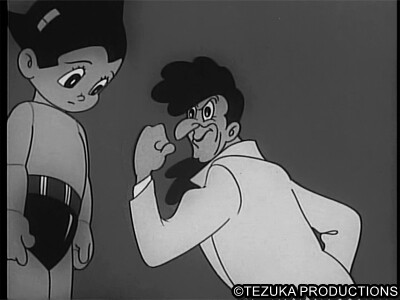
Steve, we've got a two-for-one deal on storied anime adaptations this week. Not only has Netflix graced us with yet another take on Osamu Tezuka's esteemed oeuvre, but this is also a new anime adaptation of a manga by the notoriously nuanced Naoki Urasawa.
It may not be a cold day in hell, but it's at least a momentous one in the unique underworld of PLUTO.
Steve
While Urasawa is known for his winding and layered tales of intrigue, I'm glad we finally solved the mystery of where all the anime noses went. They're here. They've been saving them up for this show.
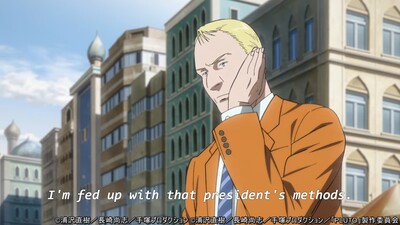
Truly, nothing embodies the "anime for grown-ups" vibe of a Urasawa joint quite like an absence of the ol' dot-noses. Then again, that might not all be down to Urasawa's preferences. He's taking on Tezuka here, who had a predilection for prominent proboscises. Even Urasawa's take on Dr. Tenma has rounded things off considerably.
Sidebar: I am only just now realizing that when broadly discussing Urasawa's works, I might need to specify which Dr. Tenma I am talking about.
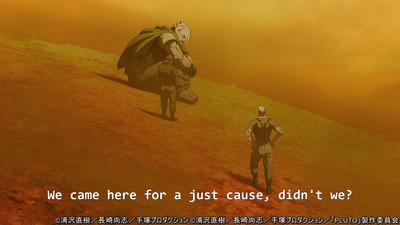
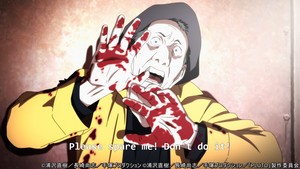
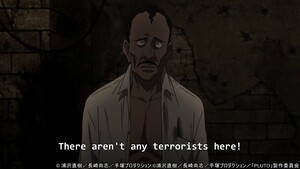
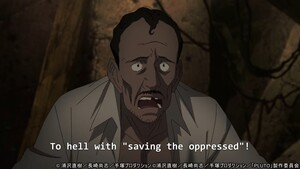
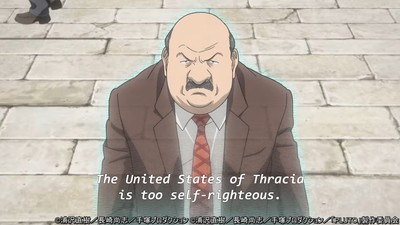
PLUTO, Urasawa's ambitious and acclaimed retelling of one specific arc from the classic Astro Boy, has finally gotten a glossy, prestige animated adaptation for all to enjoy. It's a hefty collection of eight hour-long episodes, and its subject matter covers everything from robot rights to the United States' bloody pattern of interference in Middle Eastern political affairs. You know, light material that has absolutely no bearing on any current events.
Speaking as a child of the post-9/11 era, the War on Terror, and the invasion of Iraq, I found myself periodically taken aback by PLUTO's directness. I hadn't read the manga myself, so I got freshly affected by this anime version by just how blunt its allegory was. I don't know that I'd fault anyone who turned it off because they were hoping for a bit more of an escape in their Astro Boy spin-off.
The American equivalent would be like tuning into a Mickey Mouse cartoon and seeing the visage of Saddam Hussein. I respect it.
That would be the ideal place to bring up Disney's WW2-era propaganda cartoons where Donald Duck hashed it out with Hitler, but that leads to a key point about PLUTO: It's not exactly a new idea. Taking a beloved pillar of classic comic/cartoon history and transforming it into a vector for a serious approach has a fair amount of precedent in the art form. Granted, it can't always be as nuanced as PLUTO, so you just as often wind up with stuff like SYFY making The Banana Splits into a slasher flick or that hackneyed new attempt to turn the freshly public-domain Winnie the Pooh into a horror movie.
Yeah, I think it's important to lead with PLUTO being a unique (and uniquely good) take on this pattern—for reasons we'll get into—but as mass media becomes increasingly recursive, we're seeing a lot of this approach. Hell, the "gritty retelling told from the perspective of a villain who is also the title of the work" is a genre unto itself now with films like Cruella and Maleficent. PLUTO was ahead of the curve in 2003!
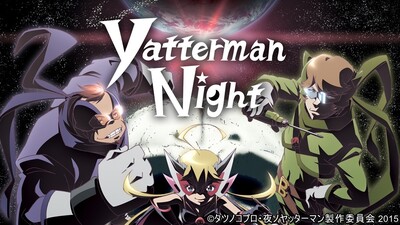
That concept seems to shake out better in our familiar anime and manga sphere here, even if they aren't as common. 2015 brought us Yatterman Night, an interesting experiment that rebooted the Time Bokan franchise's progenitor (alongside several other Tatsunoko series) from the perspective of the villains, AKA the main thing most people fondly recalled from Yatterman.
And hell, this very season has blessed us with Power of Hope: Precure Full Bloom, which sees the childhood heroes of previous Pretty Cures all grown up and grabbing beers after work together to cope with the anxieties of adulthood.
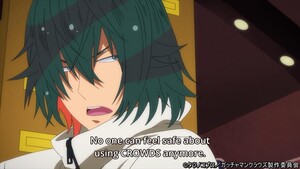
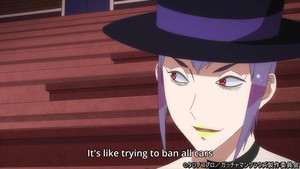
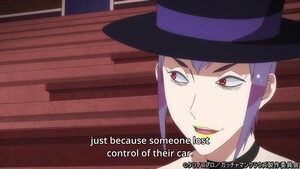
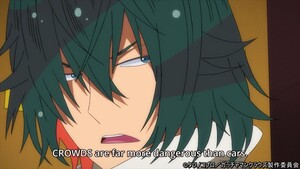
Now that there is some actual "adult" anime. And I think much of my frustration with many (mainly Western) examples of X, But For Grown Ups! is their limited perspective on what an "adult" TV show or film should be. What does it mean for a story to be "darker," and why should that in itself be an indicator of advanced maturity? There's so much more nuance to it. Like another Tatsunoko reboot, Gatchaman Crowds is bright, colorful, goofy, and full of complex musings on the state of society and social media.
Gatchaman Crowds (which just turned ten this year, jeez, speaking of aging) swings close to what PLUTO is doing. No, it's not repeating or recreating many characters from the original the way Urasawa's Astro Boy take-off is. But Crowds uses the framework of the classic Gatchaman and what a "Science Ninja Team" can be to comment on (then) relevant modern social issues. Often in the same ripped-from-the-headlines way as PLUTO.
And often with the same degree of subtlety.
All art is, to some extent, an extension of the political climate in which it was created, and that is true for children's cartoons as much as anything else. So, I love to see a vision homing in on that aspect and using "low" art as a megaphone for pointed, unsubtle commentary. In fact, generally speaking, what I want out of any piece of art is vision and direction from people with something to say. That's going to be true no matter what decade it originates from.
That's another aspect to elucidate on. It would feel a little disingenuous to act like Urasawa's PLUTO was only using Astro Boy as a convenient template. Osamu Tezuka's works, Astro Boy included, had their density, darkness, and capacity for commentary. Many unsuspecting kids were scarred by Unico. Plenty of the God of Manga's output includes ideas about robots as reflections of humanity and its capacities, like Metropolis.
One of the go-to examples is how, for years (and maybe to this day), people would claim that Evangelion legitimized the mecha genre and made it serious. Anyone who watches the original Mobile Suit Gundam will find a lot of poignant ruminations on war (between all of the Tomino-isms). Likewise, I'm sure anyone going further back to Astro Boy will find that Tezuka had things to say. He was an artist! And a hell of an influential one at that. Of course, other artists like Urasawa will pick up on what he was doing and respond to it with their art.
Keeping with the robot boy theme, one of my favorite anime series is the incredibly moody Casshern Sins, Shigeyasu Yamauchi's post-apocalyptic meditation on death and ruin. I've never watched the original Casshern, and I doubt it is quite as oppressively melancholic, but I'm sure the seeds were there.
Tatsunoko's an oddly consistent source of this sort of thing, aren't they? It's a testament to the lasting influence of archetypical entries like Gatchaman and Casshern that they're so ripe for reinterpretation. I don't know that PLUTO ever hits the same levels of esotericism that Sins winds up playing in, but it's impossible not to see the parallels, concept-wise.
It's an approach that can be applied to "classic" anime series, even if they weren't necessarily pitched to younger audiences. Gō Nagai's Devilman delved so profoundly into darkness by its finish that it famously never had its original ending wholly adapted until 2018's DEVILMAN crybaby. But even within that context, Masaaki Yuasa's take on the material still comes off as a radical, personal reinvention by the artists behind it striving to say things about the society the story occupied in its moment.
The key is strong, creative voices who bring their perspectives to the material in question. Kenji Nakamura, Masaaki Yuasa, Shigeyasu Yamauchi—these are some of the finest directors and storyboarders in the business, and the results make it obvious. They took on these projects because they were passionate about them. Likewise, PLUTO works for me because it aligns with Urasawa's other works. The man loves to craft a complicated slow-burn mystery thriller, and he's not going to let Astro Boy's setting stop him.
That leads me to PLUTO's one entertaining quirk. It would be entirely possible for some unsuspecting viewer to click onto this cool-looking new Netflix show and make it up to at least the end of the first episode, not even realizing they were watching an Astro Boy riff. It's presented as a customarily tight Urasawa thriller and 100% works on its own terms.
That might be down to opting to use the original Japanese names for the characters, regardless of release territory. It is cool but also a little disappointing that we didn't get to hear meditations on war crimes and the capacity for human hatred coming out of people with names like "Dr. Packidermus J. Elefun."
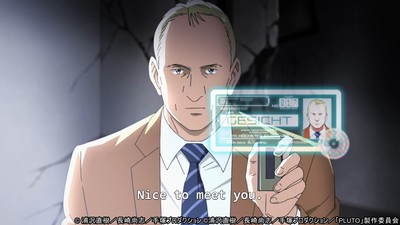
Alas. That is also how the manga's first volume is structured, with Atom only appearing in its final pages. Centering the story around Inspector Gadget—sorry, I mean Inspector Gesicht makes more sense for Urasawa's hard-boiled storytelling. It also signals his intention to make the story his while working in tandem with Tezuka's legacy. It was a balancing act so stressful he went on to say he'd never do anything like it ever again, but he certainly pulls it off with aplomb here. The breadcrumb trail of weird murders, strange visions, eccentric characters, and international conspiracy is Urasawa through and through.
I can't blame Urasawa for his delicate feelings on approaching the source material, given its storied status. That aspect, as well as the structure of the original manga's volumes, also speaks to the subject of adaptation as applied to PLUTO itself. At eight hour-long episodes, Netflix's PLUTO would seem to roughly correspond to the respective manga volumes, and that extra-length format feeds into the prestige thriller vibes the work is shooting for.
Yeah, it's funny there are multiple layers of "REAL anime for REAL adults" going on here. Not only do we have PLUTO as a story, but the adaptation also conforms to the style of series most people wouldn't be embarrassed to recommend to their mom. Mostly, it prioritizes realism and naturalism over-exaggeration, with highly detailed faces and cinematic camera effects. It fits the tone, don't get me wrong, but you can tell it's aiming for a much broader swathe of the audience than anime regulars alone. And, arguably, it should!
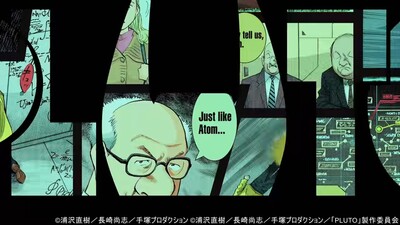
I have seen some commentators out there begrudged that PLUTO's visuals are played so grounded and straight. But I'm on your team that it fits the tone and intent of the story to a T. It's not necessarily surprising given how infamously particular Urasawa can be about the presentation of his work. This is a guy who didn't even let his manga be published digitally until recently. So, in that respect, it makes sense the anime version would hew so close to the manga panels. It straight-up reproduced a bunch of them for its opening sequence.
It's only a little ironic that a work that is itself a radical adaptation of Astro Boy gets an adaptation that's more transpositional than transformative.
Urasawa writes crowdpleasers. He's a very successful mangaka, and he can spin a page-turner like nobody's business, so I'm fine with straightforward adaptations of his material that maximize its reach. That makes it difficult for me to be too critical about its placement on Netflix. Since, again, it has that crossover appeal potential.
Even with the wilder robot designs or several setpieces involving characters fighting a giant tornado, I honestly can't disagree with continuing to play this one in Urasawa's carefully calculated clinical style. It means that for a story that's pointedly 75% talking heads having discussions as this kind of plot is wont to be, it never falls into the bloated feeling of more disposable Netflix fare. By the end of its run, I honestly felt PLUTO had earned its eight-hour movie status.
Also, just because its style trends towards "grounded" doesn't mean that PLUTO can't throw out a striking scene or two when it wants to. Netflix's bitrate be damned.
Oh, definitely. And I also wouldn't want to conflate Urasawa's popularity with a lack of ambition. PLUTO goes straight for the throat of its targets, and it's a nice reminder that, even back in the early days of the Iraq War, plenty of people recognized its fundamental absurdity and cruelty—qualities that have been echoed many times prior and many times since.
Twenty years removed from its inception, this turns an adaptation of PLUTO from a current events commentary into something even more steeped in cultural history than those Tatsunoko shows. It can be easy for commentators in These Modern Times to muse on the Iraq War and question the level of opposition to it at the time. PLUTO's story, originally started in 2003, shows how people in all parts of the world were already considering the invasion. Adapting it in 2023 lets them hammer home how right they were in those fears.
A huge lynchpin in the narrative is an inquiry into "robots of mass destruction" that turns up nothing yet spurs the war nonetheless. It's that blatant.
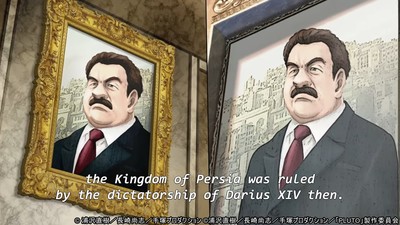
It speaks to the value and opportunities of an offshoot like PLUTO. The original "The Greatest Robot on Earth" storyline from Tezuka's Astro Boy featured a deposed Middle Eastern dictator as the directing force of the PLUTO robot. Urasawa took the opportunity to flesh that aspect out as a vector for his commentary on the then-current situation. It's in the same vein as Gatchaman Crowds's treatises on technology and social media in how it uses elements of the original to illustrate how those can still be used to explore ideas in the modern day.
Put another way: Urasawa could have commented on the Iraq War in a wholly original story. But it adds another layer to its salience to illustrate how its relevance can be reflected in the themes of something as foundational as Astro Boy.
There's always that cynical impulse to assume any reboot, far-removed sequel, or reimagining is a cash grab preying on audiences' desire to be fed familiarity over and over. And there's plenty of that to go around, don't get me wrong. But the history of art is also the history of stories being retold, paintings being repainted, and music being reinterpreted. Novelty is not in itself a virtue. It's all about how one wields their influence. To me, PLUTO's boldness justifies the loftiness of its reach, and its many payoffs remain true to that vision even if it also has a few requisite Urasawa plot threads that don't go anywhere.
It's pretty cool how this anime can feel so quintessentially Urasawa, even as he's right in the middle of the adaptation sandwich that is its existence. But the strength of that voice is, as you mentioned, key to this sort of reinvention working at all. Separate from its prestige as a Urasawa manga adaptation or its "Astro Boy For Adults" high-concept pitch, PLUTO can stand as a story on its own. That's way beyond something where the joke doesn't land if you don't know who the hell The Banana Splits are.
It's great! It's not the first of its kind, nor the last, but in a perfect world, PLUTO could be a guidepost for other artists struggling to make their voices pierce through their influences. And if nothing else, it's a masterclass on how Urasawa translated the original Atom's two-pronged hairstyle into something a person could conceivably wear on his head.
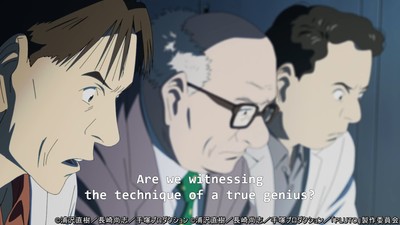
Forget any deftly applied layers of adaptational allegory; That's how you know the man is a true genius.
Follow this page for live updates directly from Anime Expo 2026.―
Where is Anime News Network at Anime Expo 2026? Thursday, July 2 News Exclusive: Square Enix Manga & Books Reveals 8 Manga, 2 Final Fantasy Book Releases Sekai Project to Release Jewelry Hearts Academia Visual Novel in West Mashle: Magic and Muscles Season 3 Anime's Trailer Unveils January 2027 Debut Manga Mavericks Licenses Motionle...
Announced after episode 14 on Friday― The 14th episode from the television anime of Kōcha Agasawa's The Ramparts of Ice (Koori no Jyōheki or Ice Castle Wall) manga ended on Friday with an announcement that the second season will premiere on October 1. The new season will again air on Thursdays at 11:56 p.m. (10:56 a.m. EDT) on TBS and 27 affiliated channels. The manga centers on Koyuki Hikawa, an al...
Author Jonathan Clements takes us on an entertaining, in-depth tour through anime movie history.― Japan's Anime Revolution! is a very good book by Jonathan Clements, one of the most respected English-language authorities on anime. It's worth saying that right off, as this book is saddled with an issue that might deter readers from picking it up in the first place. The cover, by all appearances, is A...
Step right up, step right up! Lucas and Coop explore the phenomenon that is The Amazing Digital Circus.― Step right up, step right up! Lucas and Coop explore the phenomenon that is The Amazing Digital Circus. @RiderStrike @BWProwl @LucasDeRuyter @vestenet Lucas Coop, the mandate of heaven is shifting! While much of the entertainment landscape has catered to Baby Boomers and Gen Xers over the past h...
Come see us at our panels, events and booth. Full schedule inside.―
Where is Anime News Network at Anime Expo 2026? Thursday, July 2 News Exclusive: Square Enix Manga & Books Reveals 8 Manga, 2 Final Fantasy Book Releases Sekai Project to Release Jewelry Hearts Academia Visual Novel in West Mashle: Magic and Muscles Season 3 Anime's Trailer Unveils January 2027 Debut Manga Mavericks Licenses Motion...
The cost of winning the video game was the player's time; in Sekiro: No Defeat winning comes with a more pronounced psychological burden.― Rhythm is arguably the most important thing about the video game Sekiro: Shadows Die Twice. In the 2019 action game from the acclaimed From Software studios, each fight is decided by how well the player can adjust to the right timing of parrying and striking. Eit...
Although it’s a bright and breezy magical girl manga with an adorable cast and plenty of fun, flashy battles, at its heart, Magilumiere Magical Girls Inc. is a pointed criticism of dehumanizing mega-corporate culture.― The dispiriting search for meaningful (or even merely paid) work is a depressing experience common to almost every twenty-something college graduate. Today's job market chews up and s...
Physical discs end production in January 2028; PS Store closes on PS3/PS Vita― Sony announced on Thursday that it is ending physical game disc production for all new games on PlayStation consoles starting in January 2028. All new game releases starting in that month will be digital only. This does not affect games that have already been released or that will ship prior to January 2028 as discs. The ...
Are you a fan of video games? What about the classic experience of visiting your local arcade, and playing a few rounds of the new game with your friends? Well, Taito is here to provide that experience at Anime Expo!― Are you a fan of video games? What about the classic video game experience of visiting your local arcade, chilling out with your friends and playing a few rounds at the new game cabin...
The Anime News Network anime preview guide launches 10 new shows you won't want to miss, from The World is Dancing to Young Ladies Can't Play Fighting Games!― Welcome to Anime News Network's Summer 2026 Anime Preview Guide! Here's how it goes: our team of critics writes up their impressions instantly, to be posted here as they go along. Each critic will cover as many shows as they can handle, givin...
Ikumi Hasegawa, Ayumu Murase star in FelixFilm anime― Kadokawa announced on Wednesday the television anime adaptation of Hidenori Yamaji's Soara and the House of Monsters (Soara to Mamono no Ie, the anime uses the English title Soara and Monster's House) manga, and revealed the anime's ultra teaser promotional video, ultra teaser visual, main cast and staff members, and its 2027 premiere. Yamaji als...
2nd season announced at final episode of 1st season on Wednesday― The final episode of the television anime for Jōmyaku and artist Mizuki Yoda's Marriage Toxin manga revealed on Wednesday that the anime will have a second season that will debut in 2027. The staff began streaming an announcement promotional video: The anime debuted on April 7. The anime aired on Tuesdays on Kansai TV and Fuji TV's n...
If you've already played Devil May Cry 5 Special Edition before, you won't experience anything new here. But if it's your first time on this rodeo or you want to take the game on the go, hop in and enjoy the ride.―
It's been a few years since the release of one of the best character action games in the past decade, Devil May Cry 5, and now it's finally here on Nintendo Switch 2 in the Devil Hunter ...
There's just something about a woman who could squish you. Sylvia and Chris run down (up?) some of the giantesses of anime.― There's just something about a woman who could squish you. Sylvia and Chris run down (up?) some of the giantesses of anime. Disclaimer: The views and opinions expressed by the participants in this chatlog are not the views of Anime News Network.Spoiler Warning for discussion ...
This is definitely a game that you're going to want to add to your upcoming wishlist.― Splatoon has always been a unique game franchise built upon its multiplayer content. So what happens when Nintendo decides to pivot and focus on creating a game that centers around a single player campaign? The result is Splatoon Raiders, a third person platforming shooter with a focus on exploration and treasure ...
Gundam Build Fighters Try's Shinya Watada directs anime at CyberAgent's CA Soa studio― CyberAgent announced on Tuesday that its CA Soa anime studio is producing a television anime adaptation of Mozuku Sora and Higoro Tōmori's The Bugle Call: Song of War (Sensō Kyōshitsu) manga that will premiere in 2027. CyberAgent unveiled a teaser trailer and visual for the anime. Shinya Watada (Rock is a Lady's M...
Star Trek: Picard's Christopher Monfette serves as executive producer, showrunner, writer― Entertainment industry news outlet Variety reported on Monday that Netflix is developing a live-action series based on the Persona video game series from Atlus. Although Variety noted that each main game in the franchise has its own story setting, its report did not specify if the planned adaptation is based ...
I welcome any high-budget, high-production value, mostly linear experience with a clear story to tell that clocks out right on time.― Pragmata is a game that, despite my best efforts and the quality on offer, I never could get into the groove with. Nonetheless, it's a beautiful game that makes a lot of noble attempts at novel design. First, the priors. Pragmata is a third-person action game with som...
Crunchyroll will stream 2nd season― The staff for the television anime of Kamome Shirahama's Witch Hat Atelier manga announced on Monday that the series is getting a second season. Crunchyroll revealed that it will stream the second season. The staff unveiled an endcard image: The manga's story centers on Coco, a girl who lives in a little village, and who has always dreamed of becoming a wizard. Bu...
The celebration of Sonic's birthday continues as Josh looks at the blue blur's mobile offerings!― Greetings, and welcome once again to the column! I've spent much of my mobile game-playing time catching up with Fate/Grand Order's Cosmos in the Lostbelt storyline, specifically clearing the Lostbelt No. 7, Nahui Mictlan chapter, as beating it and the subsequent opening stage of the Ordeal Call campaig...
It's going to be a hot summer and an even hotter anime line-up this season.― It's going to be a hot summer and an even hotter anime line-up this season. For us "oldtaku," there's no doubt that Science SARU's The Ghost in the Shell is one to watch. Surprisingly, the studio is also premiering the Mongolia-set historical epic Jaadugar: A Witch's Life in Mongolia in the same season with the illustrious...


 @Lossthief
 @BeeDubsProwl
 @NickyEnchilada
 @vestenet