

Summer 2026 Manga Guide After Dark (18+)
The Crow's Ballad at Dawn
What's It About?

“You paid for me, so touch me however you please...” Office worker Akito is taken away by a tofu boy yokai and steps foot into red-light district exclusive to yokai! There he meets the beautiful male prostitue, Suiren―a tan, black-haired tengu. A story of pure love between a male prostitute and a customer unfurls on the stage of a dazzlingly luxurious red-light district!
The Crow's Ballad at Dawn has a story by and art by Sakuhiro. English translation is done by Leighann Harvey and lettering by Byong Je Chun. Published by Yen Press (July 28, 2026). Rated M.
Is It Worth Reading?
Rebecca Silverman
Rating:

I have spent fifteen minutes staring at my screen telling myself that I have to come up with a better reason to have enjoyed The Crow's Ballad at Dawn than “it's more consensual than most of the other 18+ BL manga I've read for the guide so far.” While I'm not going to deny that that is, in fact, the case, it's also a pretty decent book on its own merits. Set primarily on a yokai brothel ship, the story follows Suiren, a karasu tengu (or crow tengu as the book puts it) and Akito, a human who finds his way to the boat with a little help from Suiren's attendant, Tofu Boy. (Yokai afficionados will recognize that as another specific yokai type.) Both men are unhappy with the way their lives have turned out, but together, they manage to find their way to something better.
It's honestly very sweet in a lot of ways. Akito has spent his life being punished for being the kind of guy who steps up when he sees someone being picked on – not because he's a “nice guy,” but because he can't quite tell the difference between someone who genuinely needs help and someone who needs to learn a lesson about getting themselves into a mess. Suiren is a combination of both: he's not happy with his life in the brothel even though he basically got himself into it, but he's also not doing much to help himself. Years as a sex worker have made him jaded, so at first he doesn't believe that Akito cares – or likes him for more than his body. There's a substantial building of trust that needs to happen, with both of them, and that's where the thrust of the narrative is.
The art is a major draw here. Sakuhiro's art is delicate and intricate, and Suiren's outfits and tattoos are exquisite. It's clear that a lot of thought went into how Suiren's wings would work – he has to shrink them to fit into buildings and make them vanish when he's in the human world. As you might expect, there are a fair amount of sex scenes of moderate explicitness, but what's nice (and interesting, given the setting) is that nothing happens until Akito is emotionally engaged: he refuses to treat Suiren like a sex worker as a measure of the respect he has for him. While this may read as a denigration of sex work, it's meant to show that Akito sees Suiren for himself rather than his profession, and Suiren does carry on with his work with other people for most of the book. (So if a romantic interest sleeping with someone else is a dealbreaker for you in a romance, this won't be the book for you.)
The Crow's Ballad at Dawn is, at its core, a very nice story. That sounds far too bland a description, but it's true: Akito and Suiren are people who have struggled and find love and respite with each other. And mild as “nice” sounds as a descriptor, that's just what this is – in a very non-bland, unmild way.
Erica Friedman
Rating:
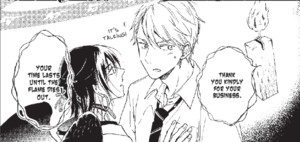
It is well known that when one finds oneself in the realm of the “other,” the rule is not to partake of food. In The Crow's Ballad at Dawn, Volume 1, we are introduced to the idea that it's not just food that is an irresistible temptation but also love.
Akito is a good person, which makes him not a great fit at his company. When he saves a yokai and is invited to a yokai brothel, he finds that it makes him a bad client, as well. His desire to see Suiren freed of his bond and to simply see – and touch—Suiren fills his mind. Akito, never a man to obsess over a woman or a man, finds himself unable to think of anything else but this lovely tengu.
This was a pretty sweet story. Balanced finely between the strict worlds of yokai existence and prostitution, Suiren's case is full of pathos, without being full of despair. Akito is clearly the man who can free Suiren, and questions of eternity can be answered later, eventually.
The art is nice, if predictable. Even as a man, Suiren is feminine and sexualized, while Akito is very much an everyman, allowing any audience to appreciate him. Of course, there is a gap in experience, lifespan, and worldly existence, but Suiren walking through the banalities of modern life as a tourist helps us appreciate things like arcades and convenience stores all over again.
Of course, we hope there will be a happy ending, and even more, we hope that the story doesn't delve too deeply into the mechanism of that ending. Thankfully, it does not.
After many volumes of stories about Yokai sans merci, it was pleasant to read a series about a Yokai brothel that didn't rely on melancholy and loss for an ending.
Disclosure: Kadokawa World Entertainment (KWE), a wholly owned subsidiary of Kadokawa Corporation, is the majority owner of Anime News Network, LLC. Yen Press, BookWalker Global, and J-Novel Club are subsidiaries of KWE.
The views and opinions expressed in this article are solely those of the author(s) and do not necessarily represent the views of Anime News Network, its employees, owners, or sponsors.
discuss this in the forum |

back to Summer 2026 Manga Guide After Dark (18+)
Seasonal homepage / archives