

The Summer 2026 Anime Preview Guide
Love Unseen Beneath the Clear Night Sky
How would you rate episode 1 of
Love Unseen Beneath the Clear Night Sky ?
Community score: 3.4
What is this?
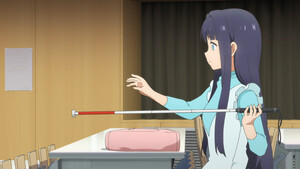
One spring night, Kakeru Sorano, a university freshman, is dragged by his dormmate Narumi to a welcome party. There, he meets Koharu Fuyutsuki, a blind girl who laughs often and speaks of her dreams; she's practically the polar opposite of him. From the moment he picks up her white cane after class, the distance between them begins to shrink. "I want to see fireworks," she says one day. Those words carry a light that Kakeru gazes at directly for the first time. A girl who cannot see and a boy who has shut himself off—this is a delicate love story woven by two people searching for light.
Love Unseen Beneath the Clear Night Sky is based on the light novel series by author Nanigashi Shima and illustrator raemz. The anime series is streaming on Crunchyroll on Mondays.
How was the first episode?

Rating:
This show has its heart in the right place. It wants to be a story about a young man learning that disabled people aren't disadvantaged and miserable, and that's not a terrible message. What I don't love is how it's going about this. Koharu, who is blind, is awfully close to being the sort of character who exists simply to teach Sorano, and viewers who identify with Sorano, a lesson about life. The opening scene even implies that she's going to die at some point in the story, further cementing the likelihood of her playing that part. It leaves a bad taste in my mouth and makes the plot feel unnecessarily ableist, and I really don't love that. Disabled people are not your training tool.
Part of this unpleasant sensation comes down to the way Koharu is introduced. She and her “student guide” Yuko attend a college party, and Sorano and his roommate Narumi instantly wonder why she's there if she can't see. Later, Yuko infodumps on Sorano about the student guide program, where an able-bodied student is assigned to help a disabled one. (I have taught blind students in a university setting. This is not a thing at the schools I teach for, though of course that doesn't mean it doesn't exist anywhere.) She talks about how you're not supposed to help someone unless they ask for it before cheerily saying that she does it anyway, then she pushes Sorano into being Koharu's student guide in a class they share. It feels important that at no point does Koharu ask for Sorano to do so, nor does she ever ask for his help during their subsequent encounters. This further solidifies the feeling that she's there less as a character in her own right and more as a person-shaped teaching tool.
That's not to say that this is wholly awful. It's true that you shouldn't block tactile paving, especially by leaving your bike in the middle of it. Sorano picking up things Koharu dropped, like her cane, isn't a terrible thing, although again, she didn't ask for help. And showing her typing on a braille device is actually a good moment, because it drives home to Sorano, at least in part, that she's not helpless. So again, this episode's heart is in the right place; it's just most of the execution that's an issue.
As Sorano gets to know Koharu better, there's a chance that the story will even out, leaving behind some of its more ableist elements as he clears them from his personal lexicon as well. I'm not sure it deserves that chance, but maybe I'm overreacting based on my experiences. In any event, this is a pastel episode down to its toes – the art, the music, and the plot are all painted in pale, gentle shades, and it's up to you whether or not that's a good thing.

Rating:
I feel like the recent upswing in disability representation that we've seen in recent anime and manga projects is its own kind of double-edged sword. On the one hand, it is an unambiguously good thing that authors and readers alike are more interested in exploring the experiences and livelihoods of people whose perspective on the world is so fundamentally different and underserved by so much of society. Putting more empathy into the collective consciousness of humanity is more important now than ever. That said, the downside of crafting a premise that specifically revolves around characters with disabilities is that you run the risk of creating a maudlin soapbox of a story that ends up defining those characters by what they lack compared to “normal” people. This isn't just a reductive and occasionally harmful way to characterize folks who are just trying to live their lives like everyone else; it makes for worse storytelling, plain and simple.
Love Unseen Beneath a Clear Night Sky clearly means very well, but its first episode does suffer from feeling a bit more like a PSA aimed at everyday folks who've never even met someone with vision impairment versus a fully-formed story about two compelling characters building a relationship. It's the sort of show that has Koharu, the blind woman that our protagonist Kakeru meets at a college singles mixer, mostly standing off to the side while other characters talk about and around her. Koharu's friend helpfully points out all of the rude reactions and social iniquities that Koharu has had to deal with, but Koharu just smiles vaguely and walks silently ahead. Kakeru mumbles and muses about the things he's never even considered about losing (or being born without) one's vision, but it's mostly delivered in the form of narration that exists for the audience's sake.
How much better of an introduction to these characters the story would be if Koharu was explaining her experiences in her own words, and then Kakeru was given the chance to respond in dialogue. You know, that famous literary tool that allows characters to bond and form a relationship that audiences can invest in? The premiere does eventually get to the point where this is happening, with Koharu explaining things like her daily routines and tricks like finding the right vending machines with button placements she can rely on, but the somewhat condescending tone of those opening ten minutes hangs over the rest of the episode like a fog.
To be clear, I don't think this is a bad anime, and there's every chance that future episodes will do a better job of warming us up to the main couple of this romance now that we've gotten past the “See! It's about a Blind Girl! Did You Even Know People Could Be Blind? Well Let Me Tell You What All of This Research I've Done Has Shown Me!” phase of the introduction. All I want is for Koharu to feel more like a complete person who was born into her world just like any other character, and not some arbitrary Disability Avatar that is to be used as a tool for the further education of “normal” people.

Rating:
As someone who has a job working with people who have special needs, I always get a little bit hesitant when I see a show have its entire premise revolve around somebody who is forced to live life differently than the average person. I think it's good that we are starting to get more anime focusing on characters that are blind or deaf, but how well those attributes are portrayed can fluctuate greatly. At their best I could end up watching a show that has a uniquely defined character but at their worst, a show could run the risk of being ableist. Love Unseen straddles that line a little bit with this first episode, but I wonder if that is kind of the point.
This premiere is all about establishing the initial relationship between Kakeru and his blind classmate Koharu. He's obviously got his own social issues, even if they can make him come off as very obnoxious. He wants to be a wallflower and not cause trouble, and the show even gives him a little bit of backstory to explain why he's like that, but it doesn't quite feel like the explanation matches the result. I am hoping the show goes into a bit more detail, explaining why he feels like such an outcast compared to a typical college student. I also don't like the fact that it feels as if his insecurity is put on the same level as Koharu's blindness, or at the very least, they're kind of giving equal attention. I think the idea is that he doesn't want to stand out, but he is more or less being forced into a position where he can look after her, which requires him to stand out. That could be an interesting contrast and maybe be the start of a character arc but it sucks that someone else's blindness would be the start of a character that he goes through.
That isn't to say that a show focusing on how people see blind people and how they can tie that back into their own lives can't be interesting. I actually think one of my favorite parts of the episode was when Kakeru started monologuing to himself about all the different emotions he was feeling in the classroom, like how he went from pity to shame to relief because he genuinely doesn't know how to handle the situation. That felt very real along with the moments where he says that sometimes he would forget that she was blind because of how confident or straightforward that she is. This is obviously supposed to be the basis for a romance, and I could see the initial sparks of chemistry. It's gonna be difficult for the show to really sell itself on this premise, especially when it has all the subtlety of a brick to the face. But I think that comes with the territory when it tries to start off with such a tricky subject matter. I am cautiously optimistic about this one, but I'd be lying if I didn't say I was curious to see where it goes.

Rating:
I got to Love Unseen Beneath the Clear Night Sky later in the day, which allowed me to see disabled people's reactions to the episode. Did that affect my read on it? Sure, but in this case, I think I'm better off for getting a chance to listen before spouting off my seeing mouth.
For all that it's awfully “very special episode,” I can't get mad at the show for its preachiness. A romance between two college students, one blind and one seeing, it covers a lot of the ground that many disabled people need to when they make a new abled acquaintance. Koharu's friend, Yuko, explains the basics of what to do: don't assume they need help unless they ask, treat them like a person, be available to assist them when accessibility tools fail, and so on. Koharu guides Sorano through the tools she uses to get around in her everyday life, from braille keyboards to screen readers to simply remembering where her drink selection is on the vending machine. Other guidelines, he stumbles into: say who you are when greeting a blind person, and describe what you're doing around them. These are real conversations that visibly disabled people have all the time, including ones in my life; frustrating and repetitive as they may be, they're unfortunately a barrier you have to cross almost every time you want to make a new friend.
And as preachy as it may be, there are subtle signs that Koharu is just another person. Like real blind people, she points her face toward sounds and uses gestures in conversation. She gets so lost in her book she doesn't notice people talking to her, chats using messenger apps, and makes jokes. It helps that Saori Hayami is in top form throughout the episode, imbuing Koharu with energy and personality beyond the poor little blind girl who is so brave and will teach this sadsack how to live. I'm less enchanted by Sorano, who spends the entire episode in his own head, comparing Koharu's significant disability to his plight of having been raised by a single mom. Those experiences aren't really comparable, are they?
Now that they've gotten all those explanations out of the way, I'm curious to see Koharu develop more as a character and get to know who she is beyond the disability. Hopefully the second episode will expand on her a bit.
discuss this in the forum (119 posts) |

this article has been modified since it was originally posted; see change history
back to The Summer 2026 Anime Preview Guide
Season Preview Guide homepage / archives