

Interview: Looking Back on Dr. STONE with the Anime's Director and Scriptwriters
by Richard Eisenbeis,
The conversation started with a big topic: what each of them feels is the main message or moral that Dr. STONE is trying to convey. “I feel like it's a positive message about humanity—like a hymn celebrating humanity,” Director Matsushita began. “From the beginning, the story has been about Senku starting from scratch. It's like he's tracing the history of humankind, or rather, rediscovering it. But I feel like it also touches on the theme of what humanity should do in the future. There are a lot of themes included in the anime. It's not just science, you know?”
“One of the themes, which I particularly like—one I want viewers to feel and think about—is [...] that science has an aspect of being something that is passed down. There's also the concept of reproducibility, which is often talked about,” Matsushita continued. “Ultimately, science is about the fact that no matter how much of a criminal or how bad a person is, if they do the same thing, they will get the same results. In short, science is a tool, and it's up to the person using it to use it for good or for evil.”
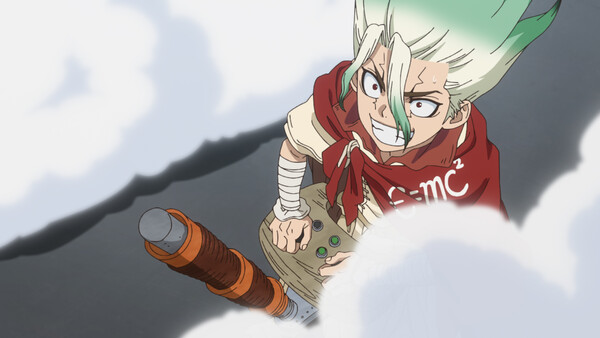
On this point, the show's example of missiles and rockets essentially being the same thing struck a chord with Scriptwriter Sunayama: “That's something that's said quite often, but many people don't know about it. It's difficult [to discuss] though, as it involves talking about war and things like that. But it's because it's difficult that I want people to think about it carefully.”
For Scriptwriter Kindaichi, on the other hand, the main message of the series is centered around the cooperative element. “Senku is a genius, but he can never create things alone. More and more people join him as the story progresses,” he told me. “To accomplish something big, you need the help of many people. I think what's most amazing about Senku is that he does this as a matter of course. It's not like one incredibly talented person does everything; it's a given to him that to accomplish something, you need to work together with others.”
To support these kinds of themes, it was of the utmost importance to structure the episodes to keep a positive tone. “An episode never ends with a 'what's going to happen now?' Instead, it'll be something about not backing down even in a crisis. It's when the protagonist is feeling relatively positive that we decide to move on to the next episode,” Scriptwriter Sunayama explained. “You might feel some despair along the way, but at the end of those thirty minutes you shouldn't. You should be feeling rather positive with Senku saying something like 'That's exciting'—that's the most consistent part.”
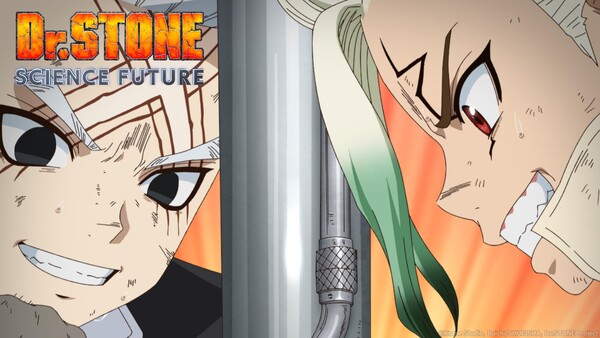
A lot of what makes this possible is the characters themselves and how they are portrayed. “While Senku can be silly, he can also be the straight man,” Scriptwriter Kindaichi explained. The same goes for Gen—and I think it's powerful that various characters can properly play both the straight man and the funny man roles. It's not just their serious side, but their reactions to the comedy scenes that allow the story to unfold. The characters create stories of various types—and the main characters have this duality so that an episode never ends with just a serious atmosphere. The richness of the characters is what leads to the richness of the work.”
Trying to stay conscious of never ending on a downbeat proved to be one of the biggest challenges the writing team faced. When planning episodes 33 and 34 of SCIENCE FUTURE, the team had to decide where to cut the story. Would they end the episode on the big emotional beat—Ryusui's eyes brimming with tears of frustration—despite it not being strictly positive? In the end, Scriptwriter Sunayama was told, "Write up to the next chapter first, and then think about it. Just try writing it once." He did so and, in the end, that was the scene they went with.
The writers also faced a pacing problem when writing up the script. “In terms of series composition, the biggest challenge was when we were initially told it would be three cour—36 episodes—and we realized the story wouldn't all fit into 36 episodes,” Scriptwriter Sunayama said. “We struggled a lot to figure out what to do. In the end, it became 37 episodes, as we had to ask for an extra episode because it wouldn't all fit.”
“We ended up stretching the story out a bit—into the size of a full episode.” Director Matsushita added. “Since it was the last episode, we were allowed to include quite a lot extra. I wanted to do it, though, that one additional episode.”

For Director Matsushita, the challenge he most remembers came from adapting one specific character from the page to the screen: “The biggest challenge was definitely how to portray Why-man at the end visually. I mean, his visualization appears in the manga, but how do you translate that into animation? What were we supposed to do? Were we supposed to animate this as is? It was quite difficult to express. Producer [Shūsuke Katagiri] and I did a lot of tests and debated how to do it from a very early stage in production. There were definitely some visual challenges in that regard.”
Of course, one of the obvious challenges the entire production faced was getting the science right. “When it comes down to it, I knew almost nothing about any of the science that came after Dr. Xeno appeared in the story,” Director Matsushita joked. “I did a lot of research, both on the internet and on my own—buying books and encyclopedias and reading them. But there were still many things I didn't understand, so I ended up consulting with experts and getting their advice while we were making the anime.”
“Regarding the modern civilization after the introduction of Dr. Xeno, I personally did a lot of research—especially on computers, like the Parametron (an original computer part developed in Japan a long time ago),” Scriptwriter Kindaichi added. “I researched it extensively on the internet and in other resources—and while I was researching and thinking about it, I didn't understand it. It was something that was to be shown in the anime, so I did my best to research what kind of component it was.”
On the other hand, Scriptwriter Sunayama didn't feel the need to get bogged down in outside research. “I wasn't really worried about not knowing about any particular scientific concept. This is because, when I read the original work, it was explained. [...] As a reader, when I read it, I understood it,” he told me. “There are times when I wondered if the explanation was a bit off or something similar, but this story is driven by fun. In that sense, I was able to read the manga with peace of mind. And even as I was making it, I thought that even if I didn't understand the scientific stuff, it would probably be okay as long as it was enjoyable.”
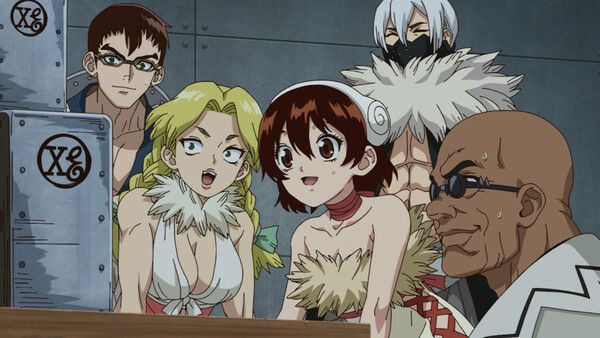
A lot of what made Dr. STONE turn out so well is the past experiences of the people making it. Director Matsushita, for example, brought his love for detail to the project: “When I first became a director, I worked on a project called Yumeiro Pâtissière. It's about a girl aiming to become a pastry chef. There were scenes where she was making sweets. We made them incredibly realistic—showing off the craftsmanship.” He continued, “I think that, in animation, it's important that those kinds of details are conveyed, so in Dr. STONE, we did so too. I made sure to be honest and not lie about the details when depicting the crafting process. That was one thing I focused on.”
As for Scriptwriter Sunayama, his experience with complex story structures helped him when adapting Dr. STONE. “There's a show called Yowamushi Pedal that was also produced by TMS, and in that show, they bring up past events a lot during the bicycle races. Every character does this, and I thought the structure felt the same in Dr. STONE,” he explained. “I did some rearranging [in Yowamushi Pedal], like deciding to insert a flashback scene between different scenes [than in the manga], or combining two separate flashback scenes into one. That kind of thing is necessary for Dr. STONE as well. When you have to condense three weeks' worth of [manga] content into a 30-minute episode, you have to figure out where to place the flashbacks—and I think the know-how I got from Yowamushi Pedal might have proved useful.”
While Dr. STONE is far from a battle manga; it does feature more than a few fights—which are something Scriptwriter Kindaichi has more than a little experience with. “I've been doing nothing but battle-oriented projects lately, so an anime with scenes that don't involve much fighting feels refreshing to me. Of course, there are battle scenes, but more often than not, the characters are 'battling' with science,” he told me. “It goes without saying that my previous writing experience certainly came in handy in the battle scenes, but I felt like I was more challenging myself with the crafting scenes and I approached them with a fresh perspective. I feel like Dr. STONE will be useful in my future work.”
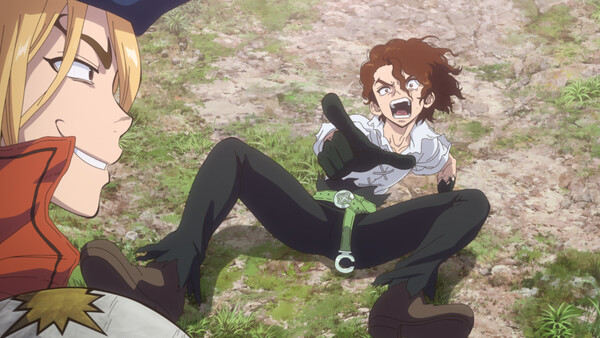
In fact, all three men learned about themselves through their years of working on Dr. STONE. Director Matsushita was confronted with his own subconscious patterns. “I feel like I've come to understand my own preferences pretty well. It's a bit vague, but I've realized that I like certain angles—like overhead shots where everyone is looking up—and when I look at them, I think, 'Oh, I used this kind of shot before!' [...] Also, I realized that I really like drawing cool male characters. I really enjoyed creating drama scenes for characters like Ryusui.”
Scriptwriter Sunayama, on the other hand, learned about his weaknesses as a writer. “I think my weakness—and something I learned a lot about this time—is character design. For example, I tend to confine characters to archetypes, like 'cool boys' or 'evil villains.' The characters in Dr. STONE are either a little bit off those tropes or quite a bit off—and many of them are like that. The way they deviate from those patterns is done really skillfully—and it makes the content quite interesting. This way of thinking is unusual for me, so it was a great learning experience.”
“We sometimes create original side stories beyond the main story. When we bring Senku and the others into our brand new story, we naturally research their speech patterns—what they say and how they say it—and it turns out that every character has their own distinct way of speaking,” Scriptwriter Kindaichi added. “In other works, if you establish individuality through speech, the content of what they actually say can be quite ordinary. But in Dr. STONE, while their speech patterns are distinctive, there are actually strict rules governing what they can say, which is incredibly difficult to write for. It's not simply enough for a character to say distinctive things—thus, it's extremely challenging. The meticulous detail in the character design, the way each character has their own unique thoughts and lines that they absolutely wouldn't say, is truly amazing. I learned a lot from it.”
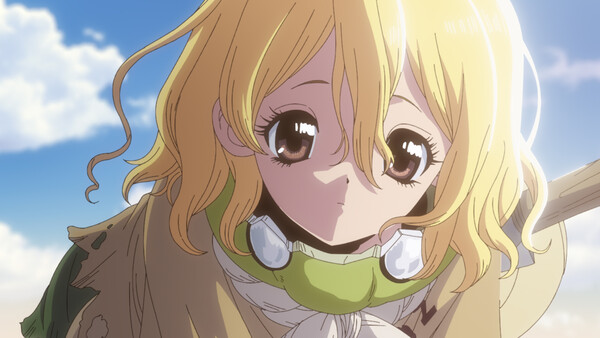
As the interview moved on, we began to look back at highlights from what they had been a part of creating. For all three, there was an easy pick for the most emotional episode they had produced. “Personally, I think it's the episode with Suika, 'Scientist, All Alone', where Suika revives all by herself, and then, after seven years alone, creates the revival fluid again,” Director Matsushita told me. “That part is vital to Dr. STONE as a whole. When I first read the original manga, I felt like it was a key moment for our heroes. I really felt the need to work hard on that part and make it emotional. That was one of my goals.”
“I know this is a bit repetitive, but my favorite part was also the story about Suika.” Scriptwriter Sunayama added, “I think there are three characters in Dr. STONE, who works hard while all alone. There's Senku and Dr. Xeno right after they wake up—and then there's Suika. Suika is the only one who is not a proper scientist; she's still a child. But the way she inherits science through written information is really in line with the theme of the story—and as Kaseki often says elsewhere, it's about inheriting what's been written down. While Kaseki becomes basically immortal after this, the story really depicts how culture and science are passed down even after death—and that's really in line with the theme [of the show]. Of course, I like Suika's efforts, but I also like that episode because it includes the theme of passing on culture to the next generation.”
“Of course, the story about Suika leaves a strong impression,” Scriptwriter Kindaichi said, responding to the other two. “But if I had to pick another episode, it would be the story of Senku and Dr. Xeno—the story of their master-apprentice relationship. It left a particularly deep impression on me and has stayed in my memory. Senku is an extremely talented person, almost a genius, but even Senku had someone he learned from. That fact made me realize that knowledge is passed down. Rather than being created by one person, it's something inherited again and again. That aspect, on top of everything else, made it a particularly moving episode.
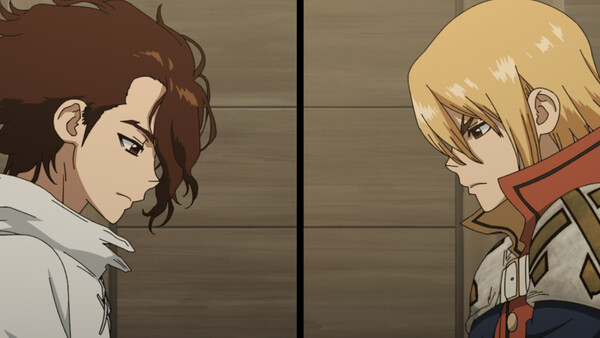
When it came to what aspects of the anime they were most proud of, their answers were much more varied. “The pace has been picking up every episode, and it's structured in a way that makes the anime consistently interesting. So, there are moments in almost every episode that I really like,” Director Matsushita gushed. “Also, although it's not about the main story, we put a lot of effort into creating the anime's opening and ending themes. We actually made a lot of different versions of the ending, changing little things here and there. So, we were able to have some fun with those, and it was a lot of fun to work on.”
Scriptwriter Kindaichi was proud to see some of his original work on screen. “Speaking of recent events in the show, the episode with Ryusui and Sai [...] left a very strong impression on me. In the anime, Ryusui and Sai almost part ways, and we added a little bit to the scene where they get on the ship at the end. When that scene actually made it into animation, I was incredibly moved. I was so happy.”
For Scriptwriter Sunayama, there was something he was happier he had been able to do rather than something he was strictly proud of. “Because I personally love space development and rockets—and because the whole process from engine testing to launch isn't something that's often shown in anime—I was really happy that I was able to depict that. I think that's the best part.”
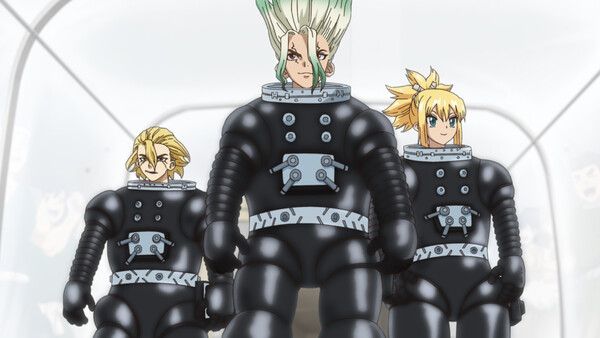
To wrap things up, the three men took a minute to talk about their feelings on having Dr. STONE—and thus several years of their lives—come to an end.
“It feels a little lonely, or rather, it's a little sad to say goodbye to a friend who was with me every day for those four or five years,” Director Matsushita began. “That said, it's rare for a series like this that has been going on for so many years to reach its final episode. After all, there are many other productions where you don't get to see the story all the way to the end. So in that sense, I'm really happy. That's why I feel like we're a good team, and I'm really proud of what we accomplished.”
“When I read the final chapter of the manga, I felt it ended with a proper, happy ending,” Scriptwriter Sunayama said nostalgically. “The anime added a few things, and it also felt like a proper ending."
“Dr. STONE has the theme of people never stopping their progress,” Scriptwriter Kindaichi concluded. “So, although the work itself ends here, it's a story that never really ends. As the director said, there is a sense of sadness, but rather I feel a stronger sense of gratitude for having been involved in it. I feel so very thankful.”
discuss this in the forum |
