

(5 questions; 35s to answer on average
Yes I'll do it later No
The Summer 2025 Anime Preview Guide - Dekin no Mogura: The Earthbound Mole
How would you rate episode 1 of
Dekin no Mogura: The Earthbound Mole ?
Community score: 3.4
How would you rate episode 2 of
Dekin no Mogura: The Earthbound Mole ?
Community score: 3.8
What is this?
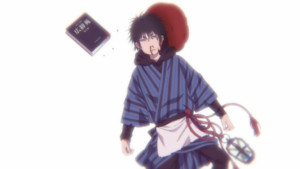
University students Magi and Yaeko one day witness a Kōjien dictionary falling on the head of a man and hurting him. However, despite bleeding from his head, the man expresses that he does not want them to call an ambulance or the police for him, which seems suspicious. In addition, after this encounter, both Magi and Yaeko start seeing strange things.
Dekin no Mogura: The Earthbound Mole is based on the Dekin no Mogura manga series by Natsumi Eguchi. The anime series is streaming on Crunchyroll on Sundays.
How was the first episode?

Caitlin Moore
Rating:
I'd ask that someone out there start cataloging obscure cultural references in Dekin no Mogura. Still, I don't know there's going to be enough of an English-speaking audience to make that worthwhile as anything but a passion project. This week, I researched the Japanese army's 2nd Division in World War II and Sukekiyo. The 2nd Division was easy, since it has an English Wikipedia page detailing its disastrous losses in the Second World War's Pacific Theater. However, I still don't know what it meant when Magi's manager yelled, “But Sukekiyo is the least liked character!”
The thing is, Mogura mentions he fought in the 2nd Division in a weighty way that indicates anyone who learned about it in history class in Japan would instantly know what it means. Learning it after the fact doesn't quite have the same impact. That's what I think holds Dekin no Mogura back from international success; it's full of the kind of deep-cut cultural references that you'd need to either grow up fully immersed in Japanese culture or be a full-on scholar in the subject to understand in the way the show expects. Not that there's anything wrong with that! Not everything has to have international appeal! It's okay for a Japanese show to be made without regard for the poor foreigners who feel left out!
And besides, even if those moments don't land the same way, it's still an interesting show. The big heads and chalk pastel coloring style stand out and catch the eye, even as they're off-putting. The witty, fast-paced dialogue keeps things moving along. The second episode delves more into Mogura's past and the nature of spirits, exploring a bit of those complexities. Instead of simply banishing spirits as malicious or forces of nature, Mogura points out that they're just people. They're drawn to music, celebrations, and cute girls. Some of them are creeps, but many of them just want to enjoy existence in whatever way they can. And wouldn't you know it, I just love an empathetic narrative that emphasizes the humanity of everyone.
Plus, Mogura is an interesting character to build a show around. He lives life on the margins, not just because of his position caught between life and death, but because he has some pretty severe trauma from fully participating in society. He clearly cares deeply, but is still cautious about connecting to others because of the precariousness of his situation. He's someone I want to know more about.
Rating:
This is a weird one.
That's not a criticism. I support weird art, even when it's not my preferred flavor of weird; it keeps things interesting—rather than everything getting filed down to samey, personality-free cash grabs made up of the current popular tropes. We may be stuck slogging through a dozen identical isekai and LitRPG series, but we're probably not going to see another series like Dekin no Mogura: The Earthbound Mole this season.
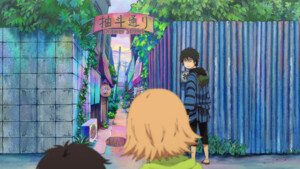
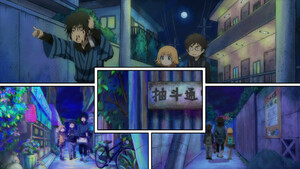
Everything about it is off-putting, seemingly intentionally so. The art style takes the kind of bobble-headed proportions that's especially common among moe-oriented series to an extreme—even on characters who aren't at all cute, like the schlubby college student Magi. The linework has a sketchy, uneven appearance, and everything is colored with a blue-purple cast, creating the sensation of looking at a bruise. Mogura's messy home, cluttered with garbage and other odds and ends, has a claustrophobic atmosphere. There's an artfulness to creating something so visually abrasive, yet beautiful in its own way.
The casting of Yuichi Nakamura as the titular Mogura dispels any doubts that I may have had about the veteran staff knowing exactly what they were doing. Nakamura has decades of experience playing weird assholes. Perhaps he's most famously Jujutsu Kaisen's Gojo and My Hero Academia's Hawks, but his resume is roughly a dozen pages long. His Mogura is exhausted and doing his best to cling to survival, but retains a sense of humor about what he's doing. He's not unkind, but his existence caught in limbo between life and death necessitates him acting selfishly. Nakamura completely dominates the rest of the cast for the entire episode.
But don't let the desperation of Mogura's situation fool you; this is a gag anime before anything else. As is always the case with gag anime, some jokes hit while others fall flat. The biggest issue for the average watcher, I suspect, is how many of the punchlines are predicated on Japanese cultural knowledge. Dekin no Mogura comes from the same creator as Hozuki's Coolheadedness, a series about the afterlife that was similarly saturated with references to folklore and myth—and neither are here to coddle you and gently introduce you to foreign concepts of life after death. And once again, that's fine! Not everything needs to be for us!
Dekin no Mogura: The Earthbound Mole is the kind of series I appreciate and want to exist, even if I don't continue to engage with it after this episode. It's weird, kind of abrasive, and steeped in cultural norms that I only have a vague understanding of.
James Beckett
Rating:
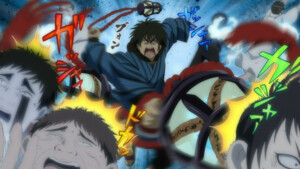
This continues to be very odd. On the one hand, I continue to enjoy the show's unique visual style and the general way that it plays around with Japanese history and mythology. The opening scene of the episode, where Mogura recalls the traumatizing experiences he had serving for the Imperial Military in World War 2, is the kind of specific character building that takes advantage of the character's immortality while also playing with the show's perspective on what life is like in modern Japan. Momoyuki is familiar enough with things like video games to follow a conversation, but that doesn't change the fact that Magi and Yaeko come from a completely different world than the one Mogura was born.
All of that, and the stuff involving Magi and Yaeko getting sucked into supernatural shenanigans after meeting Mogura, has a lot of potential. Inukai is the new character we get to know this week, and her being a very chipper high-school student provides another effective and distinct contrast to Magi and Yaeko. Dekin no Mogura's approach to spirits and ghosts feels very laid back; Mogura even tries to explain that the dead might seem creepy, but that doesn't mean they're malicious in a deadly way. In Inukai's case, all of the ghosts possessing her were simply perving on her lady curves. This isn't great, but it's a far sight better than having Inukai running around committing crimes and puking up viscous fluids.
Despite how much I feel like I should dig Dekin no Mogura, the problem remains that I simply struggle to find it entertaining. There's something about the comedic timing and presentation of the jokes that fails to amuse me on anything other than an intellectual level, and I find the pacing of the dialogue to be drawn out. I didn't laugh or even smile once while watching this entire second episode, and I found myself checking the runtime more than once to see how much of the episode could be left over.
Dekin no Mogura is one of those shows that ends up as less than the sum of its parts. It's got an interesting, kooky premise that is supported by a cast of diverse characters and a supernatural backdrop that could easily make for an excellent TV show. The individual pieces just aren't meshing well together. It's far from a terrible show, and I'm sure it will find its audience, though I think I might have to sail off to greener pastures.
Rating:
My mixed feelings about Dekin no Mogura can be summed up by the experience I had literally five seconds into the show. The very brief cold open shows us a man dressed in old-fashioned Japanese garb who is bleeding profusely from the head. The injured man laments that “Nobody expects a Kojien to fall out of the sky.” The subtitle onscreen labels a book next to the guy as the “Kojien,” so we at least understand what hit him on the head, but I don't have any idea what the hell a “Kojien” even is, though it sounds vaguely familiar. So, before we can even get past this ten-second-long preamble, I have to pause the show and hop onto Google so I can figure out what this joke is supposed to be. It doesn't take long for the search results that I find before that godforsaken AI-generated crap to reactivate long-dormant knowledge from my days studying Japanese in college: Kojien is a monstrously thick volume that serves as an all-purpose Japanese dictionary that pretty much any Japanese student would be familiar with to some degree; one recent publication of the 7th-edition totals an obscene 3,216 pages. After getting distracted and wasting a few more minutes reading about the many additions and changes that the Kojien has undergone over the decades, I was finally able to resume Dekin no Mogura. “I see!” I thought to myself, “The joke is basically like if someone in an American TV show was walking along the street and got conked in the head by a box set of the Encyclopedia Britannica, or some other famously dense tome.”
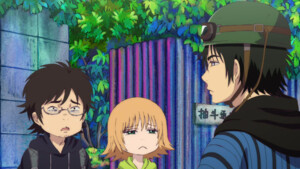
You may have noticed the inherent problem here already: Dekin no Mogura opens with a silly and casual visual gag that I'm guessing many Japanese viewers would get a mild chuckle out of instantly. I, on the other hand, had to spend several minutes of my own research to simply understand why the joke specifically references Kojien. Sure, you could argue that the localizers may have gotten more mileage out of the bit if they simply identified the book as a dictionary. Still, the deeper issue is that this one joke is merely establishing the fact that Dekin no Mogura is a reference-heavy comedy that is written by, about, and presumably for Japanese nerds with degrees in literature. Our protagonists are two enthusiastic but somewhat neurotic college students who are enrolled in a seminar on Japanese kids' lit. Their misadventures begin when they find the aforementioned injured bloke in the middle of the street, who turns out to be an undying victim of an ancient curse whose woes are all reflections of Dekin no Mogura's satirical observations about Japanese history and culture.
To put it simply: I can absolutely appreciate Dekin no Mogura on an academic level, but the linguistic and cultural barriers make it harder to parse as a silly cartoon that is supposed to make you laugh. There are plenty of elements about the show that I can appreciate, don't get me wrong; I love the colored-pencil backgrounds and the charming character designs, and I think the show has a lot of educational value for a relatively ignorant Westerner like me. I'm able to pick up on the obvious jokes, like references to Osamu Dazai and jokes that play on famous lines from No Longer Human, but the jokes that rely more on cultural stereotypes and everyday references to life as a broke Japanese twentysomething are more anthropological to me than they are knee slapping. I might continue to check out Dekin no Mogura to satisfy my more collegiate impulses and see if its sense of humor can grow on me, but I wouldn't blame most viewers for treating the show as a mildly interesting curiosity before moving on to more mainstream entertainment.

Rebecca Silverman
Rating:
You know those people who just won't shut up, even for a second? That's what this episode felt like, the anime equivalent of the conversation you just can't escape. That's at least a little too bad, because there are some good bits and pieces strewn throughout it. The opening segment, wherein we learn that Mogura saved Yae's great-grandfather (and probably many other soldiers) with his ghost fire during WWII, is pretty good. In some ways, a ghost soldier saving lives on the battlefield feels like a better show than this one, although maybe that's just because I'm the granddaughter of a Battle of the Bulge survivor. Still, it's interesting lore and helps to both ground the plot and make Mogura a more sympathetic character.
But then it keeps going. And going. And going, without any similarly interesting angles and a lot of nonstop talking. There does seem to be another 20th-century Japanese literary reference tucked in; as far as I can tell, “Boss Sukekiyo” is a reference to a character in Seishi Yokomizo's 1951 mystery novel The Inugami Curse. There's also a band called Sukekiyo, which may be part of a multilayered reference, since music is specifically mentioned later on. Continuing the trend (more or less) is the fact that Yae's new coworker with a ghost problem is named “Shio,” which means “salt;” in folklore, salt is one of the methods to ward off or harm ghosts, so her name is meant to be ironic, because ghosts are drawn to her.
If the show focused more on that kind of gag and references, either on the whole or in a way that is more accessible (as in, cultural notes were provided by Crunchyroll), it would probably be a lot more fun. But what we largely have instead is small segments thrown together that are only marginally a full story because of the characters involved in all of them. It's just not particularly funny or interesting to watch Mogura grump and grumble and occasionally do something useful. Yae and Maki aren't interesting. The plot has potential, but it's not using it, and this second episode has dashed any interest I had in pursuing this show any further.
Rating:
My degree in children's literature (or kiddy lit, as we called it) taught me one very important thing: there's always another world lurking just beside our own. In all fairness, it was probably reading children's books that really taught that lesson; two of my favorite books in elementary school were The People of Pineapple Place and The Hunky Dory Dairy, both by Anne Lindbergh. I kept thinking about them during this episode, because in both novels, the heroines stumble upon worlds out of time down side streets in their towns, where people continue to live as if it were the 1940s or 1880s. That's more or less what happens to Magi and Yaeko when they meet Mogura – just in a more “jaded college student” way.
That's actually what brought this episode down for me. Neither Magi nor Yaeko are particularly enchanted by the discovery that Mogura lives on a strange street that most people can't see, the equivalent of a divine junk drawer, according to him. Mogura has been alive since at least the Edo era (based on his clothes and his lantern) and is now thoroughly disenchanted by life and everything about it. But…so are our college kids, and this show would be so much more interesting if they were at least a little fascinated by Mogura's life outside of time.
It may be the point that they're not. Both are taking a children's literature seminar, not actively studying kiddy lit, and their points of literary reference are much more staid and depressing, like the works of Osamu Dazai. You know, capital “L” literature, whereas kiddy lit is often looked down upon by Serious Literary Types and once it enters the realm of serious (or “serious”) academic scholarship it stops being read by actual children. So maybe the point here is that they'll learn to see beyond the strictest academic definitions. After all, the story does open with someone getting literally hit on the head with a book.
I'm not sure where this is going, though, nor if I'm interested in sticking around. The art used in the backgrounds does seem to support the idea that there's a children's literature component, since they look like picture book illustrations in their use of color, and that juxtaposes nicely with the grittier adult character designs. I suppose we'll see, but for now, chalk this one up as mildly confusing and kind of bizarre.
Subscribe to Crunchyroll here!
discuss this in the forum (364 posts) |

this article has been modified since it was originally posted; see change history
back to The Summer Anime 2025 Preview Guide sponsored by Crunchyroll
Season Preview Guide homepage / archives