

All the News and Reviews from Anime Expo 2026
Loading into Cyberpunk: The Ghost in the Shell Director Mokochan, Character Designer Shūhei Handa
by Lynzee Loveridge,
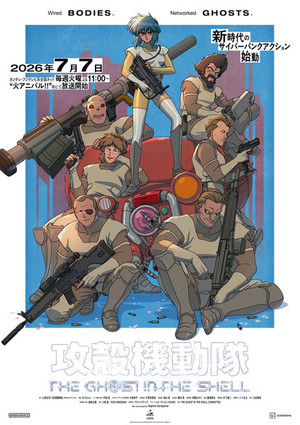
Ghost in the Shell may be one of the most revisited worlds in the anime medium. Across decades, fans have followed Major Motoko Kusanagi across multiple continuities, each imbued with a vision of a startling technological future.
Following in the footsteps of esteemed creators is Mokochan. The director is making his full-fledged debut in Science SARU's The Ghost in the Shell after previously working with studio founder Masaaki Yuasa on the Golden Globe-nominated film, INU-OH. Joining Mokochan on the project is character designer and animation director Shūhei Handa, a Trigger studio collaborator whose punchy, cartoony style appeared in episodes of Kill la Kill and Scott Pilgrim Takes Off.
At Anime Expo, we talked about Ghost in the Shell's legacy, and how despite all of its technological advances, the series' creation is still powered by humans.
So my first question is for Mokochan; you're now among well-respected creators such as Mamoru Oshii-san and Kenji Kamiyama-san. Mokochan, how does it feel taking the reins of such an important anime franchise?
MOKOCHAN: I got a lot of pressure while producing this new franchise, but I want to make it into an amazing work of art, including supervising all of the animation. I check those details very seriously.
The different iterations and continuities of Ghost in the Shell all offer alternate views of our future world. What makes The Ghost in the Shell unique compared to the other versions?
MOKOCHAN: Because this new series is completely based on the original manga, we didn't modernize it. That was not our intention. And the original manga was created in 1989. In that era, we didn't even have mobile phones. Also, monitors weren't like the LED style; they were all CRT. So we tried to capture the same feel and make everything match the concept in the original manga. It's not updated. It's more focused on the retro future.
What parts of Masamune Shirow's original story feel the most relevant to the time we're living in right now?
HANDA: AI technology. That's what I think. Because we've been hearing a lot of things about AI recently. AI is kind of becoming the mainstream right now. That's why I think it's the most relevant component of the series.
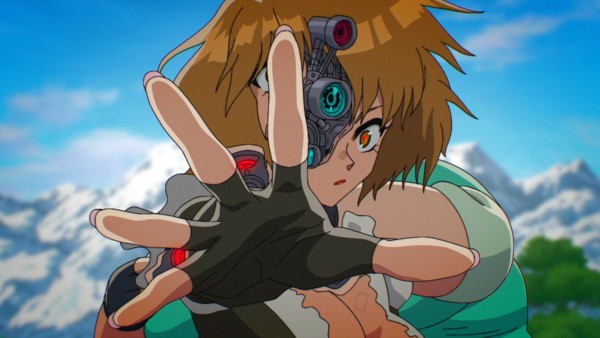
This might be a little bit off topic. I was in Japan in March, and I went and saw the Sailor Moon stage play that they had at a hotel there. And even the topic of that new stage play was about AI. AI really does seem to kind of be everywhere right now.
HANDA: It's a sensitive topic.
Yes. Do either of you have a feeling whether AI in The Ghost in the Shell is shown in more of a positive sense or a negative sense, or both?
MOKOCHAN: It's neither.
HANDA: It's not positive or negative.
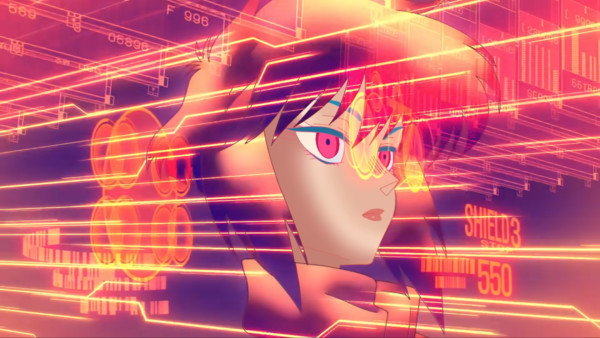
It just depends on how it's used. Are there other cyberpunk or science fiction stories that had a strong influence on you as a storyteller?
MOKOCHAN: There are a lot. So it's really hard to just say, "just choose one of them." Because I reference a lot of work and projects, I don't want people to think, "They're just focusing on some of the examples." So it's better not to mention any of them. There are almost 100 [influences].
Okay. So viewers should just watch and see what they might notice.
MOKOCHAN: Yes. So fans can definitely look for them. If they realize some of the references mentioned in the series, it's fine for them to find those details. But there are just so many, so it's kind of difficult to mention all of them.
And I don't want to limit the vision to just a few, because that's not accurate.
Major Motoko Kusanagi remains an all-time favorite anime character. What do you think is her long-lasting appeal?
MOKOCHAN: Major Kusanagi is kind of mysterious and very cool, but actually she is very human. So for the fans, when they watch the series, it's kind of very easy for them to put themselves into this character. For example, even a normal human has a lot of concerns about humankind and the lives they're living in this world. So it's just normal. Just a concept of a normal human being. And Kusanagi also has that concept in her character.
I see. Handa-san, you were brought onto the project for the character designs. Can you discuss working on the new character designs? Was the approach to closely adapt Shirow-sensei's original character designs?
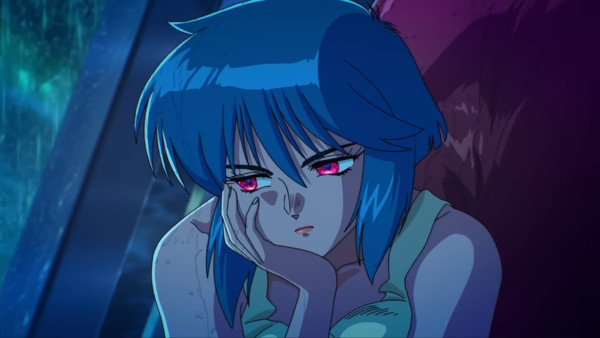
HANDA: So when I joined the project, they'd already decided to make this new series based on the original manga. So I tried to follow the original manga while keeping the authentic parts of its art style. For Aramaki and Tokusa, the eye design is just very simple black dots. I didn't try to emphasize the character or make them the main character. I didn't adjust it. I just kept the character role as is.
Mokochan-san, prior to The Ghost in the Shell, you worked on other projects for Science SARU including DAN DA DAN, INU-OH, and Scott Pilgrim Takes Off. Can you give examples of techniques that you honed during your previous projects and how they helped you on The Ghost in the Shell?
MOKOCHAN: When I worked on this project with Science SARU, I actually worked under Yuasa as his assistant to learn how to make animation, and the technique he learned from his master was to use animation to do the storytelling. And the director of DAN DA DAN [Fūga Yamashiro] is also my co-worker, so he also specialized in storytelling in an animated style. I think that definitely helped.
I got to meet Yamashiro-san at AX not last year, but I think the year before, and he showed his storyboards to me, and it was so impressive. He also seems to really love Ultraman.
Given its focus on technology, I wanted to ask which tools you used during the production process that had an impact on The Ghost in the Shell? Either the look, the coloring, or anything like that.
MOKOCHAN: For The Ghost in the Shell, it's the human body. The main concept in the original manga is to showcase what a human being is, so we would like to follow the same concept when making this new series. We need to make the body move, and that's why I focus so much on the hand-drawn art style. So the human body was really helpful during the process.
So even though it's anime that features advanced technology, you could say that it's powered by humans.
BOTH: Exactly.
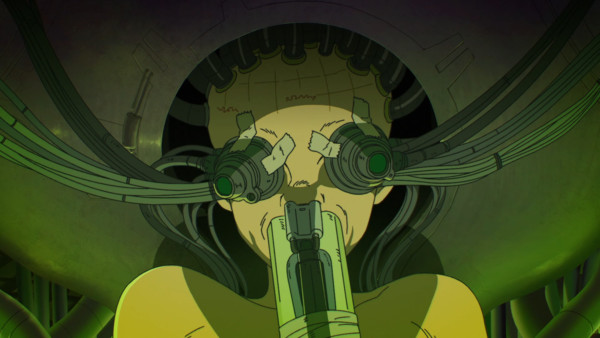
If offered the opportunity to get your own cyber brain implant, would you do it?
HANDA: Yes. Immediately.
MOKOCHAN: For me, it depends on the price.
HANDA: Only the cyber brain? I'd buy the eyes and also an arm—a mecha arm.
Yeah. Then your muscles wouldn't get sore anymore.
HANDA: To draw animation, I want a mecha arm.
discuss this in the forum |

back to All the News and Reviews from Anime Expo 2026
Convention homepage / archives