

Summer 2026 Manga Guide
Billy Bat
What's It About?
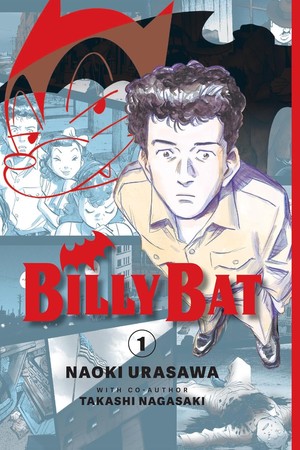
The story begins in 1949 Los Angeles. Kevin Yamagata, a Japanese American cartoonist, has built his career on Billy Bat, a sharp, wisecracking detective beloved by readers. But everything shifts when Kevin realizes he may have unknowingly copied the character from an image he once saw in Japan.
Determined to find the truth, Kevin returns to a devastated, postwar Japan. What he uncovers goes far beyond questions of inspiration or theft. The image of the bat is ancient, surfacing again and again across history, tied to moments of upheaval, power, and violence.
As Kevin follows the trail, he is drawn into a far-reaching mystery that blurs fiction and reality, where a single drawing may hold the key to forces shaping human history.
Billy Bat has a story by and art by Naoki Urasawa and Takashi Nagasaki. English translation is done by Kristi Iwashiro and lettering by Aidan Clarke and Brendon Hull. Published by Kana (June 2, 2026). Rated 16+.
Is It Worth Reading?
Rebecca Silverman
Rating:
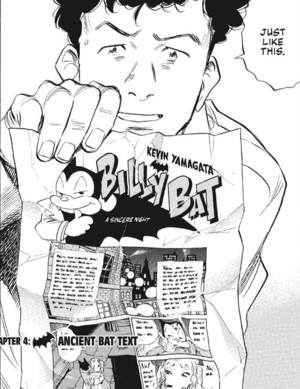
How much of our creativity truly comes from our own minds and how much is a synthesis of what we see around us? That's a question that Kevin Yamagata never even thinks to ask. After leaving the army at the end of World War II, he returned home to L.A. and began drawing a popular crime comic about a hard-boiled bat detective for Marble Comics. But when someone mentions they saw a character who looks just like Billy in Japan during the war, Kevin freaks out – he does not want to make a living from stolen work. Putting his serialization on hold, he heads back to Tokyo, where he served as a translator, trying to track down the manga he might have inadvertently plagiarized. And because this is a Naoki Urasawa manga, the answer is much, much more complicated than he ever imagined.
Despite it being after the war, 1949 was a difficult year. In Tokyo, that mostly involves trying to rebuild society while American soldiers are still very much present; back in the U.S., the Red Scare is building, and we readers in 2026 know that Senator McCarthy is also going to come for crime comics like Kevin's in just a few years. Just as he does in Asadora! for the mid-1960s, Urasawa manages to depict a time of great social upheaval without being too heavy-handed about it. It's clear that American soldiers are persona non grata among actual Tokyoites, while it is equally evident that they see themselves as swaggering heroes. Kevin, as a Japanese-American, is conflicted; even in Japan, he goes by his English name rather than the Japanese one his parents gave him, and he clearly thinks of California as home, despite the difficulties of growing up there. (There's no mention of the Japanese internment camps, but I do hope Urasawa at least mentions them at some point.) What consumes Kevin is honesty and the integrity of his comic, which leads him down a strange, potentially ancient, cult-based rabbit hole.
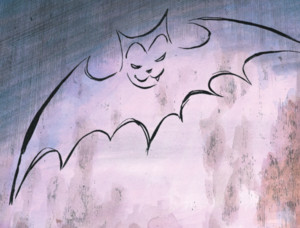
There are precious few answers as to what the bat – and whether it's black or white – actually is, but it seems to be an ancient object of worship that keeps reappearing. In 1949, sex workers, forced into their profession by post-war conditions and often abused, worship it as a potential savior. In Kevin's comic, Billy's on the side of good for the most part, but with plenty of room for shades of grey. And in a flash-forward to 1969, the bat shows that his reach might be farther than anyone thinks…
If you get a slight Batman feel from all this, I think that's on purpose. Urasawa's inclusion of Kevin's comic is pitch-perfect Golden Age work, from the style and setup to the colors used. His art is always good, but I'd say he's outdone himself this time, using a distinctly American comics style superimposed on manga, and throwing in some realistic (for manga) female nudity for good measure. (It's nonsexual and important to the scene rather than prurient.) Urasawa fans are hopefully already planning to pick this up (especially Monster readers), but I'd say appreciators of pre-code American comics should consider it, too. The bat is universal. We just don't know how yet.
Lucas DeRuyter
Rating:
Man, do I love it when a mangaka gets big enough that they can open a new work with a slow burn. With the serialized nature of long-running manga, most works have to make a defining impression immediately, lest they risk cancellation in a hyper-competitive landscape. If any mangaka has earned the trust of their editors and the patience of their readership, though, it's Naoki Urasawa — of Monster, 20th Century Boys, and Pluto fame — and he uses his acclaim to great success in penning the mysterious and enticing opening volume of Billy Bat.
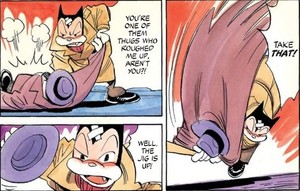
Co-written by Takashi Nagasaki, who produced/edited Urasawa's aforementioned masterpieces, Billy Bat begins with a marvelous, full-color installation of the in-universe comic Billy Bat, where the titular character is an anthropomorphic bat detective. This opening comic looks so stylish and is such a fun bit of throwback detective noir that I would read an entire manga just for this story-within-a-story. The frame does pull out after two dozen or so pages, though, and we learn that Billy Bat is the brainchild of Kevin Yamagata, a Japanese-American artist living in 1949's America. When the police take over his studio to spy on a supposed Soviet spy, Kevin learns that he may have accidentally stolen the design of Billy Bat from an artist in Japan while he was stationed there, and he travels to the nation to make things right.
Things immediately take an impossible and concerning turn, though, as Kevin quickly discovers Billy Bat is at the center of a generations-spanning conspiracy that has only grown more fraught in Japan's post-World War Two reconstruction. With an acquaintance murdered, the symbol of Billy Bat being worshiped as a local deity, the emergence of competing factions, and the (supposed) original Billy Bat mangaka's latest manuscript predicting events as they unfold around him, Kevin's trip to Japan goes from strange to impossible. Though the scope of what Kevin stumbled into may go beyond even this, with the final pages of the first Billy Bat volume jumping ahead several decades to show Neil Armstrong and Buzz Aldrin discovering the Billy Bat logo on the moon.
Naoki Urasawa has such a bulletproof body of work that anyone who likes manga as a medium should just read anything with his name on it. Even without Urasawa's name attached, Billy Bat would be sure to draw in audiences with its thrilling mystery, catching art style, and incredible heart. The attention and respect this work gives to sex workers just trying to survive amid societal collapse is deeply affecting, and Kevin is an immediately likable protagonist for his earnestness and strong sense of justice. I'm going to read every volume of this work, and I implore everyone reading this to get in on this ride with me.
Kevin Cormack
Rating:
It's no exaggeration to say that I've been waiting for the English language release of this manga for years. Although I read the single English volume of his earliest work, Pineapple Army, released by Viz way back in 1990, it wasn't until 2006, and the publication of Monster, that I really sat up and paid attention to the manga of superstar author Naoki Urasawa. Pluto, 20th Century Boys (my personal favorite of Urasawa's stories), Master Keaton, and Asadora! eventually followed. Several of Urasawa's longer series have unfortunately never been translated, and for me, the biggest gap on my Urasawa shelf was reserved for Billy Bat. Now, the long-awaited day is here. Of course, this is a twenty-volume series, so I'll be waiting a long time for the conclusion.
Like all of Urasawa's best work, Billy Bat is a period mystery with plenty of moving pieces, bizarre twists, and a protagonist who finds himself trapped by events beyond his control. It's 1949, four years following the end of the Second World War, and we follow Japanese-American comic book artist Kevin Yamagata, whose Billy Bat comic is exploding in popularity. As a man with a strong moral core (his father drilled into him the importance of never stealing), he is disturbed to learn that he may have subconsciously copied the design of his comic's titular character from a Japanese manga. Leaving his work to his assistant, he jets off to Japan to investigate. It doesn't take long for him to become embroiled in a complex conspiracy that may even have supernatural aspects.
Urasawa nimbly jumps back and forth between manga panels depicting Yamagata's adventures and those of his Billy Bat comic, some of which appear in full color, yellowed to look like an old US comic. It's deliberately disorienting and helps blur the boundaries between fact and fiction. This early in the story, it's hard to tell why anything is happening; we're in the same situation as the hapless Yamagata, pulled along by the inexorable momentum of plot development. That's all part of the fun of Urasawa's storytelling, though. The moment the reader thinks they know where the plot is going, Urasawa throws another curveball, and suddenly everything's changed.
Urasawa's pacing is relentless, and it's impossible to be bored as he keeps the story moving at a fair clip. Yamagata descends into an existential nightmare as he explores the dark origins of ideas. Surely every writer desires to write something original, but who knows what subliminal influences are expressed when the pen is put to paper? Can anyone have an original thought? I'm keen to read Urasawa's opinions on the matter.
Erica Friedman
Rating:

Billy Bat, Volume 1 is a fantastic look at post-war Japan, mid-century comics, and a full-throttle murder mystery.
When a book is “much-anticipated,” there's always the risk that it might not live up to the hype. Urusawa delivers here. This was an absolute page-turner of a manga. Japanese-American veteran Kevin is drawn by his comics into an unnerving adventure that ends up in murder and government conspiracy. As Kevin runs after the truth…and then from it…We are shown a post-war Japan dealing with privation, corruption, and violence, a Japan just on the cusp of a manga boom.
Urusawa's art is spectacular, ranging from the titular Billy Bat cartoon, an animal detective caught up in a gritty noir murder with Russian spies, to the art of a beret-wearing elderly manga artist, to the main story's realism. It's all done so deftly, we might not actually notice how skilled the artist is except that, of course, we do.
Both art and story are cinematic in scale. Kevin's story, which begins with his character running from murder and the communists, seems to reach out of the page until he, too, is running from murder, secrets held within the scribbles on a cement pillar, ancient Japanese scrolls, and communism. It's all tightly wound with an unremitting tension. Will Kevin be able to unspool the mystery and save his life, much less his reputation, or will the government, or the communists —or whatever organization hides behind them both— catch up to him first? We'll definitely have to tune in to Volume Two to find out!
The views and opinions expressed in this article are solely those of the author(s) and do not necessarily represent the views of Anime News Network, its employees, owners, or sponsors.
discuss this in the forum (3 posts) |

back to Summer 2026 Manga Guide
Seasonal homepage / archives