

Summer 2026 Manga Guide
Hotel Inhumans
What's It About?
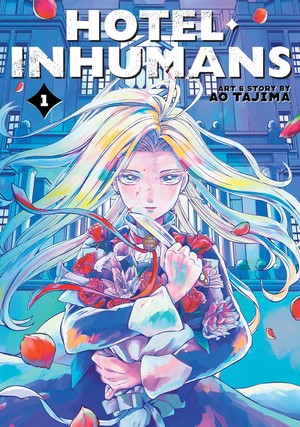
A luxury hotel has certain standards: exquisite dining, flawless comfort, unforgettable entertainment. And also: the latest weapons, forged identities, and perfect body disposal. This is a hotel where the guests are professional assassins, and the concierges never say no. At the boundary between life and death, killers arrive with wishes they cannot entrust to anyone else. Each request is answered without judgment, and every stay becomes a story of violence, regret, warmth, and beauty.
Hotel Inhumans has a story by and art by Ao Tajima. English translation is done by Erin Husson and lettering by Kai Kyou. Published by Seven Seas Entertainment (August 11, 2026). Rated OT.
Is It Worth Reading?
Erica Friedman
Rating:
There are no stories more schmaltzy than gangster stories. Japanese gangster manga is the schmaltziest of all. Death is used as a punch line over and over, and whether the innocents of the story are dead or alive, at the end, there are most emotionally manipulative violins playing and manly tears along with the drying blood.
I generally like stories like these because they are hugely predictable. A man looking for his long-lost sister, an assassin looking for the perfect kill, a killer who falls for an idol group, a man who has lost his memory…all of these come to Hotel Inhumans to have their needs tended to, fine food, and luxurious rooms. Their stories end with death, regrets, and, just to keep us coming back, the pets aren't killed, not even the human ones.
On the positive side, Hotel Inhumans isn't bogged down in weapon or technique mania. They use guns and knives, about which we are told absolutely nothing. I appreciate that, I really do. The point here is never “how to assassinate,” but “how to write a short story with an ironic ending, manga style.” One can see the ending telegraphed from a mile away, but it's fine. That's what we're here for.
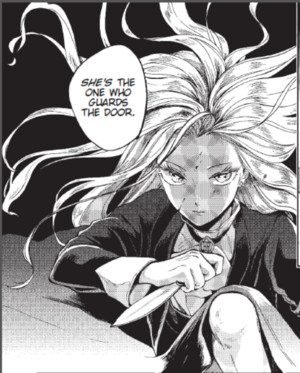
There is a fair amount of action. Sara, the hotel concierge, is clearly a trained fighter. We'll get dramatic views of her coming down for the kill, or to protect someone. Most of our killers are ready to leave the game one way or another, which gives us ample opportunity to hear that sad violin before the last bullet hits. The only negative is the comedic relief supplied by the other concierge, who is supposed to be funny. He's not. But we need someone to explain things to.
I wouldn't say this was ground-breaking, but for an episodic dose of gangster melancholy and schmaltz, Hotel Inhumans is a good bet.
Rebecca Silverman
Rating:
If any genre has the right to be maudlin, it's probably assassin stories. The job, in good storytelling, is inherently tragic: it's about ending someone's life for whatever reason. In the hardboiled variant, killers are cold-blooded, and all death is earned. In the more humanistic version, killers and victims are both flawed, and tragedy is never far behind. Hotel Inhumans is part of the latter subgenre, and boy, does it ever lean into it. While some of the deaths are richly deserved – the drug dealer in the second story, for example – others are just transactional, like in the final story of the book, and all of the killers themselves are humans doing inhuman work. It's a series that delights in basic ironies and isn't necessarily interested in subtlety.
That does leave me feeling emotionally manipulated by this volume. While all good fiction does that to some degree, this one isn't quite well done enough to mask it. From a man killing until he can see his sister again, only to find out she's dead, to a “perfect” killer who makes just one mistake, everything is remarkably cookie-cutter in terms of genre. That doesn't make this a bad book, per se, but it's also one where you absolutely know where every story is going from the moment the conflict is introduced. While that can make it comfortable reading, it can also fall under the heading of “predictably bland” depending on your mood.
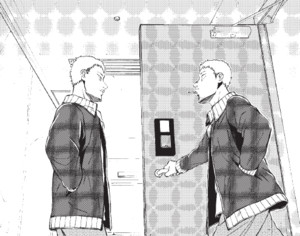
I do want to give it credit for largely keeping the story focused on the human elements, though. There are no exhaustive summaries of killing techniques or rhapsodies about the merits of different weapons. Killing is a tool for the plot, much like it functions for the characters themselves. It's just the best way to tell the story Tajima wants to share, not the book's purpose. There are action scenes and on-page killing, but most of it serves to reach the chapters' ironic endings and to show the difference between the two concierges – Sara will always get her hands dirty, while her coworker handles the emotional side of things.
From what I recall of the anime, this is very close. If you enjoyed the adaptation, there's a good chance you'll like the original as well. Hotel Inhumans may be a bit maudlin, but it does try to justify it, and sometimes that's all you can ask for.
The views and opinions expressed in this article are solely those of the author(s) and do not necessarily represent the views of Anime News Network, its employees, owners, or sponsors.
discuss this in the forum (22 posts) |

back to Summer 2026 Manga Guide
Seasonal homepage / archives