

Game Review
by Richard Eisenbeis,STEINS;GATE RE:BOOT Game Review
PC (Played), Nintendo Switch 2, Nintendo Switch, PlayStation 5, Xbox Series X|S
| Synopsis: |  |
||
It's the summer of 2010 and college student Rentaro Okabe is indulging in his delusions of being a mad scientist. He spends his days in an apartment in Tokyo's otaku mecca of Akihabara with his friends while ranting about his plans for world domination and making one useless “invention” after another. But then one day, after attending a local lecture on time travel, he comes across the body of famed genius scientist Kurisu Makise and, in a panic, sends a text from his phone—and the world itself warps. The formerly deceased Kurisu is suddenly alive and has no memory of her death and a satellite has crashed into the building where the lecture (should have) occurred. Soon enough, Okabe and Kurisu come to one inescapable conclusion: Okabe has accidentally invented the world's first time machine—and neither he nor his friends are in anyway prepared for the consequences that come from playing with time. |
|||
| Review: | |||
When it comes to visual novels, it's hard to imagine one with more world-wide impact than 2009's STEINS;GATE. With its memorable characters, complex time travel mechanics, and tear-jerking story, it has been adapted into a hit anime, gotten several sequels, and been ported to every gaming system under the sun. It's even been remade twice—with STEINS;GATE RE:BOOT being the second of these. RE:BOOT is a full remake from the bottom up—though that doesn't mean the core gameplay has changed. Like with the previous versions of the game, player interaction is limited. Throughout the story Okabe receives emails and calls on his phone from the other characters. You are able to respond to these in various ways—which sometimes affect the greater story and other times just give fun optional messages. But most importantly, at key moments, you are given the chance to use the phone to activate the time machine—or not to—which often leads directly to one of the game's several endings. 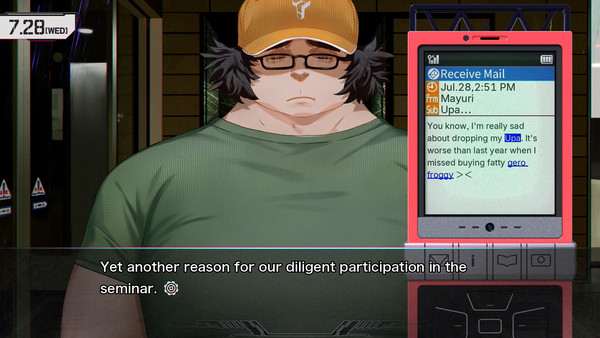 ©MAGES./Chiyo St. Inc. ©MAGES./NITRO PLUS Licensed to and Published by Spike Chunsoft The story of RE:BOOT, while revised a bit in the telling, is still largely the same as the original version of the game from over a decade-and-a-half ago—and the plot still hits as hard as ever. What starts as the tale of a man reveling in his adolescent delusions coming true soon becomes the story of a man fighting fate itself. His heart is broken and soul flayed as first he watches the unintended consequences of his actions spiral out of control and then is forced to make impossible choices in an attempt to undo them—robbing his friends of their found happiness in order to preserve his own. Even as the player, this is emotionally difficult as not only do we spend hours with each of the characters but they are both likable and nuanced as well. Brilliantly, the various alternate endings of the game show what happens if Okabe gives up at any point, unable to take from his friends what they hold most dear—or unable to continue on due to the constant mental stress. 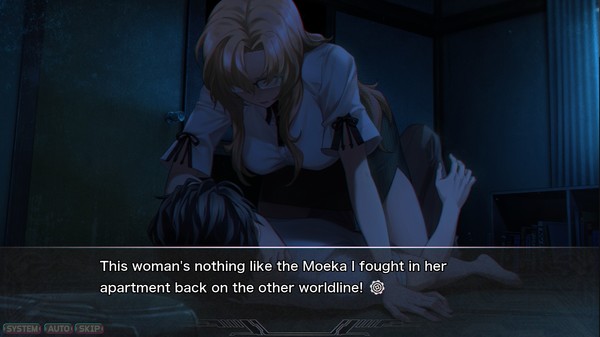 ©MAGES./Chiyo St. Inc. ©MAGES./NITRO PLUS Licensed to and Published by Spike Chunsoft In the original game, while Kurisu, Mayuri, Suzuha, Luka, and Faris each had an ending tied to them, Moeka was left as the odd woman out—the only heroine without an ending all her own. RE:BOOT rectifies this. Based largely on 2010's Steins;Gate Drama CD γ “The Hyde of a Dark Dimension” Divergence 2.615074%, this new ending is tied to both Moeka's story and Nae's. The trip into the rarely-explored Gamma Attractor Field adds to the overall STEINS;GATE plot by showing that inaction, just like action, can lead to unforeseen consequences—ones so dire that there is no coming back from them, even for those with a time machine. Of course, that's far from the only thing new in STEINS;GATE RE:BOOT. While the previous remake, STEINS;GATE ELITE, took the script and voice acting from the original game and combined it with footage from the anime (along with a few newly animated bits), RE:BOOT takes no shortcuts. Every background has been lovingly redrawn in greater detail than ever before and there are more than double the number of special event scenes when compared to the original. However, the big stand out visually are the character models. Rather than being a collection of 2D static pictures as in the 2009 title or the obviously 3D animated models from recent related titles like ROBOTICS;NOTES DaSH and ANONYMOUS;CODE, RE:BOOT manages to combine the best of both worlds. huke's iconic character design style (something lost almost completely in the anime) returns in full force while the characters' facial animations are simply amazing—hands above those in the aforementioned titles. The breadth of emotions displayed—not to mention how fluidly they flow from one to another—takes the game to a whole new level. 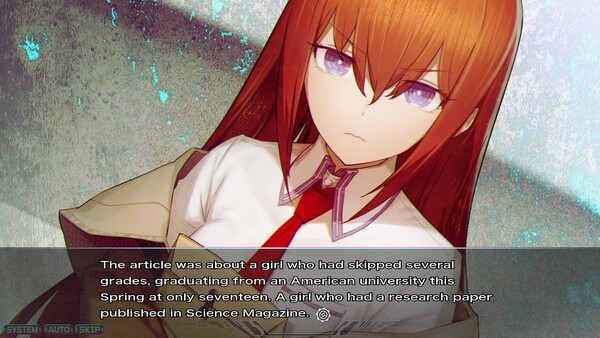 ©MAGES./Chiyo St. Inc. ©MAGES./NITRO PLUS Licensed to and Published by Spike Chunsoft Sadly, there are still some nitpicks to be had with the visual presentation—namely with the presentation of the character thought and dialogue text. Simply put, there are times when the text is squished vertically in order to fit it all into a single text box. While this is no doubt due to the fact that Japanese, due to its use of pictographic kanji, is often shorter in length than the corresponding English translation, it clashes with the normal font whenever it appears—visually taking you out of the story for a beat. Along the same line, I did encounter a few typos in my playthrough (the most notable listing the current in-game month as November instead of August). However, I did play a review copy of the game and any simple text errors may be fixed by the time the game releases. Beyond the visuals, the aural side of the game has been completely redone as well. Every bit of music has been rerecorded—and so has every line of dialogue. Mamoru Miyano's Okabe performance remains the heart and soul of the entire game and he clearly hasn't lost a step. Similarly, Tomokazu Seki's Daru and Kana Hanazawa's Mayuri are spot on even after 15 years since they first stepped into these roles. However, not all the performances are this way. 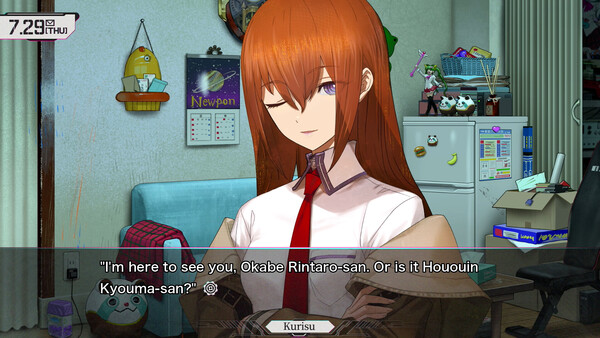 Asami Imai's Kurisu is so far removed from her original performance that I legitimately wondered if the character had been recast. This is not to say that her new line delivery is inherently bad—far from it. Rather, the issue is that Kurisu and the way she sounds is so deeply ingrained in the public consciousness that I'm certain this performance will be a shock to many. That said, in my experience, as the game went on, the difference between the old voice and new became less and less noticeable—though whether this was due to me getting used to it or Imai getting more and more back into the role as recording went on, I don't know. When it comes down to it, there are now three different versions of STEINS;GATE readily available for purchase: the original STEINS;GATE, STEINS;GATE ELITE, and STEINS;GATE RE:BOOT. If you are new to the series—or are a fan of the anime looking to try out the game—there is one obvious question: Which one should you play? The answer is simple: this one. 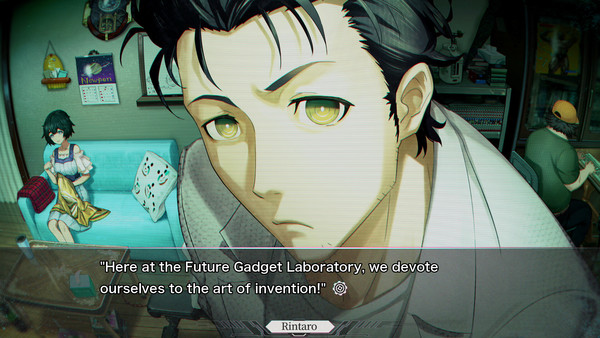 ©MAGES./Chiyo St. Inc. ©MAGES./NITRO PLUS Licensed to and Published by Spike Chunsoft With its new ending, STEINS;GATE RE:BOOT is the most complete version of the story to date. On top of that, the visual upgrades—especially the emotive faces—make each bit of drama hit harder than ever before. The rerecorded music likewise sounds great and the voice acting is top-tier—even if individual performances sometimes differ from those that came before. If you love STEINS;GATE you owe it to yourself to play this game—and if you've never experienced this story before... I envy you. STEINS;GATE is the kind of story that leaves emotional scars even as it excites your imagination for years to come—and you're about to experience it for the first time. STEINS;GATE RE:BOOT is currently available on Steam. The game will be released on Nintendo Switch 2, Nintendo Switch, PlayStation 5, Xbox Series X|S on October 29, 2026. |
|
The views and opinions expressed in this article are solely those of the author(s) and do not necessarily represent the views of Anime News Network, its employees, owners, or sponsors.
|
| Grade: | |||
Overall : A-
Graphics : A
Sound/Music : A-
Gameplay : C
Presentation : A-
+ Same amazing story with a brand new alternate ending. New emotive character models that manage to preserve Huke's unique art style. |
|||
|
discuss this in the forum |
bookmark/share with:

|
|||