

Goodbye, Lara
Episode 7
by Rebecca Silverman,
How would you rate episode 7 of
Goodbye, Lara ?
Community score: 4.4
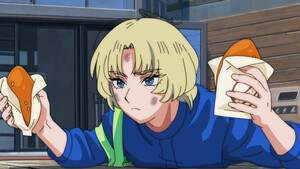
There's a reason we're still quoting Shakespeare hundreds of years after his death – he got it right a remarkable number of times. In this case, his statement from A Midsummer Night's Dream about the course of true love never running smooth is spot-on. Many Victorian literary fairy tales, specifically those by both Hans Christian Andersen and Oscar Wilde, took that statement and ran with it – where folkloric fairy tales tend to end with prince and princess living happily ever after (for a given value thereof), Andersen and his contemporaries more frequently crafted stories without the Disney ending. The Little Mermaid is obviously one of them, as both reading the tale itself and watching the first and seventh episodes of Goodbye, Lara will attest.
That unhappy-to-modern-readers ending (Andersen maintained it was happy because the Mermaid had the possibility of gaining a Christian soul) is important to this week's episode. In the 18th century, as we know, Lara was turned into sea foam after she was rejected by the prince, who, up to that point, had given every indication that he loved her. The dealbreaker for him was when she turned out not to be human, so when Luca, who appears to be the prince reborn, finds Lara in the present day, her mermaidhood must be what draws him to her. Where before he found her true form grotesque and frightening, he now finds it beautiful and fascinating. When you add in his clumsiness, which mimics Lara's early attempts to walk on her new legs, it suddenly starts to look like Luca is being punished for his past rejection of her.
It's a very Andersenian move, especially since for most of the episode Lara is primed to reject him, and does in fact do so briefly. In stories like The Nightingale, the Emperor nearly dies because he rejects the natural beauty of the eponymous bird's song for a mechanical replica, and he's only saved when he recognizes the superiority of the real thing, while The Steadfast Tin Soldier teaches a lesson about finding beauty in imperfections. The Nightingale leaves the Emperor at the end of the story after saving him, while the ballerina the Tin Soldier loved has her spangle blackened in the flames as he turns into a perfect tin heart. Both stories follow The Little Mermaid in rewarding the protagonists (freedom, love, a soul) while punishing those who could not see their worth – that is, if we consider the prince's marrying someone else a punishment.
Kinema Citrus certainly seems to, because Luca is now forced to face Lara's rejection, to have his art misunderstood, and to be unable to walk easily, not from a disability, but from mere clumsiness. His twenty-first-century self can finally appreciate the beauty of Lara's form, just as she, like the Nightingale, seems set to fly away free.
But this isn't a retelling of that story. It's The Little Mermaid, and someone – Grace, Lara's heart-knife – wants it to end the “right” way this time. And that's what's most interesting to me about bringing the prince back into the story. Lara's search for “true love” was actually going pretty well with a focus on her relationship with Mari and her family. Between Mari and her brother, there was space for both romantic and platonic love, with familial thrown in for good measure. But Luca seems to reinforce the idea of a heteronormative romantic love, that a princess needs a prince. And more alarmingly, the presence of seawater on Lara's shoes after the fireworks show suggests that now that she's on that path again, her days are numbered.
A lot is going on in Goodbye, Lara. Both The Little Mermaid and The Wild Swans are trying to play out, while Luca is living his punishment from past life actions. Mari and her family seem to be the observers, the stand-ins for readers of Andersen's tales who are trying to guess where the story will go. If that seems passive, it's important to remember how fairy tales are passed down: through telling and retelling. Most of Andersen's stories are literary fairy tales, meaning he made them up, but The Wild Swans is ATU451 and The Princess and the Pea is ATU1452. That makes his versions variants, retellings of a known worldwide tale type. And who retells the stories? Readers and listeners, who keep them as living documents.
Mari's role thus far has been relatively passive. Yes, she took Lara in, and she helps her with little things (and shoved her into Lake Biwa), but mostly she's been an occasionally annoyed observer. But if anyone has the power to retell Lara's tale, it would be her. It's how she'd choose to do so that's important; just as important as the clock that may have begun ticking down and the knife that hangs suspended over the town.
Rating:
Recommended Reading:Snow White, Blood Red edited by Terri Windling and Ellen Datlow, this first in a series of fairy tale retellings contains multiple authors' takes on literary and folkloric fairy tales. This is my favorite of the series.
Goodbye, Lara is currently streaming on Crunchyroll.
The views and opinions expressed in this article are solely those of the author(s) and do not necessarily represent the views of Anime News Network, its employees, owners, or sponsors.
discuss this in the forum (29 posts) |

this article has been modified since it was originally posted; see change history
back to Goodbye, Lara
Episode Review homepage / archives