

All the News and Reviews from Anime Expo 2026
Beauty and Monsters: A Chat with Anime Producer Ena Hamabe
by Bamboo Dong,

We had the opportunity to interview Hamabe at Anime Expo, where Infinite, Inc., screened the first episode of I Want to Love You Till Your Dying Day, which is currently streaming on Crunchyroll. We were able to dive deeper into Hamabe's process of project consideration, as well as her thoughts on the stories that move people.
As a producer, when you're considering a project like I Want to Love You Till Your Dying Day, what do you hope stays with audiences long after they've finished watching it?
Ena Hamabe: I hope these stories can help people release the negative emotions they're carrying. Even if the story is sad, I want viewers to finish it feeling, "I'll do my best again tomorrow," or feel ready to move forward with a more positive outlook.
You're also producing This Monster Wants to Eat Me. Although the two series are very different, they both center on relationships between young women. More importantly, they approach those relationships with remarkable sincerity. What is it about those relationships that you think resonates so strongly with audiences?
Ena Hamabe: Both series portray the thoughts and emotions of young women in a way that feels authentic to who they are at that stage of their lives. I hope viewers can see parts of themselves in those characters and the experiences they go through. At the same time, I hope they enjoy watching the characters grow, and perhaps even find moments that encourage them as they grow alongside them.
What fascinates me is that both stories explore very heavy subject matter. They're sad, sometimes even dark, but they never feel hopeless. They leave you with a sense of optimism.
Ena Hamabe: That's one of the strengths of adapting these stories into animation. By bringing them to life visually, we're able to place even more emphasis on their hopeful side. Even though they deal with sadness, I hope viewers finish watching with the feeling that they can face tomorrow with a positive outlook.
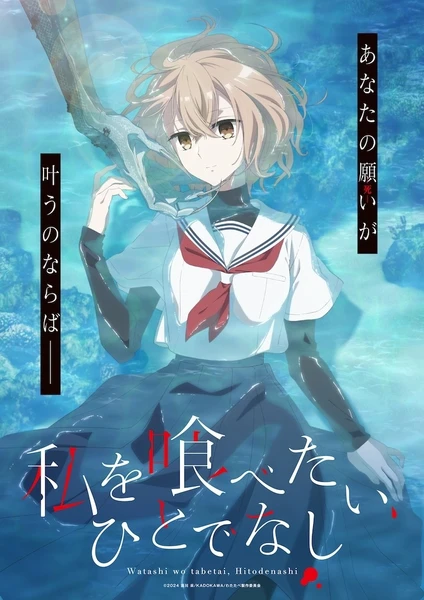
What was your first emotional reaction when you read This Monster Wants to Eat Me?
Ena Hamabe: The protagonist carries an incredible amount of sadness, but it's the kind of sadness anyone can experience. Because of that, she felt very real to me. I also felt that the story expressed those emotions in a very beautiful way. I immediately thought it was something I wanted more people to experience through animation.
What was it about the relationship between the two main characters that resonated with you the most?
Ena Hamabe: Sometimes we don't know the truth. We only see what we want to see, and when the truth finally comes to light, our entire world can change. Even after experiencing that, these two characters slowly but steadily continue moving forward. They reach a point where they want to believe in something again. There's something incredibly precious about that relationship.
Was there a particular moment in either series when you thought, "This is it. This is the scene I want to see animated?"
Ena Hamabe: Usually that feeling comes very early, often in the first chapter. There's a moment where I deeply empathize with the protagonist's emotions, and I immediately think, "I want more people to experience this." That's usually the point where I know I want to help bring the story to animation.
Earlier, you described both of these stories as beautiful. What does beauty in storytelling mean to you?
Ena Hamabe: To me, beauty comes from the way sadness and kindness exist together. It's also about how those emotions are expressed. I don't think a story should force its message onto the audience. It should communicate naturally, allowing people to connect with those feelings in their own way. When those elements come together, that's what I find beautiful.
One thing that stood out to me in I Want to Love You Till Your Dying Day is that the protagonist questions everything happening around her. She asks why people have to fight and why so much suffering is treated as normal, while the people around her seem to accept it without question. How did you want audiences to relate to her?
Ena Hamabe: Within the world of the story, those circumstances are considered normal. But if any of us were placed in that situation, we would ask the same questions she does. We would wonder why people have to fight. We would wonder why war exists. In that sense, the protagonist represents the audience. She's experiencing the world in the same way many of us would.
When I was watching it, I found myself almost getting frustrated with the other students because they just accepted everything without really questioning their circumstances.
Ena Hamabe: That's one of the strengths of the original work. Everything happening in that world feels ordinary to the characters because it's all they've ever known. But from the audience's perspective, it feels completely different. That contrast naturally makes us question the world alongside the protagonist.
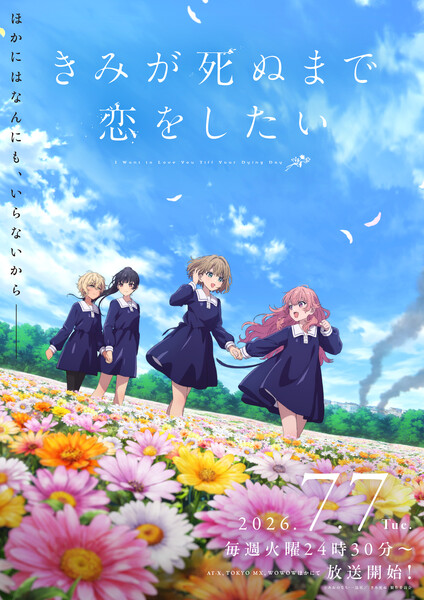
There's another scene that really stayed with me. Sheena sees two girls who look like they're about to kiss, but then one of them says, "We're not kissing. We're healing each other." That scene could have come across as a little cheesy, but instead it felt incredibly sincere. How do you approach scenes like that without them feeling forced?
Ena Hamabe: The most important thing is staying true to the characters' emotions. Whether a scene is interpreted as romantic isn't really the point. What's important is honestly expressing what the characters need from one another in that moment. If you're faithful to those feelings, the scene naturally becomes sincere.
I really appreciated that, because it reminded me that affection doesn't always have to be romantic. Sometimes it's simply about comforting another person.
Ena Hamabe: Exactly. There are many different forms of love, and many different ways people can support one another. I hope audiences are able to appreciate those relationships without feeling the need to define them too narrowly.
As a producer, one of your biggest responsibilities is bringing together the creative team that makes a project possible. How do you decide who the right collaborators are?
Ena Hamabe: I'm fortunate to work with many talented people, so I always think about how I can bring out each person's strengths. Of course, there are times when the project I imagine and the reality of production don't completely align. That's simply part of the process. But when the right people come together, everyone's strengths complement one another, and the final work becomes something that none of us could have created alone.
Do you usually begin a project with a clear vision of what you want it to become?
Ena Hamabe: Yes. We always begin with an ideal vision. Whether we're able to realize that vision exactly depends on many different circumstances, so throughout the process we try to stay true to what inspired us to make the project in the first place.
You've now worked on several stories that explore grief, mortality, and human connection. At the same time, they're all ultimately hopeful. Do you think your own outlook influences the kinds of projects you're drawn to?
Ena Hamabe: Yes, I do. Those kinds of stories have always stayed with me. They're the stories that have helped me the most throughout my own life. Whenever I was struggling or feeling overwhelmed, some works supported me and gave me the strength to move forward. Because of that, I hope stories like these continue to exist. If they can encourage someone else the way they encouraged me, then I'd like to keep making them.
It sounds like, for you, these stories aren't really about sadness. They're about helping people through sadness.
Ena Hamabe: Exactly. Even when a story is painful, I don't think the goal is to leave people with only those feelings. I hope viewers can experience those emotions alongside the characters, reflect on them, and then feel ready to take another step forward. If a story can stay with someone in that way, that's something very meaningful.
That's beautiful. Thank you so much for taking the time to speak with us today.
Disclosure: Kadokawa World Entertainment (KWE), a wholly owned subsidiary of Kadokawa Corporation, is the majority owner of Anime News Network, LLC. One or more of the companies mentioned in this article are part of the Kadokawa Group of Companies.
discuss this in the forum |

back to All the News and Reviews from Anime Expo 2026
Convention homepage / archives