

All the News and Reviews from Anime Expo 2026
Truly Outrageous: MARRIAGETOXIN Director Motonobu Hori and Bones Film Producer Tatsuya Saitō
by Bamboo Dong,
 |  |
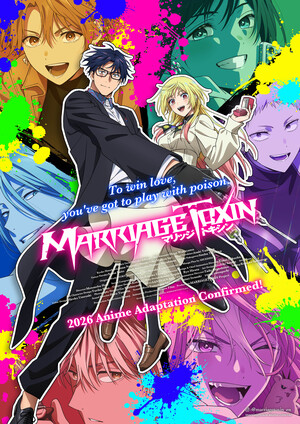
MARRIAGETOXIN director Motonobu Hori and Bones Film producer Tatsuya Saitō took to the stage at Anime Expo for an exciting panel celebrating the action-romcom MARRIAGETOXIN. The series, adapted from the manga by Jōmyaku and Mizuki Yoda, follows an assassin named Gero who is suddenly tasked with finding a wife to ensure his family's bloodline while protecting his sister.
We had the opportunity to talk with Hori and Saito about their experience working on the series, and their thoughts on what makes the characters so lovable and memorable.
What was it about the MARRIAGETOXIN manga that made each of you want to adapt it to animation?
Tatsuya Saitō: The characters were the biggest reason. In the first season, heroines like Himekawa, Ureshino, and Arashiyama each have distinct personalities. Through Gero's interactions with them—both the matchmaking and the action—you can gradually see him grow. Of course, I always give everything to every project I work on. But I felt this was a series where we could be especially particular about the animation.
Motonobu Hori: One thing that immediately stood out to me was how outrageous the manga is. I thought that would be a lot of fun to animate. There's also a lot of action, so I felt that if BONES approached it carefully, it could become something really entertaining. At the same time, underneath all of that chaos, the story has moments that genuinely stay with you. That balance was what made the original manga so appealing to me.
You mentioned the series being "outrageous." Could you explain what you mean by that?
Motonobu Hori: It's difficult to separate where the series is being serious and where it's being funny. It has the energy of a Weekly Shonen Jump manga, but sometimes you're not quite sure whether a scene is meant to be taken completely seriously or whether it's a joke. I thought that ambiguity was one of its biggest strengths.
When you're reading a manga like that, are you already imagining how those scenes will move once they're animated?
Motonobu Hori: After I was asked to direct the series, I re-read the manga while thinking about how I would animate it. One thing I realized was that the manga is extremely well constructed. It makes excellent use of techniques that only manga can use. Some moments feel very dynamic on the page because of the way the panels are composed.
Ironically, that makes it difficult to animate. Simply reproducing those pages wouldn't necessarily work. Instead, I thought we should break down what was happening in each scene, understand why it worked in manga form, and then rebuild it through movement. I felt that approach would make the animation more interesting.
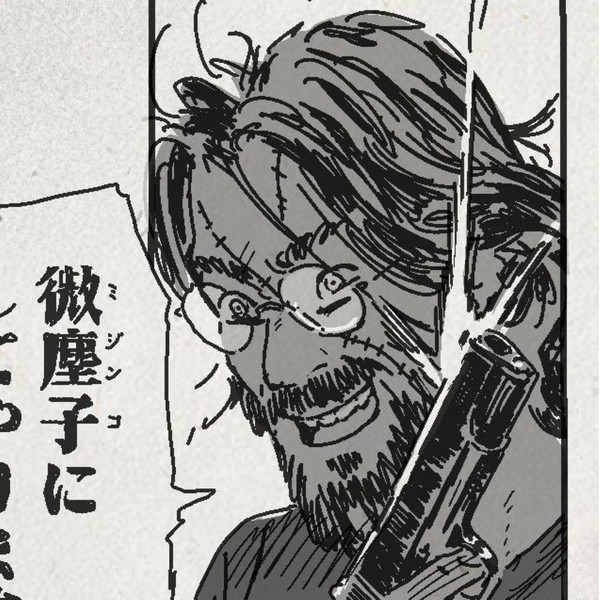
Motonobu Hori: It was very difficult. Part of the manga's appeal is that there are moments where you're not entirely sure what's happening between one panel and the next. That uncertainty creates a kind of energy that's unique to manga. Earlier I mentioned that we broke scenes down and connected them more clearly for animation, but if you explain everything, you lose some of that energy. Because of that, we spent a lot of time thinking about the balance. How much should we explain? How much of that chaos should we leave intact? Finding that balance was one of the biggest challenges.
You mentioned balance, and that's something I really noticed while reading the manga. It constantly shifts between comedy and very sincere emotional moments, but it never feels like either side overwhelms the other. Why do you think readers continue to connect with these characters, even as the premise becomes more and more outrageous?
Motonobu Hori: Take Gero, for example. He was raised from childhood to become an assassin—a killing machine. Or take Byakko. Her childhood is so tragic that it almost feels unbelievable. Their situations are very extreme. But Gero also has something like his inability to eat food prepared by other people. That comes from the way he was raised. I think everyone has something like that. Maybe it's because of the way they grew up, or something they experienced when they were young. Everyone has something that stays with them. The situations in MARRIAGETOXIN are exaggerated, almost to the point of becoming comedy. But underneath that, I think every character has something people can relate to.
One thing I found really interesting is that MARRIAGETOXIN doesn't just explore romantic love. It also spends a great deal of time exploring family, obligation, and the different ways people care for one another. When you approached the series, did you think of it primarily as an action story? Or as a love story? How did you approach those emotions as a director?
Motonobu Hori: What interested me most was how the story begins. Gero is incredibly strong within the world of battle manga. But right at the beginning, he loses to Kinosaki. He's the strongest in one world, but outside that world—in the world of romance—he can't win. To me, that's the most distinctive thing about this manga. It places those two worlds side by side. That doesn't mean the battles stop being important. The story moves back and forth between the two, and I thought that was what made it so interesting.
So it's not only the balance between those two worlds, but also the contrast between them?
Motonobu Hori: Yes. There's a line later in the story where Gero says, "I want to become more attractive." If this were a typical battle manga, the protagonist would probably say, "I want to become stronger." Instead, he says he wants to become more attractive. I think that's what happens because he's living between these two worlds. As he moves back and forth between them, his values gradually begin to change. Watching that happen is one of the things I find most interesting about the story.
Putting together a series like this also means putting together the right creative team. What made you (Saito) want to work together on MARRIAGETOXIN?
Tatsuya Saitō: Hori and I have worked together several times now. This is our fourth project together, so I already understood how he works. Around the time we decided to make MARRIAGETOXIN, we were also working together on My Hero Academia: Vigilantes, and I had the chance to see how he'd grown as a director.
Motonobu Hori: At one point, Saito thought action scenes were my weak point.
Tatsuya Saitō: That's true. In the past, I thought Hori's strengths were more in portraying the characters and their emotions. But while we were working on Vigilantes, I realized he'd become much stronger at directing action. That gave me confidence that he was the right person for this project.
Tatsuya Saitō: We also spent a lot of time talking about recent anime. We'd discuss what we liked, what was working, and what kind of action we wanted to create for this series.
Motonobu Hori: I also wanted to learn from the way recent productions approach action.
Tatsuya Saitō: The overall quality of action animation has become much higher in recent years. We knew we had to think carefully about how to create action that could stand alongside everything else that's being made today.
It almost feels like you're competing with yourselves. BONES has such a long history of raising the bar that I imagine there's always pressure to create something audiences haven't seen before.
Motonobu Hori: No, not at all. We're just doing our best not to fall behind everyone else.
Speaking of the action itself, one thing I really enjoy about MARRIAGETOXIN is that the fights aren't simply about who has the most power. Every character has such unusual abilities that each battle feels more like solving a puzzle. Did that create any new opportunities for the animation team?
Motonobu Hori: There are so many moments in this series where you honestly can't tell whether something is supposed to be funny or completely serious. For example, Gero melts a car using toilet cleaner. If we presented that as a joke, the audience would simply think, "Oh, this is a gag manga." But that's not how I see this series. I think what's interesting is that it keeps walking a very fine line between the serious and the absurd. It never fully becomes one or the other. So I told the animators to treat those scenes seriously. Even when something ridiculous is happening, I wanted it to look as cool as possible. That was something we thought about from the storyboard stage onward.
Last question. If you could become one of the characters in MARRIAGETOXIN and inherit their unique ability, who would you choose?
Motonobu Hori: I'd choose Gero's. I'd like to use his poison abilities to strengthen my body... so I could spend more time working. (laughs)
Tatsuya Saitō: There's actually a character who hasn't appeared in the anime yet. His name is Beppu. I'd probably choose him. (laughs)
discuss this in the forum |

back to All the News and Reviews from Anime Expo 2026
Convention homepage / archives