

Summer 2026 Manga Guide
Smells Like Green Spirit
What's It About?

Suffocated by his rural hometown and the ruthless homophobic bullying he endures at school, Futoshi Mishima has only one escape: late at night, he swipes his mother's lipstick and delights in quietly dolling himself up. So when that liberating lipstick slips out of his pocket one day, Mishima is at a total loss—until he finds his worst tormenter trying it on for himself. The two stumble into a summer of unprecedented freedom…but as they soon discover, freedom doesn't come without a cost, and they may not be the only ones in town with something to hide.
Smells Like Green Spirit features art and a story by Saburō Nagai. The English translation is by Jo Lumley, and the lettering is by Carolina Hernández Mendoza. Published by Vertical Comics (July 21, 2026). Rated 16+.
Content Warning: Bullying, sexual assault, power harassment, and queer trauma
Is It Worth Reading?
Erica Friedman
Rating:

In a run-down town with no industry or opportunity, Mishima is tormented by bullies for being girly. At home, late at night, Mishima finds solace in putting on makeup and seeing his true self.
Classmate Yumeno has a pathological hatred for Mishima and escalates his treatment well beyond bullying, right up to torture. Kirino keeps pulling Yumeno back, but can only modulate Yumeno's out-of-control violence. Mishima is unable to find solace—even a sympathetic teacher crosses the line.
When Mishima sees Kirino trying on a lost lipstick, they begin to talk a little. Up on the roof with Kirino, just two girls are chatting. Maybe Mishima can relax a little.
The teacher, too, has memories of trauma and rejection from his childhood, for having been found with gay media. But that doesn't excuse assault. Yumeno is struggling with attraction to Mishima, but again, Mishima is the one who ends up being burdened. Three boys, one adult man, all crushed under the weight of “being gay.” This is a story about queerness in isolation. This is a story about thinking being gay is wrong, and being hurt for it, and finding one's way out from under that weight.
I found this manga hard to read, especially as someone who has spent a lifetime sharing information and community, so young people don't feel alone. I didn't think it was cute that the one girl in the story ends up being a punchline. And, unfortunately, the happy ending really failed to land, without much processing of that trauma.
I wouldn't recommend this book to a young queer person, but it might be fine for an elder, thinking about their life as a gay kid in the boonies.
Bolts
Rating:

Discovering who you are and what your sexual preferences are is not always made easy by the environments that people grow up in. While things are much more accepting in certain parts of the world now, many people still hold back their true desires for fear of what the consequences might be if that information gets out. Some people internalize their feelings of being gay into outward aggression, some people find little moments in their lives where they can take the mask off to be who they really are, and other people try their best to wear it proudly, regardless of what other people think. No two journeys are really going to be the same, and the end of those journeys isn't always going to be an optimistic one. Smells Like Green Spirit is a coming-of-age story featuring a bunch of different teenagers who are all struggling with that journey, and it might be one of the most real portrayals of the subject that I have read in quite some time.
This is a story that doesn't really pull any punches about just how toxic and uncomfortable living as a gay person can be. The unwanted prejudice and harsh expectations imposed on you by others can be suffocating. It can lead to some really toxic and even violent qualities that were very difficult to read during the initial chapters, but it's not all terrible. There are moments here that felt genuinely inspired and optimistic about the future, while others genuinely made me want to cry over their simple tragedy. Three boys are the main focus of this story, and I have seen all three of these boys at some point in my life. Hell, I have been all three of these boys at some point in my life, and if I was made uncomfortable, it was never because I thought the story was doing something for shock value; it's because I found things that were relatable.
The artwork comes off as overly simple in a lot of ways, but I like how the characters are stylistically drawn to properly convey the different styles of gender. There's even one teacher character in particular who has some really twisted manifestations of his repressed homosexuality, and it is every bit as gorgeous as it is terrifying. It would've been nice if there were more styles like that throughout the entire book, rather than just centered on one character, because I think the story could've stood out a bit more with a distinct visual identity to match. It's a deeply personal story, and the writing managed to leave a significant impact. If you are not straight and are in the middle of your own journey of self-discovery, or maybe you know somebody who is going through that journey and wants to understand it better, then please give this a read.
Jean-Karlo Lemus
Rating:
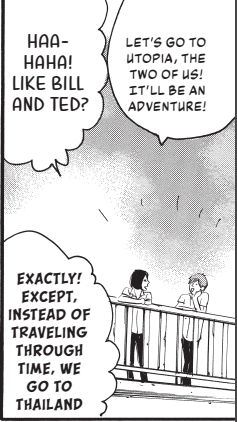
Let me front-end this: Smells Like Green Spirit deals with a lot of homophobia, both internalized and externalized. There is a lot of pain and bullying in here, and also a very vivid depiction of sexual assault. Most heartbreakingly, one character is fully disowned by their father because of his homophobia (the story underlines he's an American from a “small town”). The ending is also keen on underlining that our protagonists never reach their Utopias; protagonist Mishima does move to Tokyo and have a happy life with his husband, even partaking in drag shows where he's beloved by many. But even in Tokyo, a comparative paradise to our protagonists living in a rural farming town, there are problems the protagonist must face. Our hero lovingly kissing his husband in an elevator gets cut short by a middle-aged woman leering at them. We can't all go to Utopia and find our happy ending.
Smells Like Green Spirit really nails the pain of internalized hatred. Mishima getting his hair forcefully cut as he's bullied is tense and painful. They're the victims of barbs and rumors in their small town. But it does get better. Their brush with the results of a lifetime of internalized hatred makes them realize how important it is to love themselves and each other, to find from within what doesn't come from without. Sometimes family is there to help. Sometimes you need to find your own family. But through and through, the only balm for internalized hatred is internalized love.
It's heartbreaking to see Kirino lament his body changing in ways that cause her pain. She deliberately hides his eyes as she tells Mishima how miserable it makes her. Over and over, Smells Like Green Spirit brings focus to the eyes of our cast and what hides behind them. The last thing we see is a dragonfly reflected in Mishima's eyes as she laments that summer is ending. Was her choice the right one? Mishima never knows. It's impossible to say, we have to make our own choices in life. Maybe it's for the better, maybe it's for the worst. But it's never too late, no matter how many summers pass.
There are a lot of people in the world who never have to worry who they are or what it means to be themselves, who never need a Pandora's Box. This story may or may not resonate with them. But even to them, I'd urge them to read Smells Like Green Spirit. We all want to find our own Utopia. It's the one thing that unites us as people. Even if the reality is less glamorous than we'd hoped, we can only hope to reach it together. Strongly recommended, with major content warnings for scenes of homophobic bullying and sexual assault.
The views and opinions expressed in this article are solely those of the author(s) and do not necessarily represent the views of Anime News Network, its employees, owners, or sponsors.
discuss this in the forum (16 posts) |

back to Summer 2026 Manga Guide
Seasonal homepage / archives