

(1 question; 18s to answer on average
Yes I'll do it later No
News
Shigeru Mizuki's 'White Flag' WW2 Manga Gets Anime Special on Sunday
posted on by Rafael Antonio Pineda
NHK announced on Friday that it will air a special anime based on Shigeru Mizuki's "Shiroi Hata" (White Flag) manga for its NHK Special documentary program on Sunday, August 16. The special is titled "Iwo Jima no Shiroi Hata" (The White Flag at Iwo Jima).
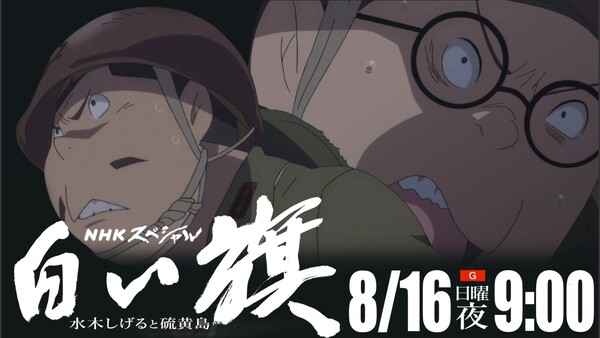
Mizuki's original manga tells the story of an Imperial Japanese Army lieutenant in World War II named Nishiōeda. After fierce and brutal fighting between American and Japanese forces at the Battle of Iwo Jima, Nishiōeda raises the white flag of surrender in order to allow the the troops under his command to live. The surrender went against the army's orders to fight to the death, and Nishiōeda was executed for treason.
Mizuki has said in an afterword to the story that the manga is based on a story he heard about a friend of his older brother, who was an Imperial Japanese Navy officer. The story has never been verified. Mizuki first used the character in his "Futari no Chūi" (Two Lieutenants) manga story, first published in Hinomaru Bunko's Hinomaru magazine in 1964, before reworking the story into "Shiroi Hata," which was published in Seirindō's Garo magazine in 1968. Mizuki used the Nishiōeda character in three different manga stories. Kodansha has compiled four of Mizuki's World War II manga stories, including "White Flag," into a book also titled White Flag, which the publisher released in 2010.
The NHK documentary will show the anime based on Mizuki's original story, as well as research on both American and Japanese reports of a raised white flag and a surrender.
The Battle of Iwo Jima was fought at the tail end of the Second World War, with American forces landing in February 1945. The island saw fierce fighting for about a month, and sporadic fighting with holdout forces for months afterward. For the first time since American forces conducted amphibious landings against Japanese forces in the Pacific campaign, American casualties outnumbered Japanese casualties, despite American forces vastly outnumbering Japanese defenses. Joe Rosenthal took his iconic "Raising the Flag on Iwo Jima" photograph of six U.S. marines raising the U.S. flag to claim victory on the island's Mount Suribachi. American forces eventually built an airfield on the island, which hosted bombers that would later go on to bomb military and civilian targets on the Japanese home islands for months before the war's ultimate end.
Mizuki was born in Osaka in 1922, and he grew up in Tottori Prefecture. He was drafted into the Japanese Imperial Army during World War II, where he injured — and later lost — his left arm. He penned multiple manga based on his experiences in World War II, such as Onward Towards Our Noble Deaths and Watashi no Hibi.
Mizuki was famous for his manga about yōkai — Japanese supernatural creatures. His manga and research into yōkai is largely responsible for the popularity that yōkai stories have today.
Mizuki died on November 30, 2015.
Sources: NHK, Comic Natalie
