

Review
by Andrew Osmond,Death Note: The Musical Stage Show Review
| Synopsis: |  |
||
In modern Tokyo, criminals are falling dead inexplicably, as if killed by some invisible executioner. But no one could have believed who the real perpetrator is – a precocious schoolboy called Light Yagami, using a magic “Death Note” that was dropped by a death god. Light seems unstoppable in his vigilante crusade… until he's challenged by a mysterious detective, L. |
|||
| Review: | |||
Death Note: The Musical, now playing at London's Barbican Centre until 12 September, is very good fun, and that's both its main virtue and its biggest failing. It's thoroughly entertaining, full of the zingy energy you expect in a stage musical, and it's packed with tricks and ideas. What's missing is the source material's coldness, any deep immersion into Death Note's amoral hubris. There's also no effort to update the story to the present day, where thousands of furious keyboard warriors wish they could kill each other with words. Then again, perhaps Death Note doesn't need updating. At heart, its diabolical high concept isn't about thousands of people. It's about you. Hey, kid! Yes, you, the one reading that Shonen Jump manga. What if you were given the magic power to kill anyone you wanted? As the show opens, Tokyo schoolboy Light Yagami, played with loud and wholehearted vigor by Xander Pang, is railing against the uselessness of the law in fighting crime. His classroom argument with his teacher morphs into the first song (“Where Is The Justice?”), as the other students gyrate in their seats to the music. Soon Light acquires the supernatural Death Note that lets him kill with abandon, just by writing people's names on its pages. At first, he slaughters monstrous criminals. Soon, he's murdering anyone who opposes his crusade. By the end of the musical's first half, his victims literally dance to his tune, as he kills them en masse, over and again. 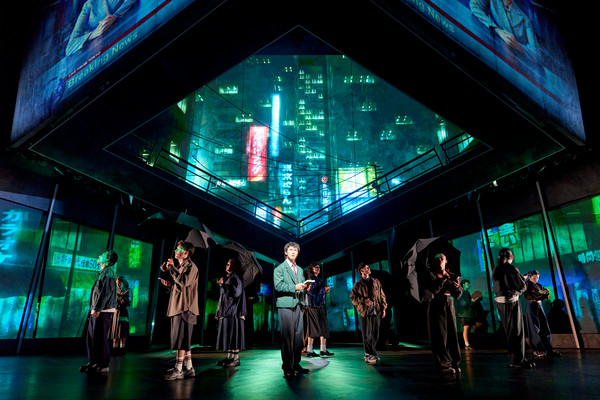 Death Note: The Musical, Barbican Theatre until 12th September. Tickets: DeathNoteTheMusical.com This is a story of mortals and immortals. Unlike Christopher Nolan's The Odyssey, there's no question the gods are real. In Death Note, they're death gods, the Shinigami, and we first see them walking on a tilted square metal frame that's suspended over the stage. One of them complains how boring immortality is. He's Ryuk (Telly Leung), a gleeful scene-stealer in snazzy black. Once he descends to Earth and pairs up with Light, he's filled with merry joie de vivre – his well-known love of apples is milked for all it's worth. For the musical's first half, it's mostly the Light and Ryuk show, as their relationship is the only one given room to register. Light's arch-enemy, the great detective L, can't hope to make the same impact. He's mostly shown as an isolated madman in a Matrix world of green computer type. Watari, who was the fatherly Alfred to L's Batman in the original, is deleted entirely, while L's relationship with Light's cop dad Soichiro (Paolo Montalban) never gets past antagonism. The dishevelled staring youth needles Soichiro with his suspicions that Light is the killer they're vainly hunting. L still gets high points – one song synchronises him with a set of dancing doubles like a 1980s music video. I'd also forgotten his hilarious explanation for why he sits hunched like a human owl. But he's no match for his killer foes. Instead (minor spoiler), the musical gives its second half its own identity by highlighting two more characters. These are the pop star Misa (Stephanie Zaharis), who's obsessed with the "Death Note" killer, and Misa's own Shinigami companion, the female-presenting Rem (Grace Mouat). Another Shinigami, Gelus (Chloe Saracco), has enough time to make a poignant impact before they bow out. Their inclusion seems to be a change from previous stagings of the musical, where Gelus reportedly didn't appear. Together, Gelus, Misa and Rem express one of the musical's main themes, that love is a heroic folly that people embrace, even when they've seen how that love will doom them. In a musical context, it's easier to accept that a death god suddenly falls in love with a human girl than to believe – for example – that L sees Light as a friend, as he clunkily claims out of nowhere. The show's second half contrasts the macho ruthlessness of Light and L with the masochistically joyous self-sacrifices of Misa and Rem. Misa never worked in the original Death Note story; she just got shuffled out of the way when there was nothing more to do with her. The musical doesn't make Misa deeper or give her more agency, and the feminine gendering of self-sacrifice is retrograde. Yet in the context of a musical without nuance, it works, structurally and dramatically. While Light and L may be heroes in their own heads, the musical smartly suggests that the true heroes are characters that the men barely consider, except as means to their ends. The songs are by Jack Murphy (lyrics) and Frank Wildhorn (music). Wildhorn also composed stage musicals of Fist of the North Star and Your Lie in April – the latter came to London in 2024 and I reviewed it for ANN. My reactions to Death Note's songs are the same as they were to Your Lie's. They're consistently enjoyable, but rarely memorable, save for a rising chorus of “Kira!” “Kira!”. But again the structure is strong, as Misa and Rem get romantic ballads in the second half to puncture Light and L's rock posturings. As well as the suspended platform on which Shinigami walk, the stage is continually lively. Police offices and recording rooms glide smoothly on and off again. We see projections of Tokyo's high-rise, while giant overhead screens show news announcers and Misa's pop concert. After one of Light's massacres, particles of seeming soot blow over the audience. A memorable confrontation between Light and L from the manga and anime is recreated on stage, and it's goofy and delightful. Like Ryuk, who might be our true stand-in on stage, we're constantly entertained. But my main misgiving remains; it's rarely any more than fun. It leans into the comedy emphatically, not just via Ryuk and his apple fixations, but also the teen-girl mannerisms of Misa and Light's sister Sayu (Elise Buckley). “Show me your Shinigami!” Misa yells to Light at one point, and yes, it's played exactly like that. It's all fun, but where are Death Note's chills? Where is a sequence such as the part in the original story about the intrepid widowed agent Naomi, with its terrifying punchline? Don't look for anything like that here. Fans of Death Note, of course, may mentally add that more serious baggage into the musical while they're watching it. But I suspect newbies to Death Note may soon dismiss the story as too darn silly, especially with the compressed exposition. Shinigami are real! The police rely on a Great Detective they've never seen! You'll never guess who Light's dad is! The musical cuts Death Note's lesser chapters, but it's still a heck of a lot of story. As a serial, it could hook you in chapter by chapter. In one sitting, its preposterousness may be too much if you weren't raised on Shonen Jump. Also, the musical's ending is a let-down, glib and arbitrary. There was a better end in the live-action Japanese film, Death Note: The Last Name, which similarly trimmed the original manga down to size. The musical's denouement makes some sense, given its subversive slant on Death Note's characters, but the way it ends is still too much of a cheat. |
|
The views and opinions expressed in this article are solely those of the author(s) and do not necessarily represent the views of Anime News Network, its employees, owners, or sponsors.
|
| Grade: | |||
Overall : B+
Music : B+
+ Very entertaining and great fun, with a clever structure that cunningly subverts the original story. |
|||
|
discuss this in the forum |
bookmark/share with:

|
|||